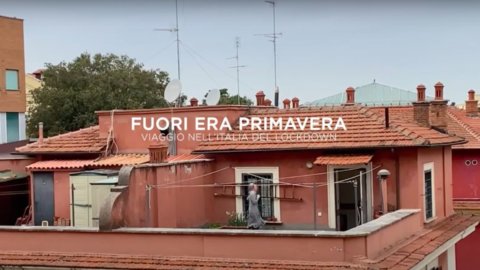
A few months have passed since our country emerged from a nightmare that no one could have ever imagined: about 90 days of total closure, blockage of all activities, segregation at home for millions of people. It all started at the end of February when, precisely “It was spring outside”.
Today we talk about it as a distant period, which we hoped had already passed into the history books, archived, and which instead threatens to recur. During that time there was a story that was first and foremost about strong, powerful images: how can we forget the photograph of the nurse slumped over the computer, the Pope in the churchyard of St. Peter's, the columns of military trucks, the deserted cities, the sheets on the windows with "everything will be fine"? It is the fate of dramatic forms and figures: on the one hand we would like to forget them forever and, on the other hand, we would like to keep them in mind as a warning or as a teaching. On the themes of images during the lockdown days on FIRSTonline we have written a lot.
Il Salvatores film collects a visual synthesis of those days, of those moments, and renders well the drama of what we have gone through. It is necessary, appropriate to review what happened and who was involved. The authors of the videos are the same people who were the direct and indirect protagonists of that spring tale: relatives, children, grandchildren and grandparents, women about to give birth, patients with intubation, doctors and nurses in first line. All of us who went through that period in a thousand different ways. It is a story of people but also of places, the intimate and private ones and the public ones: the family bed where the children jump as well as the streets, alleys, squares where collective life takes place. Finally, Salvatores' work recalls the "social" figures: the volunteers who during those days took care of those who couldn't go out, those who couldn't work and needed assistance.
"Journey to Italy of the lockdown" is not a film, it is above all a historical document and in this key it can be seen. History, as is known, takes time to settle emotions, to separate facts from feelings, to be fully written. While watching, it is difficult not to think about these hours and what could happen in the next few days. It is difficult not to remember that just yesterday the Prime Minister, Giuseppe Conte, has launched a new DPCM which seems to take us back, at least in part, to last spring. Here you are the limit and the value of this documentary it is exactly in being in the borderland between a recent past not yet concluded and an uncertain and confused future.
From the images, from the story it offers us Gabriele Salvatores, you feel the air of something that has passed when unfortunately, it doesn't seem like that. In any case, images of a good, optimistic, positive, strong and supportive Italy can be seen scrolling by, as sometimes, perhaps with a hint of rhetoric, one paints too easily. But a documentary is exactly what it means and what it sets out to be: it collects and records what images are capable of representing, what we were during last spring and what we wish so much would never happen again.
Side note. It's about a document of national history, a public and collective heritage and as such should be treated and offered to the general public. It was also made by Rai Cinema and should be broadcast in November on a Rai network. It is also desirable that it can circulate free of charge wherever it can be useful to remember, not to forget.