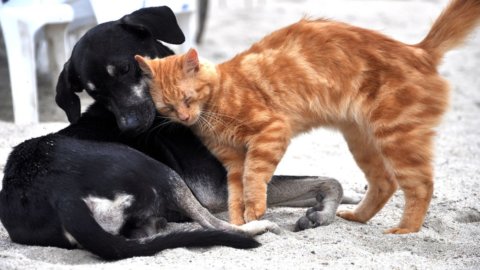
Technology? Pharma? Artificial intelligence? No, the big hit under the August sun concerns the food for dogs and cats. In fact, on Friday, the American fund Hellman & Friedman, known so far for its presence in publishing (Axel Springer) and pharmaceuticals, offered three billion euros for the control of the German Zooplus: 8 million customers in thirty countries, a turnover of 2020 billion euros in 1,8 (+18 percent), an empire that from Munich grows together with the population of dogs, cats (but also hamsters, ferrets and turtles) adopted by families to compensate for loneliness and pandemic stress. A phenomenon which, in business terms, has translated into a boom of croquettes and jars of meat (the least valuable, therefore the most profitable for the pet food industry), but also of leashes and other gadgets for four-legged customers, protagonists at the Frankfurt Stock Exchange of a draw worthy of an agility competition. Since last March Zooplus stock is up 300 percent before the handshake that sealed the agreement between the German managers who will continue to lead the company after the deal and the US financiers on Friday. Everyone is happy, not least the shareholders who will be able to join theTakeover bid launched by US partners at a price of 390 euros, or another 40 percent more than the previous day's prices.
In short, the bubble lurking in this hot summer has also affected collars, leashes as well as bird bites. But it is not the consequence of a sunstroke but the manifestation of a precise market trend already underway before Covid which has only accelerated the phenomenon which, among other things, now also involves Asia. During 2020, according to Euromonitor, the pet business it grew by 8,7 percent globally, with double-digit peaks for China and the Far East. And the phenomenon tends to accelerate. In 2015 in the US one in four homes (i.e. 25 percent) also housed an animal, after the pandemic the figure reached 38 percent. A trend that is also widespread among young people: millennials have more pets than children and, in addition to buying a puppy, they adopt from shelters where there are dogs and cats in need of more care.
Europe is no different. According to Zooplus estimates, the pet products market is destined to rise from the current 29 billion to 49 billion by 2030 and, even more importantly, to transfer weight to the Internet which today represents only 17,5% of the turnover. business but which is destined for double-digit growth in the coming years. The move by the US private sector on August 50 thus fits into a rapidly changing picture, not only in the food sector, marked by the geometric growth of services for animals, starting with medical care, another rapidly expanding frontier (+60-XNUMX% turnover of the sector according to international statistics). A movement that has been intercepted by multinationals.
Last February Nestle, which controls Purina, one of the leading pet food brands, has invested 3,5 billion euros to strengthen, together with the Silver Lake fund, its minority stake in the capital of the Ivc Evidensia, the English giant that brings together over 1.500 veterinarians in 11 countries, for over 22 employees and is the flagship of the Swedish Eqt.
Meanwhile BC Partners, after purchasing the American Pet Smart, took control of Chewy.com, launching it for listing on Wall Street, under the guidance of Ryan Cohen, one of the protagonists of the GameStop boom, which introduced new, aggressive formulas to the sector online sale in which the customer, behind deep discounts, undertakes to purchase for a long time in exchange for a strong discount). Chewy, introduced on the stock exchange in 2019 at 8,7 billion dollars, today trades just under 40 billion.
And Italy? Here too the sector is in turmoil, with a turnover around 2,2 billion in 2010, today in great expansion especially on the online front. The Permira fund already five years ago bet on Arcaplanet one of the big names that multiplied revenues from 136 to 339 million at the end of 2020, also thanks to some targeted acquisitions. But the competitors are multiplying: from the Hungarian Partner Pet Food who acquired Landini Giuntini via Credit Suisse to United Petfood which landed on the Peninsula with the purchase of the Effeffe brand. Rather than the Spaniards of Agrolimen who have taken over Novafood. But the producers of our house are no less, favored by the fact that there are not the few owners who trust the made in Italy in this case too in an attempt to escape fraud against the four-legged animals.
The doc label, in this regard, is that of undisputed leader of the sector in Italy: Monge, at number 22 in the European ranking with a turnover of 385 million. Thanks to his beloved dogs Baldassarre Monge, 86 years old, already a street vendor in via Sacchi in Turin, a pioneer in the sector in the Fifties until he created a small pet-food empire (300 employees, a network of 120 salespeople), made headlines last winter when reports to Consob revealed that the family from Monasterolo di Savigliano, in the province of Cuneo, had more than 1 percent in the capital of Mediobanca. Without ambitions, for heaven's sake, to compete with Leonardo Del Vecchio, but to consolidate the assets created thanks to the four-legged friends: these days, Fido's food, in terms of profitability, certainly does not fear the competition from investment banks.