“America is ready for Trump just as Italy was ready for Berlusconi”. The long-awaited comparison is not long in coming: the New York Times in an editorial signed by Roger Cohen, former correspondent in Italy for the Wall Street Journal. The points of contact between the former Italian premier and the man who is - against all odds - earning the nomination as Republican candidate in the US presidential elections, are actually not few: "The path from real estate to television - writes Cohen -, the admiration for Vladimir Putin, the obsession with virility, the tinge of bigotry, the contempt for the 'nerds' of politics, the dependence on tell-it-like-it-is (the lack of diplomacy, ed). And then the accumulated wealth, and the media that have taught them that no one has ever lost by betting on human stupidity”.
There is also – with due proportions – the tendency to exacerbate the tones, which forced three days ago Donald Trump to cancel the rally in Chicago, where there were violent clashes (two policemen were injured) and some demonstrators were photographed while giving the Nazi salute. Images that shocked America: "He created this climate", accuses the challenger Ted Cruz, which hopes to build its comeback in the Republican primary on these incidents. “It's not an accident – the Nobel Prize always maintains in the columns of the NYT Paul Krugman -: the Trump phenomenon is the result of the same policy of the Republican Party, which for decades has fueled this anger in the population that Trump now rides. Such anger had to get out of control of the establishment sooner or later”.
It is in this climate that today the primaries that will designate the candidate for president of the Grand old party face another decisive stage: voting takes place in 6 states, in three of which (the very important Florida, the Mariana Islands and Ohio) the formula of the winner-take-all. That is to say, no proportional distribution of delegates, but the winner takes it all: these three states are worth a total of 174 delegates to be assigned to the winner alone, and in addition another 193 are distributed between Illinois, Missouri and North Carolina. “This Tuesday will be able to consolidate the advantage of the front runner (Trump and Hillary Clinton on the democratic front, ed) or give new life to the pursuers”, writes the Washington Post. Trump is currently ahead: 460 delegates against the 370 collected so far by the more moderate Ted Cruz. Whoever reaches 1.237 wins: a goal that after this round could really get close for the 70-year-old tycoon, who won the last significant stage a week ago, winning three states out of four and containing the comeback attempt of the 45-year-old governor of Texas.
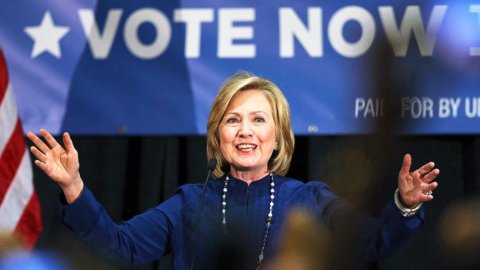
Democrats – On the democratic front, however, the campaign continues in a more relaxed manner: today there are votes in 5 states (the same as in the Republican primaries, excluding the Mariana Islands) and almost 800 delegates are assigned. Hillary Clinton he is still firmly in command: counting superdelegates, i.e. the party members who will vote in favor of him in Congress regardless of the outcome of the primaries, he has more than twice as many delegates as his challenger Bernie Sanders (1.234 against 579, won at 2.383). The former First Lady is therefore more than halfway through the work, even if without the i superdelegates the duel would be much tighter: 767-553 the score obtained so far "on the field".
The comeback of the 74-year-old socialist, who has included the minimum wage and free college for all in his program, is therefore unlikely even if in the last important round, in Michigan, there have been signs of a turnaround in the consensus. It being understood that Hillary has absolute control of the over 50 electorate and of the black population, Sanders is consolidating himself as the idol of the young and preferred by the white population, but in Detroit and its surroundings he undermined Clinton's hegemony even among the black: 30% voted for him, while they had been under 20% on average in the previous rounds of the primaries. And then there is the matter of working-class voters, In which industrial midwest has even more weight than elsewhere (today we vote in Chicago's Illinois and Cleveland's Ohio), and above all of the unemployed: “Michigan – writes the WP – has lost a lot of jobs in the manufacturing sector in the last 25 years (rising from 21 to 14% of the total workforce, ed), also due to the free trade agreements NAFTA type". The free trade agreement between the USA, Canada and Mexico, accused of having brought the manufacturing system to its knees, is one of Sanders' strong points, apparently quite successful.
“Opposition to free trade agreements – wrote the New York Times – could help Sanders in Ohio, Illinois and Missouri, also because the electorate does not forget that these agreements were supported by Hillary Clinton when her husband was president”. The paper also notes Sanders' fervent commitment to the case Flint, also in Michigan where there was a lack of drinking water, in the face of "tepid declarations by Mrs. Clinton on the need to clean up the Obama administration's Environmental Protection Agency". The New York newspaper also called on the candidate favored by the establishment to "stop tying the image of Sanders to National Rifle Association (the association of firearm owners, very influential in the States, ed)”. In reality, both contenders (unlike the Republican candidates) are in favor of new laws after the escalation of massacres, but Clinton accuses Sanders of the endorsement received via Twitter from the NRA. “Sanders has spent decades against racial discrimination, poverty and gun violence. To suggest otherwise is wrong,” argues the NYT.
PREDICTIONS – The following chart “delegate calculator” of the New York Times, which elaborates the projected results on the basis of the consensus of the last round of the primaries, see still Trump favorite for the final victory at the Grand Old Party congress, which will be determined in June. The "mathematics" could arrive right at the crucial stage in California, on June 6th. But this provided that the contenders still remain so numerous: if instead Marco Rubio e John Kasich (respectively senator of Florida and governor of Ohio, among the states where we vote today) were to leave after today's vote, the polls predict a landslide victory for Cruz with 75% of the votes between now and June. After the controversies of the last few days, and given that both Rubio and Kasich are almost out of the game, this circumstance seems increasingly possible. The vote in will be decisive Florida St, which assigns 99 delegates to the winner alone, and which could put the candidate of Cuban origin, who plays at home, back in the running. On the democratic front, however, there will hardly be room for Sanders comeback, but mostly because of the establishment's support for Hillary Clinton. For which it is enough to keep the roadmap obtained so far: a consensus that is not entirely clear, indicating in any case a preference - even among the democratic electorate - for candidates "out of the mainstream".