There are exhibitions that display objects and exhibitions that display ideas. "Troy and Rome: Myths, Legends, and Stories of the Ancient Mediterranean," held at the Colosseum Archaeological Park., definitely belongs to the second category. Because its true subject is not Troy, nor even Rome, but the very construction of cultural memory: the way a civilization imagines its past to legitimize its present. For at least two centuries, Western archaeology has pursued Troy as a physical place, a city to be excavated, measured, and catalogued. From Heinrich Schliemann's campaigns to the most recent Anatolian research, the question has always been the same: how much of the history is there in the Iliad? The Roman exhibition, however, shifts the issue to a more interesting level. It's not so much a question of whether the Trojan War actually occurred, but rather of understanding why its narrative has continued to generate meaning for three thousand years.
An international project
The first impression is that of an exhibition project of great international scope. Finds from Italian and Turkish museums, archaeological materials, works of art, reconstructions and multimedia equipment make up a vast narrative, which crosses the entire Mediterranean.The ambition is clear: to transform the visitor from a simple observer of antiquities into a witness to a long history of migrations, cultural appropriations, and identity constructions. But the true quality of the exhibition emerges above all when it abandons the didactic dimension to address a more complex issue: the relationship between myth and power. The idea that Rome descends from Troy through the figure of Aeneas is, in fact, one of the most extraordinary political inventions in history. It is not simply a legend. It is a cultural device that allowed the Romans to place themselves within a heroic genealogy capable of connecting their destiny to that of the Greek world. In the Aeneid, Virgil carries out an operation that today we would call "nation building": he constructs a tale of origins destined to become the symbolic foundation of the empire. The exhibition has the merit of highlighting this dynamic without reducing the myth to mere propaganda. Aeneas does not appear as a simple ideological tool. Rather, he becomes the archetypal figure of the exile, the migrant forced to cross the sea in search of a new homeland. In this sense, the Trojan hero acquires a surprising contemporaneity. Observing the artifacts that testify to the circulation of images, cults, and tales between East and West, we understand that the ancient Mediterranean was far less separated than we often imagine. The exhibition suggests an implicit but important thesis: cultural identities are not born from purity, but from contamination.
This is where the curatorial project achieves its best result.
For some time now, a segment of museum archaeology has suffered from a sort of encyclopedic complex. It accumulates objects in the belief that quantity equates to knowledge. "Troy and Rome," on the other hand, attempts to use the artifact as a narrative tool. The object is not the end but the means. A ceramic, a statue, an architectural fragment become chapters in a broader narrative about the transmission of myths. In some passages, the exhibition design seems to yield to the temptation of contemporary spectacle. The presence of large-scale scenographic installations and immersive reconstructions sometimes creates friction with the silent power of authentic archaeological materials. This tension runs through many contemporary exhibitions: on the one hand, the need to engage the public; on the other, the risk of turning history into entertainment. The exhibition retains considerable intellectual depth and never relinquishes complexity. From an art critical perspective, perhaps the most interesting aspect is another. "Troy and Rome" demonstrates how the boundary between archaeology and art is much less clear than one might think. The exhibits on display are not just historical documents; they are also images that have helped shape the European imagination. The figures of Achilles, Hector, Aeneas, Helen, and Priam belong to the history of art as well as to the history of literature. They continue to resurface in Renaissance painting, neoclassicism, contemporary cinema, and even popular culture.
In this sense the exhibition speaks above all of the present
Troy is presented not as a lost civilization but as a mental place that continues to generate interpretations. The visitor leaves with the feeling that every era has built its own Troy: that of the ancient Greeks, that of the Romans, that of the humanists, that of nineteenth-century archaeologists, and finally our own. This is probably the most effective reflection of the entire journey. Civilizations don't survive because they preserve their monuments; they survive because they continue to tell their stories. And Aeneas's journey, crossing the sea carrying with him the remains of a destroyed city, thus ends up appearing as a metaphor for culture itself: a fragile legacy, continually reinvented, passed from generation to generation, transforming without ever disappearing. At the end of the visit, one understands that The true protagonist of the exhibition is not Troy, nor Rome. It's the myth. And his inexhaustible ability to shape history.
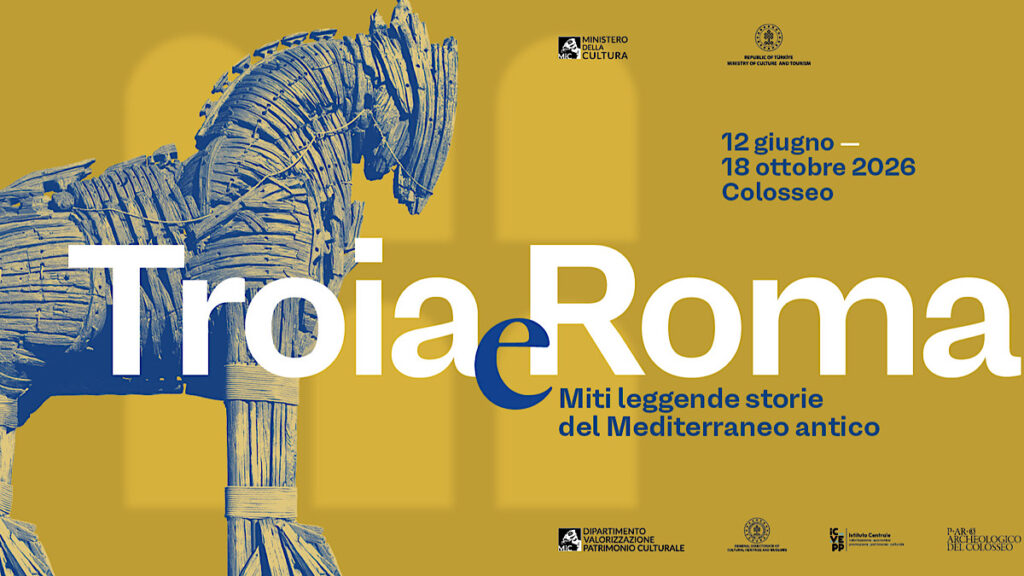
A cultured and ambitious exhibition that transcends the confines of traditional archaeology to interrogate the relationship between memory, identity, and power. A few concessions to spectacularization do not compromise a project of great scientific and cultural quality, destined to be one of the most significant events of the Roman exhibition year.