The exhibition dedicated to Goodbye by Pablo Picasso at the Museo del Novecento in Milan, stands out for its ability to transcend the traditional exhibition model centered on the masterpiece to offer a broader reflection on the relationship between art and political engagement in the late twentieth century. Through extensive archival documentation, photographs, and historical materials, the exhibition reconstructs not only the work's history as a collector, but above all the cultural and ideological context that led to its acquisition by the City of Milan in 1972.
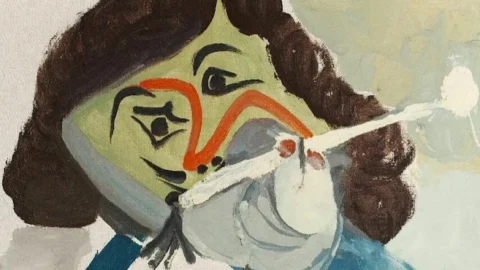
Work from the Musketeers series
The most interesting element of the exhibition lies in the curatorial choice to remove Goodbye to the purely formal interpretation that long characterized the reception of Picasso's late work. The painting, part of the celebrated Musketeers series, has often been interpreted as an expression of an extreme phase in the artist's research, dominated by a revival of pictorial tradition and an autobiographical reflection on the role of the artist. The Milanese exhibition, however, offers a different perspective: the Musketeer is not merely a symbolic figure in Picasso's poetics, but becomes the hub of a complex network of political and cultural relations that spanned Europe and Latin America during the Cold War years.
Amnesty. This is from Spain
The exhibition highlights how the work's circulation intertwined with some of the major international solidarity movements against the Franco regime. In this sense, the event "Amnesty. That's Spain," organized in March 1972 at the Palazzo Reale, takes on a paradigmatic significance. The initiative demonstrates how the art system could become a concrete instrument of political mobilization, engaging public institutions, unions, and democratic organizations in the defense of civil rights in Spain. The purchase of the work by the City of Milan, promoted by Mayor Aldo Aniasi, therefore appears not as a simple cultural operation, but as a deliberate political gesture, capable of symbolically translating international solidarity into public heritage.
Paris, Cuba and Milan
Particularly effective is the way the exhibition connects seemingly distant geographical contexts. The Paris of the Salon de Mai, the revolutionary Cuba of the Salón de Mayo, and the Milan of the anti-Franco mobilizations emerge as stages in the same geography of cultural engagement. The exhibition thus suggests a transnational vision of art history, in which works are not autonomous objects but active instruments of exchange, propaganda, diplomacy, and consensus-building. This perspective helps overcome an aestheticized conception of artworks and restores centrality to the social dynamics that determine their production, circulation, and reception. From a museological perspective, the project fits into a contemporary trend that favors historical contextualization over the celebration of the isolated masterpiece. Picasso's work is presented not as a relic to be contemplated, but as a historical document capable of triggering critical reflection on the relationship between culture and power. This choice is particularly significant at a time when museums are called upon to question their public role and their ability to contribute to the construction of collective memory. However, some problematic issues remain. The emphasis on the political dimension sometimes risks relegating the painting's linguistic and formal complexity to the background. The figure of the Musketeer, with its iconographic ambiguity and symbolic layering, appears subordinate to the historical narrative surrounding it. While this approach allows us to understand the reasons for its acquisition, it could also reduce the work's interpretative autonomy, transforming it primarily into documentary testimony. This limitation, however, does not compromise the overall value of the exhibition. On the contrary, the show demonstrates how Picasso's late work can be reinterpreted in light of the political tensions of his time, restoring the artist to a public dimension often obscured by his consecration as a modernist myth. The Picasso who emerges from the halls of the Museo del Novecento is not only the innovative genius of art history, but also a committed intellectual, part of an international network of solidarity and resistance.
The exhibition represents an important contribution to the reflection on the political role of art in the 20th century.
Through the story of Goodbye, it demonstrates how a work can simultaneously become an aesthetic object, an ideological symbol, and an instrument of civil action. The project's strength lies precisely in its ability to demonstrate that art history is inseparable from social and political history, and that the museum can still be a privileged space for critically interrogating the past and its legacies in the present.