
Declining birth rates, the flight of skilled young people, low female labor market participation, low wages, and immigration are all aspects of the low productivity encouraged by governments in Italy. However, consider each aspect in isolation and any national or local government can feel as innocent as a newborn baby when faced with plagues that come from "outside."
The president of the Republic, Sergio Mattarella, tells us to start again from falling birth rateStatistics from advanced countries show that the higher the employment rate, the higher the fertility rate. Women working more than 70% in Central and Northern Europe have a higher fertility rate, that is, children per woman, than Italy and Spain, which have much lower employment rates. And you don't have to go outside Italy to see it: a study Bank of Italy by region shows that women who work at 67% in Trentino Alto Adige have more children per capita than in Molise and Sardinia where women work less (47 and 50% respectively).
The fertility rate—the effects of which will be visible in 20 years—increases, however, only if women don't have to do double work, at home, after the office or the factory. See the graph below from Claudia Goldin's Nobel Prize speech. The measure to increase the number of children per woman is simple: more daycare centers, preschools, and services for the elderly.
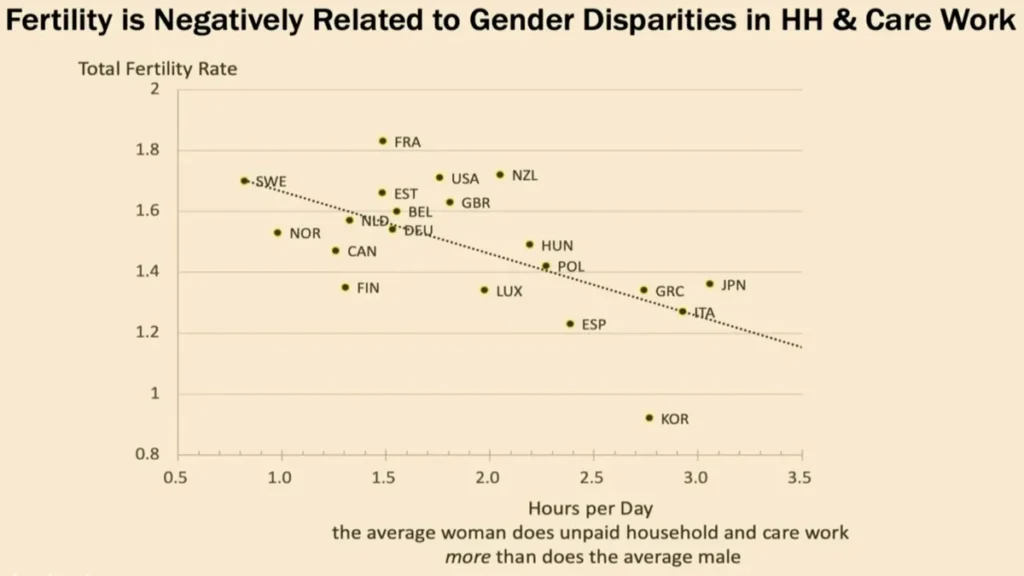
A higher employment rate of dataand – which is achieved with equal pay and the same services that are needed at the rate of fertility– It immediately increases GDP: in Italy, up to 0,6 percentage points according to the OECD. And it counteracts the demographic decline of the working-age population. Indeed, for a country's economy, what matters is not the working-age population, but the number of people working.
In the UK, by 2024, 9 million of the 43 million working-age population were neither working nor studying. In Italy, there were 2 million NEETs, in addition to women and those receiving benefits. To increase the number of workers, we need better wages, which means truly incentivizing innovative businesses, rather than bankrupt firms reclassified as startups.
Even more striking is the Super bonus, conceived by the Conte government and maintained by other governments of all stripes, which gave the equivalent of the National Recovery and Resilience Plan (NRRP) to construction, the sector with the lowest productivity/innovation. This sector thrives on the low wages of immigrants. These are the kind of national policies that encouraged unskilled immigration and caused 630.000 young Italians to flee between 2011 and 24, 42% of whom were graduates. They were not replaced by young people from advanced countries: the ratio is 1 in 8 young Italians who fled. Perhaps this will have an impact on the birth rate?
Technological backwardness is robbing our young people of their future: spreading AI-driven innovations to all businesses increases productivity by 50 to 100% in digital products and services, and by 40% in professions and healthcare. This would finally lead to higher wages in Italy, which are much lower than in the rest of Europe. Of course, AI will lead to layoffs, but the most recent studies (IMF) find 1,3 jobs created for every AI-driven job. And should we not forget the demographic decline of the working-age population, which will in itself reduce the number of jobs?
The increase in total productivity, due to innovation, means that the same amount of production is achieved with fewer resources. This is the most realistic scenario that takes demographics into account. A study of 34.000 companies by Studio Ambrosetti for the National Council of Economy and Finance (CNEL) last year found that in Italy, productivity growth thanks to AI could close almost the entire working-hour gap due to the decline in the working-age population by 2040. This is without the social risks of mass immigration, which then become risks for our democracies.