

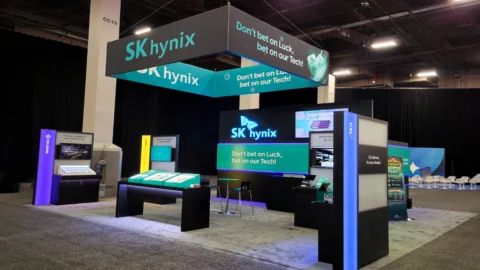
It's not just the fact of having accomplished a triumphal entry on Wall Street: for South Korean SK Hynix what is worth most are the perspectives. The CEO Kwak Noh-jung after bringing home a gain of 13% of the shares to debut on the Nasdaq, reaching 168 dollars, has already predicted for thenext year a clear one lack of supply with respect tohuge question international memory chip: a field where SK Hynix has become a cornerstone in the AI supply chain with the development of its high-bandwidth memory (Hbm) also used by giants such as Nvidia.
“We expect that the next year will be the worst in history of the sector from supply point of view“, Declared a Reuters Kwak, born in 1965 and a Stanford graduate, in an interview, predicting that memory demand will continue to outstrip the company's production capacity well into the next decade, despite aggressive capacity expansion. “The question of our customers continues to increase, while ours production capacity is limited“, he said. “We expect customer demand to remain greater than our supply capacity. even beyond 2030. But we are doing our best to solve the problem.”
SK Hynix's ADRs, ten of which are equivalent to one ordinary share, opened at $170 each. the offering price was $149, at a premium of 2,7% compared to the average share price over the last three trading days in Seoul.
Full steam ahead with production to try to meet demand
So the priority now becomes the production. The proceeds arising from the sale of shares, 26,5 billion dollars, will go especially for the construction of new plants for the manufacture of wafer. Kwak told him United States remain one of several candidates for future investments although no decision has been made yet: will give priority to resort able to provide land, electricity, water and skilled labor in sufficient quantities at competitive production costs. “If these conditions are met, the United States, the Japan and Southeast Asia will all be taken into consideration,” Kwak said. Reuters. “Nothing has been decided yet. We are evaluating which location can offer the greatest commercial advantages.” president of the SK group, Chey Tae Won, Told Bloomberg TV that the company aims to develop an AI data center capacity of 5 gigawatts outside of South Korea,
I SK Hynix's main plants are found in South Korea, Icheon, where the company is based, and Cheongju, and is also building a large complex in the city of Yongin. Both SK Hynix and Samsung Electronics, the two strongholds on which the stellar success of theSeoul Stock Exchange Kospi Index, are participating in a South Korean government plan for double the country's memory chip production capacity within five years. This includes a investment of 400 trillion won, equivalent to about 266 billion U.S. dollars, for chip manufacturing plants in the southwest of the country.
Profits and stocks soar thanks to its HBMs
SK Hynix was one of the companies that benefited most from the AI boom, thanks to its huge investments in hbm, a type of high-bandwidth memory, once snubbed, but now revealed to be a good choice: has become an essential commodity for the huge amount of data processed by graphics processing units (GPUs) dedicated to artificial intelligence, produced by companies such as Nvidia e Amd. THEoperating profit The company's revenue reached a record 47 trillion won, equivalent to 31 billion dollars in 2025, double the previous year's figure, after the perdita registered operation in 2023The positive momentum continued even this yearThe April-June quarter is shaping up to be even more impressive, with LSEG estimating an operating profit of 65,5 trillion won. The company's listed shares also Kospi have skyrocketed. While concerns about the sustainability of the AI-related stock rally have led to an 18% decline in the last two weeks, they have risen by 18% over the last 12 months. more than seven times.
MicronSK Hynix's U.S. competitor, Micron, has also surged 711% over the past 12 months. Analysts say SK Hynix's U.S. listing will help close the valuation gap between the two companies, broadening their investor base and accessibility. Despite its dominance in the HBM sector, SK Hynix trades at about 5,8 times expected earnings, compared to Micron's around 7 times, according to LSEG data.
How long will the strong demand for chips last? Alarm lights
But right there AI application that Sk Hynix is talking about is under examinationSome analysts speculate that the AI investment cycle is approaching a turning point. And it is precisely this aspect that has contributed to the recent semiconductor stocks decline. Some alarm lights they are lighting up: Apple is seeking to diversify parts of its semiconductor supply chain to include Chinese suppliers; Meta is trying to commercialize the excess computing power resulting from artificial intelligence.
However, industry executives and analysts argue that theoffering of memories at the moment is still insufficient. The CEO of NvidiaJensen Huang said last month that the shortage of memory for artificial intelligence will continue for several years due to strong demand, adding that Sk Hynix will remain the company's primary memory supplier.
The ubs forecasts that the global DRAM memory market will remain undersupplied at least until the second quarter of 2028. Similarly, Bank of America maintains a positive outlook on the AI investment cycle, estimating that global capital spending by hyperscalers will reach approximately $851 billion this year and $1,15 trillion next year, driven by robust cloud order books, improving returns on AI investments, and growing demand for compute-intensive AI applications. The bank also said that the approximately $244 billion raised this year by leading hyperscale service providers largely reflects balance sheet optimization rather than signs of financing difficulties, maintaining that capital remains readily available to support ongoing infrastructure investments.
Moreover, this optimistic view has been strengthened this week by Micron, when it announced it plans to invest more than $250 billion in the United States by 2035, up from $200 billion it planned last year, citing growing demand for memory chips in the age of artificial intelligence and President Donald Trump's commitment to boost domestic semiconductor production.

Good morning, thank you for the article's depth and breadth of insight. However, I find no confirmation of the initial statement, namely that SK Hynix shares rose 13%, which would have closed sharply higher. I have instead noted that the stock's performance on the Nasdaq, despite a rapid rise to $173, then gradually reversed over the course of the day, closing with a slight loss.
is there a mistake in the article?
Thank you and greetings
Good evening, and thank you for your attention and your comment. To be fair, before responding, we rechecked the stock's price on the Nasdaq and can confirm that, according to the stock exchange (i.e., the primary source) and various news agencies, SK Hynix (SKHYV) closed its opening session up 12,76% at $168,01. Conversely, SK Hynix (SK Hynix Inc OLD) closed slightly lower on the Kospi. Kind regards, please continue reading.
MS