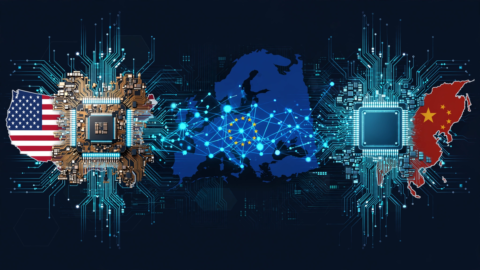
The European Union she took care of artificial intelligence with serious delay. Taken by surprise by the explosive phenomenon of ChatGpt, the first concern was to regulate a phenomenon for which there was not yet a strong industrial and technological presence. In the meantime, United States and China continued to invest on an incomparably larger scale, placing AI at the heart of the competition for technological supremacy and for future productivity growth.
Europe – where there is certainly no shortage of personalities of fundamental importance for AI Half Hassabis, British, to Yann LeCun, French, to Jurgen Schmidhuber, German – has suffered the impact of three major structural limitations: a complicated and burdensome regulatory framework, a structural limitation of access to data to which the Americans were not subjected and the absence of a financial system capable of supporting high-risk, capital-intensive investmentsThese factors have widened the gap with the major global AI hubs.
In particular, Europe has lost ground in the development of continental founding models, that is, cognitive infrastructures on which to build applications, services, and competitive advantages. An initial turnaround came with the AI Continent Action Plan of April 2025, which focused on strengthening the AI superfactories already envisioned by the "European High Performance Computing Joint Undertaking" program launched to provide Europe with ultra-high computational capacity to support startups, universities, and businesses.
The most significant turning point, however, was recorded in 3nd June this year, with the Technology Sovereignty Package, which addresses the essential issues of the European competitivenessSemiconductors, cloud computing, computing infrastructure, and artificial intelligence. Two elements are particularly different from the past: the choice to promote open source, capitalizing on the vast amount of freely accessible AI technology, and the role of public demand as an enabler of technological development also for European startups.
This setting rewards the choices of operators such as Techvisory, who developed the platform TextGenius Completely open source with a cloud-agnostic architecture, compliant by design, and equipped with the traceability and human oversight guarantees required by European regulations. TextGenius is designed to be lock-free and ensure low operating costs with a token-free model.
The challenge now is to prevent the proposals contained in the technological sovereignty package from being let good intentions remain without producing concrete resultsBut time is running out: Europe must quickly recover lost ground if it doesn't want to miss the most important technological revolution of this century. The human and financial resources exist. We must transform them into industrial capacity, qualified demand, and autonomous technological infrastructure, without missing this opportunity.
...
The published text is the first of three analyses dedicated to Artificial Intelligence and technological sovereignty by Franco Bernabe, President of TechVisory, which FIRSTonline will host on a weekly basis courtesy of the author and the AI Magazine.