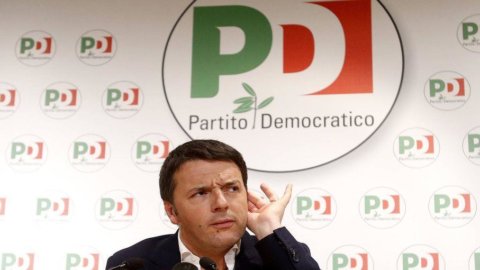
Matteo Renzi cannot be said to have enthused in his first real test as premier: he fell like a rookie into the trap of lobbies and corporations by giving the Ministry of Economic Development to a completely inconsistent and politically ambiguous entrepreneurial figure such as Federica Guidi and the ministry del Lavoro to the powerful head of the Coop League, Giuliano Poletti. It couldn't really get worse than this, despite the many conflicts of interest that Guidi and Poletti bring with them. A ruinous signal, only partially counterbalanced by the choice of a super technician like Pier Carlo Padoan at the Ministry of Economy.
Either Renzi finds a way to redeem himself immediately or the government of change will remain a chimera. Even in politics, discontinuity is important, but it alone is not enough to improve. In addition to the registry office, competence and the ability to really deliver what is promised count. Otherwise it's just smoke, destined to vanish soon.
If desired, the possibility to redeem oneself, however, exists and does not require any law. But she must be caught on the fly: immediately, in the next few hours. The occasion is the formation of cabinets and ministerial teams. The governments first of Mario Monti and then of Enrico Letta experienced first-hand the hidden sabotage and tireless obstructionism of the super-bureaucrats who occupy the crucial posts of the ministries. Who doesn't remember the ballet of figures on redundancies or the no less disheartening one on the rates of the mini-IMU?
It is no coincidence that the doubt arose as to who is really in charge in Italy: politics or the lobbies and the extremely powerful and immovable bureaucracy? As a thoroughbred scholar like Gustavo Visentini pointed out on FIRSTonline on 14 September last, the invasive power of corporations and ministerial technostructures has now emptied Italian politics. Of course, politicians' weakness and lack of popular legitimacy matter, but they don't explain everything.
Here then is the golden opportunity of the Renzi government: in all the ministries you immediately change, with very rare exceptions, the heads of cabinet, start the rotation of the directors general from one ministry to another and renounce to increase the ministerial teams of advisers of State that they usually write the texts of the law thinking first of all about their privileges, their double salaries and their scandalous pension benefits.
It is obvious that the elites of the Italian bureaucracy are not all the same and that there are public managers of great value but it is time to give a signal and restore the hierarchies of power. Redimensioning the super-bureaucracy would be a reform that costs nothing but above all it would be the obligatory passport to open the construction site of other reforms: from the electoral one to those of the tax authorities, labor and public administration, rightly indicated by Renzi as priorities.
To err is human even for the new prime minister, but to persevere leaving the super-bureaucrats in their comfortable armchairs would, yes, be truly diabolical.
Read the previous analysis by Director Franco Locatelli: "Government, discontinuity is not enough"