In recent days, a massive fire broke out at a luxury resort in Santo Domingo, hosting 252 Italians. We don't mean to be demagogic: the terrible AVS couple might argue that these Italians are among those taxpayers who should be subject to a wealth tax, especially since we often hear reports of Italians spending their holidays in charming resorts scattered across the globe; while our hoteliers are expecting a sold-out summer in Italy too. Perhaps it would be time to bring some order to our statistics, to realize that many of our fellow citizens are counted multiple times in different, often even contradictory, groups, or provide an inaccurate representation of themselves. The following data for the various conditions surveyed do not refer to the same years, but the variations are not so significant as to elude credible comparison.
In 2024, the average number of people looking for work in Italy was equal to 1 million 664 thousand. As for the CDs NEET, in 15-29 year age group: in Italy it is estimated that approximately 1,18 million subjects (equal to an incidence rate of 13,3%). Extending the monitoring up to 34 years of age, the absolute value rises to over 2 million NEETsMore generally, inactive people (of working age between 15 and 64 years) amount to approximately 12,5 milliona inactivity rate stable at around 33,3%.
Unemployment, inactivity, and poverty: the fragile face of the country
In Italy, people in a condition of absolute poverty are 5,7 million, Equal to 9,8% of residentsThe data concerns more than 2,2 million families (8,4% of the total) and presents a particularly critical situation for minors, foreigners, and large families. It is important to clarify that Italian families in this situation represent 6,2% of the total, while foreign families represent more than 35%.
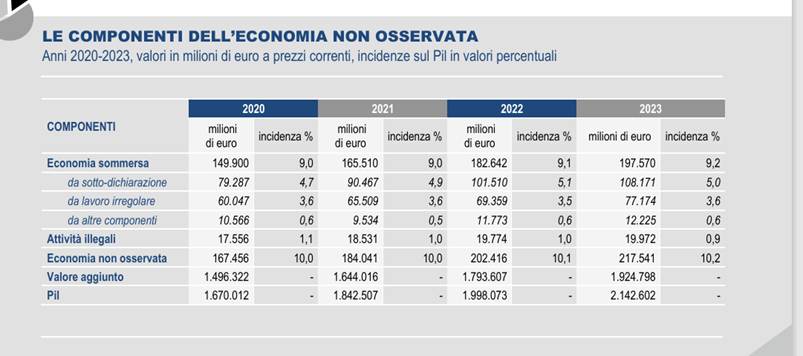
In 2023, the underground economy (i.e. net of illegal activities) stands at just under 198 billion euros, up 14,9 billion compared to the previous year, while the illegal activities are close to 20 billion. The irregular work units are 3 million 132 thousand, growing by over 145 thousand units compared to 2022. In essence, what is defined as the "unobserved economy" stands at 217 billion, equal to 10,2% of GDP.
As can be seen from the Istat table, the overall dynamics of the unobserved economy was driven by the growth of its main components. Compared to the previous year, the added value due to sub-declaration recorded an increase of 6,6% (equal to +6,7 billion euros), while the one generated by irregular work recorded an 11,3% growth (corresponding to +7,8 billion). However, the contribution of other components of the underground economy was limited: undeclared tips and rents increased by 3,8% (equal to +0,5 billion) compared to 2022, while illegal activities increased by 1,0% (approximately +0,2 billion). The strongest growth in value added from irregular work Compared to other components, this has led to a slight recomposition of their relative weight within the overall unobserved economy. Specifically, the incidence of value added from irregular work rose to 35,5%, reaching the level observed in 2021 (35,6%) and recovering 1,2 percentage points compared to 2022 (34,3%). Conversely, the weight of value added from under-declaration fell to 49,7% in 2023 from 50,1% in 2022 (it was 49,3% in 2021). The other components of the underground economy contributed 5,6% to the overall unobserved economy (5,8% in 2022 and 5,2% in 2021). Finally, it continues: the progressive reduction of the impact of the illegal economyIn 2023, it stood at 9,2%, 1,3 percentage points below the 2020 level (when it was 10,5%), 0,6 points less than that recorded in 2022 (when it was 9,8%).
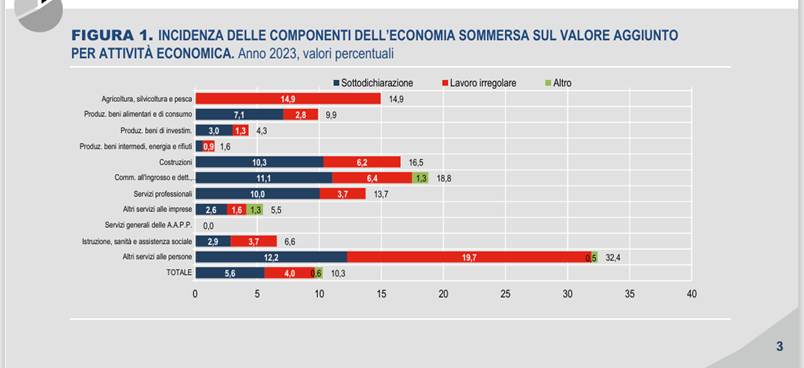
The incidence of under-declarations and irregular work raises concerns about tax evasion.
Overall tax gap estimates: In addition to the Istat data, joint reports from the Ministry of the Economy and Finance and other research institutes estimate that the actual "tax gap" (missed tax and contribution revenue) fluctuates annually around a figure between 80 and 100 billion euros.
Declared Income and Tax Burden: Who Really Pays Personal Income Tax?
At this point, the praiseworthy analyses of Itinerari previdenziali (Prevention Itineraries) come to account for general taxation in Italy and the participation of various income recipients.
Of a population of 59.030.133 residents (note that residency is different from citizenship), 42.026.960 filed a tax return in 2023 (with reference to the previous tax year). Only 32.373.363 residents paid at least €1 in personal income tax (IRPEF), or just over half: therefore, each taxpayer corresponds to 1,405 inhabitants. But the devil is in the details. 9.330.900 taxpayers, or 22,20% of the total, earn up to €7.500 gross. 7.626.579 taxpayers declare incomes between €7.500 and €15.000 gross per year. 5,4 million taxpayers declare gross incomes between €15.000 and €20.000. 9,5 million taxpayers earn incomes between €20.001 and €29.000. This is followed by taxpayers with incomes between €29.001 and €35, accounting for 3.754.371 taxpayers, or 8,93%, who pay a total of 12,17% of taxes. Adding together all income brackets up to 29 euros, it is clear that 75,80% of Italian taxpayers pay only 24,43% of the total IRPEF: a photograph closer to that of a poor country than of a G7 member state And which would also appear unrealistic—according to Itinerari previdentiali—when looking at Italians' consumption and spending habits. It's easy to see that few taxpayers pay taxes commensurate with their lifestyles, and too many report incomes that are too low. By the law of large numbers, however, tax evasion is prevalent in this second group.
At this point, a question arises: will the nearly €200 billion circulating in the underground economy, the €77 billion from irregular work, and the €108 billion attributed to under-declarations (intentionally misreporting turnover and/or costs) end up in someone's pocket? Even the illegal economy generates income for households' final consumption. Certainly, there's nothing positive about this dissociation between regular and irregular income. We can't indulge in the usual art of making do, but at least let's not treat tax evaders like paupers.