Leonardo da Vinci, Maria Callas, and Beethoven could soon be in European wallets. Alternatively, the future ofeuro could be entrusted to kingfishers, storks, rivers and natural landscapes. ECB revealed the ten finalist proposals for new look for banknotes and has opened a public survey through which citizens can express their preferences until September 21, 2026.
La final decision is expected towards the end of the year. It will be there first redesign full use of euro banknotes since their introduction in 2002, although it will still be several years before the new banknotes actually change hands. You can participate in the official ECB survey on the new banknotes and consult the page with all the finalist proposals.
New Euro banknotes: From Leonardo to Beethoven, Europe puts culture in its wallet.
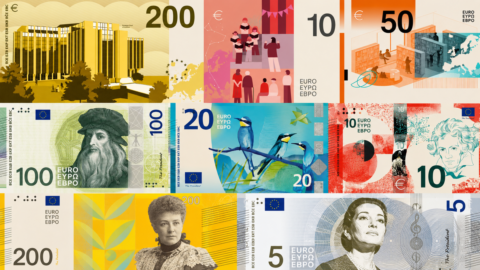
Il The first theme in the competition is “European Culture” and transforms the banknotes into a small gallery of great characters that have marked the continent's history. Among the various denominations, there is room for Maria Callas, Ludwig van Beethoven, Marie Curie, Miguel de Cervantes, Leonardo da Vinci, and Bertha von Suttner, Austrian writer and the first woman to receive the Nobel Peace Prize.
Il Retro instead he tells about the banknotes the places where culture comes to lifeThere are street performances, choirs, schools, universities, libraries, museums, and public squares. The result is a euro that abandons the current bridges and imaginary architecture to finally showcase recognizable faces and scenes from European life.
The 5-euro note is dedicated to the performing arts and features Maria Callas, while the 10-euro note celebrates music with Beethoven. Marie Curie represents schools and universities on the 20-euro note, Cervantes accompanies libraries on the 50-euro note, Leonardo da Vinci appears on the 100-euro note dedicated to museums and exhibitions, and Bertha von Suttner occupies the 200-euro note, associated with public squares as places of meeting and sharing. "Euro banknotes are not simply a means of payment: they are one of the most tangible expressions of Europe," explained the ECB President. Christine LagardeAccording to Lagarde, the combination of beauty and meaning should help strengthen Europe's common identity.
New euro banknotes: the alternative soars among rivers, storks, and kingfishers.
La second road takes you away from theaters and libraries to immerse yourself in natureThe theme “Rivers and Birds” uses waterways and avian species to represent a Europe without borders, bound by freedom, diversity, and the responsibility to protect the environment.
Sul front of banknotes The wallcreeper, the kingfisher, the bee-eater, the white stork, the avocet, and the northern gannet appear. The animals are placed in landscapes that range from spring mountains to waterfalls, from river valleys to wetlands, and even the great waves of the ocean. Retro Instead, it is reserved for the main European institutions. The Parliament, the Commission, the European Central Bank, the Court of Justice, the European Council, the Council of the European Union, and the Court of Auditors thus become the institutional counterweight to a series dominated by wings, water, and natural landscapes.
Citizens won't necessarily have to choose a single design and reject all the others. In the questionnaire, they can evaluate the various proposals and express multiple positive opinions, helping to determine which solutions are most convincing, recognizable, and representative.
New Euro banknotes: a competition launched with over 1.200 submissions.
The ten proposals come at the end of a competition open to graphic designers from across the European Union. The ECB has Received over 1.200 applications and selected 25 professionals, inviting them to develop a proposal for one or both themes.
Further narrowing the field was a independent jury composed by 21 designated experts from the central banks of the eurozone. Not just graphic designers, but also specialists in communications, history, and neuroscience, called upon to evaluate both the artistic quality and the readability and visual effectiveness of the projects.
Alongside the consultation open to all, a independent research firm to conduct second survey with the same questions on a representative sample of the euro area population. The ECB Governing Council will take into account the citizens' responses, the jury's opinion, and the technical checks before selecting the winning proposal.
Old banknotes will not lose value
The change of image it will not lead to a bank run nor a sudden retirement of current cash. banknotes already in circulation will retain their value and will continue to be usable even after the new series arrives. The chosen design will also need to be developed, refined, and subjected to extensive testing before mass production.
The restyling is not just about aesthetics. The new banknotes will be equipped with more advanced security tools To make counterfeiting more difficult and authenticity verification easier. Greater attention will also be paid to accessibility, especially for the visually impaired.
The ECB also aims to achieve more wear-resistant tickets, thus extending their lifespan, and using materials and production processes with a lower environmental impact. "The design of the new graphic design of euro banknotes is part of the Eurosystem's long-term action to ensure that cash remains a safe, efficient and citizen-friendly means of payment, preserving their access to public money and their freedom to choose how to pay," he declared. Peter Cipollone, member of the Executive Board of the ECB.
First, however, the graphical dilemma remains to be resolved. Is it better to pay for a coffee with Beethoven, shop with Leonardo, or receive your change under the gaze of a stork? For once, at least part of the answer lies directly with European citizens.