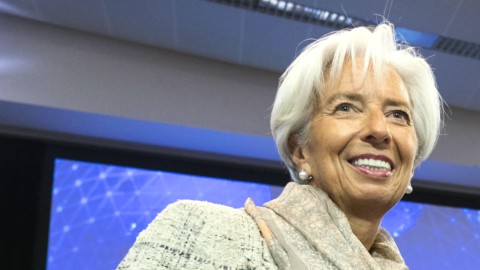
“Restrictive rates, as long as necessary”. A message from the president of the ECB Christine Lagarde he's been repeating for months now like a mantra. There ECB kept rates unchanged for the third consecutive pause in the cycle of increases that began in July 2022 and reiterates its data-dependent approach, inflation first and foremost, also in light of the new tensions in the Middle East. So far no surprises, but the experts look above all to the words of the number one of the European Central Bank. The question is always the same, when will Frankfurt be ready to cut rates? Talking about cuts is still “premature” for Lagarde and the board of directors, relaunching a possible cut during the summer. Decisions will continue to be made on a “meeting by meeting” basis.
The rate on main refinancing remains unchanged at 4,50%, that on deposits at 4%, and that on marginal loans at 4,75%.
Lagarde: “The economy is weak but recovering during 2024”
“It is likely that theeconomy of the eurozone be stagnant in the last quarter of 2023 and weak in the first quarter of 2024,” explains Lagarde. However, amidst this, positive indications of a possible recovery later in the year are emerging.
Il job market remains robust, with the unemployment rate reaching its lowest level since the launch of the euro, standing at 6,4% in November. Despite this, there is a slowdown in job demand, reflected in a lower number of vacancy announcements.
To ensure a lasting economic outlook, explains the number one of the ECB, governments are advised to gradually reduce energy support measures to avoid future inflationary pressures. Targeted fiscal and structural policies are needed to enhance productivity and competitiveness.
Lagarde: “Inflation continues to decline”
In December, inflation reached 2,9%, mainly due to some tax changes that affected energy prices. However, the rally was less intense than expected. The general trend is a reduction in inflation, with the cost of food falling to 6,1% and services inflation remaining stable at 4%.
“We expect inflation to decline further this year as the effects of past energy rises and supply chain challenges fade,” Lagarde said, adding that “tight monetary policy will continue to impact demand.”
Furthermore, always in December, the inflation expectations have decreased, especially in the short term, while longer-term ones remain around 2%.
Downside risks to economic growth
I risks pertaining to economic growth of the euro area persist, sloping downwards. Possible stronger effects of monetary policy, a weaker world economy or a further slowdown in global trade could negatively impact growth. Geopolitical tensions, such as the situation in Middle East and Russian-Ukrainian conflict, constitute significant sources of risk, threatening business and household confidence and disrupting global trade. Conversely, higher growth could occur if increases in real incomes generate higher-than-expected spending or if the world economy grows more than expected.
Upside risks to inflation
Increased geopolitical tensions, especially in the Middle East, could lead to increases in energy prices and transportation costs in the short term, with possible impacts on the global economy. L'inflation could surprise to the upside if wages or profit margins prove more resilient than expected. However, an unexpected slowdown in demand due to tighter monetary policy or a deteriorating global economic environment could lead to downside surprises in inflation. Reduced market expectations about oil and gas prices could also contribute to a faster decline in near-term inflation.
Financial Conditions
I market interest rates have remained relatively stable sincelast meeting. Tight monetary policy continues to impact financing conditions, with business lending rates decreasing slightly in November, while mortgage lending rates increased slightly. However, the high rate climate has contributed to a reduction in credit demand, especially in the real estate and investment sectors. Despite a slight improvement in credit dynamics, the overall remains weak, with a slowdown in loans to businesses and limited growth in loans to households.