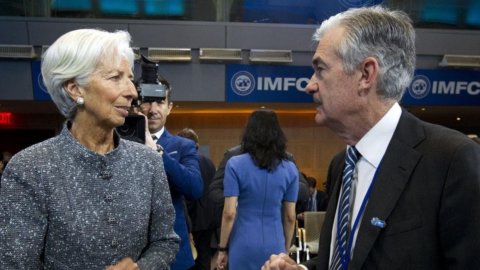
This will be one of the busiest weeks for the monetary policies of the central banks: they will announce their decisions in Federal Reserve, on Wednesday, while the European Central Bank and the Bank of Japan are expected on Thursday.
There is a different story for each of these, although the current forecasts are for a 25 basis point rate cut by the Fed and nothing for the other two.
Meanwhile, currencies are mostly sitting on the sidelines and waiting: the index of dollar, which measures the greenback against some major currencies, remained virtually unchanged at 98,90, the euro is stable at 1,1628 dollars, while the single currency has strengthened to reach 178,13 yen, a historic high. yen continued to decline against the dollar for the seventh consecutive session.
The Fed, reassured by contained inflation, will cut rates by 25 basis points. Keep an eye on the QT.
While the US government continues the shutdown For almost a month, keeping analysts and the Fed itself in the dark about the state of the US economy due to the failure to publish data, a light appeared on Friday: exceptionally, the Trump administration published inflation data, late from October 15, showing lower-than-expected consumer prices, allaying fears of a negative impact on inflation from duties of Trump.
The data further corroborated the'waiting for a rate cut, Not only in this round, but also in the December round. The current US benchmark rate is 4%-4,25%. In September, the FOMC ended a nine-month pause, cutting rates by a quarter point, following emerging signs of a weakening labor market.
Investors will also be closely watching statements from Fed Chairman Jerome Powell for signs of when the central bank might conclude its budget reduction program, known as quantitative tightening (QT). Powell recently reported that the end of QT you are approaching, fueling speculation that the Fed might announce its end at this week's meeting or outline a roadmap for tapering it. Barclays strategists say the most market-impacting outcome would be "an immediate end to QT coupled with a signal for imminent direct asset purchases to bolster bank reserves."
This should be bullish for Treasuries, because it reduces the supply on the market, pushing prices higher and yields lower. An exit from QT would also mean that the Treasury's financing needs would decrease, as it would no longer need to borrow as much to cover the Fed's repayments. "This is another positive factor for fixed income securities like Treasuries," said Neil Sutherland, portfolio manager at Schroders. "At the limit, it's worth going long on bonds, but since yields have fallen, valuations are no longer as attractive as they were three or four months ago. This suggests that fixed income remains well supported."
Meanwhile, investors bonds are reassessing their long-dated Treasury securities, with some reducing positions and others even going short their benchmark, Reuters reports. Portfolio managers typically favor duration, which involves buying debt securities. longer-term when the Fed eases rates, as a hedge against further economic weakness. However, some investors are abandoning this strategy, believing that a soft landing for the US economy is still within reach.
ECB: This week's data releases should support the ECB's decision to keep rates on hold.
This week Europe will be subjected to rigorous economic scrutiny, which will help to assess theimpact of US tariffs on growth and inflation, while ECB officials, meeting exceptionally in Florence instead of Frankfurt, will decide on rates.
The most important data will be the initial reading of the gross domestic product for the eurozone in the third quarter, due on Thursday, just hours before the ECB's announcement. Analysts expect GDP growth to be limited to 0,1%, as in the three months to June. National reports from some of the region's largest economies will add further detail. Almost equally important will be the inflation data October, published the following day. It is expected to decline to 2,1% from 2,2% last month. The ECB will also publish its survey on bank credit, which helps assess the effectiveness of monetary policy in the real economy.
The stagnation of the eurozone economy does not necessarily alarm the ECB, which is expected to keep borrowing costs at 2%. With inflation hovering around 2% and forecasts pointing to a stronger economic recovery towards the end of the year, most investors are content to leave the deposit interest rate unchanged and may do so for the next two years, according to a survey of analysts conducted by Bloomberg.
I company surveys released on Friday raised hopes that a eurozone recovery will indeed materialize, as activity in the private sector unexpectedly reached its highest level since May 2024. The Germany, which is about to allocate billions of euros in spending on infrastructure and defense, is the driving force, while the France, once again shaken by political turbulence, is struggling.
Boj: Will he raise rates or will he follow the new prime minister's advice and hold off?
The least obvious monetary move is likely to be the Bank of Japan Thursday, torn between continuing its past course of monetary tightening to keep inflation under control by raising interest rates, or following the advice of the new Japanese Prime Minister Sanae Takaichi which instead, in perfect Trump Style would like low interest rates and strong public spending stimulus.
The BoJ is likely to debate whether there are condizioni right to resume rate hikes, given that fears of a tariff-induced recession are easing, although political complications may keep the issue on hold for now. Trump On his Asian tour, he left Malaysia, where he anticipated the possibility of an agreement with China, and is flying to Japan, the second stop on his Asian tour. In Tokyo, he will meet both theEmperor Naruhito, both Takaichi.
“There is a risk that the Bank of Japan will raise rates, and any hawkish stance could move the yen significantly,” said Bob Savage, head of macroeconomic markets strategy at BNY.
Japan is now facing inflation and a weak currency, two factors that are highly unpopular among the Japanese people. If Takaichi were to exert political pressure on the Bank of Japan and the yen depreciated further, inflation would rise even further. It would be a very, very risky game for her.