Almost two centuries after the birth of Anthony Blessed (ca. 1835–1905/1906), the Fortuny Museum in Venice dedicates a major exhibition to one of the most fascinating protagonists of nineteenth-century photography. The exhibition, divided into four sections, retraces the Venetian photographer's long journey through the Orient and the Mediterranean, offering a previously unseen portrait of his pioneering gaze.
La Mariano Fortuny's house-atelier, a place where art, travel, and visual experimentation intertwine, proves to be the ideal setting for this dialogue between two authors united by intellectual curiosity, a spirit of adventure, and a shared interest in the Orient and Islamic culture. Beato and Fortuny, though distant in time, share a common drive for discovery and the ability to narrate the world through light and image.
The Mediterranean and wars: the origins of a vision
The exhibition opens with the section “The Mediterranean”, dedicated to the formative years. Between 1854 and 1857, Antonio and his brother Happy Blessed, together with his brother-in-law James Robertson, they traveled from Constantinople to Athens, from Malta to Jerusalem and Cairo. These were decisive years in which the two brothers refined their photographic technique and laid the foundations of a language that would become a school. The following section follows: “The Wars”, which documents the photographic campaigns carried out by Beato and Robertson between 1855 and 1859 in the theatres of war in Crimea and IndiaPowerful and sometimes disturbing shots tell the dawn of the war reportage, suspended between the aesthetics of composition and the rawness of reality. For 19th-century Europe, those images were a new window onto an unknown Orient.
The Egyptian Years: The Heart of the Exhibition
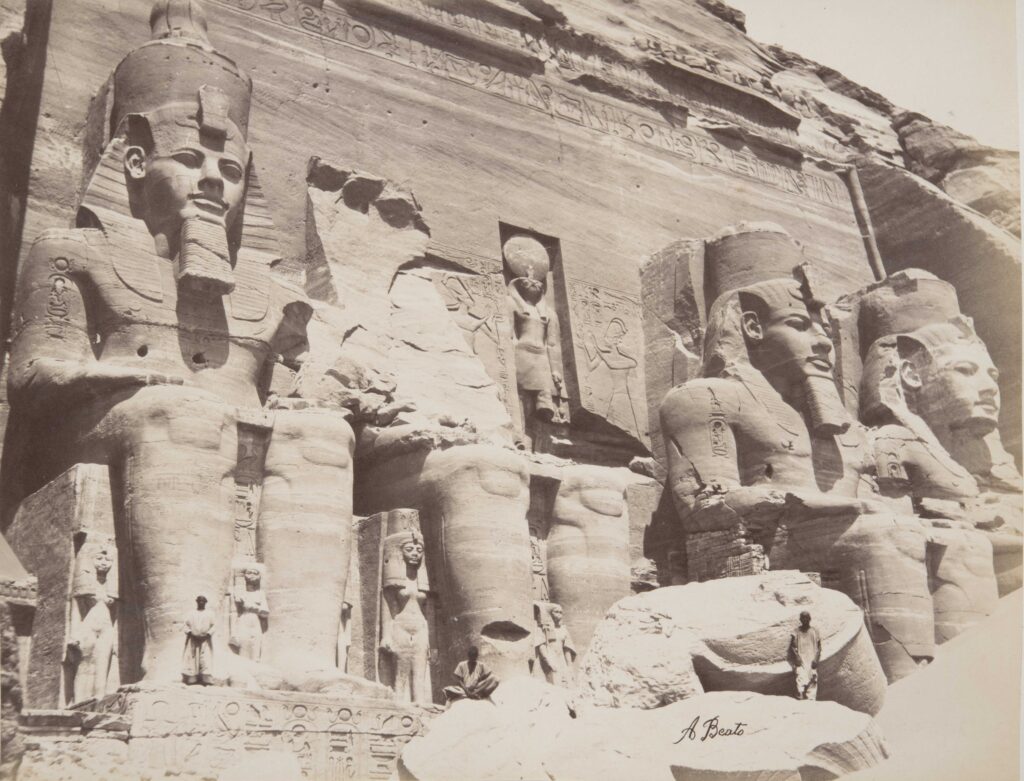
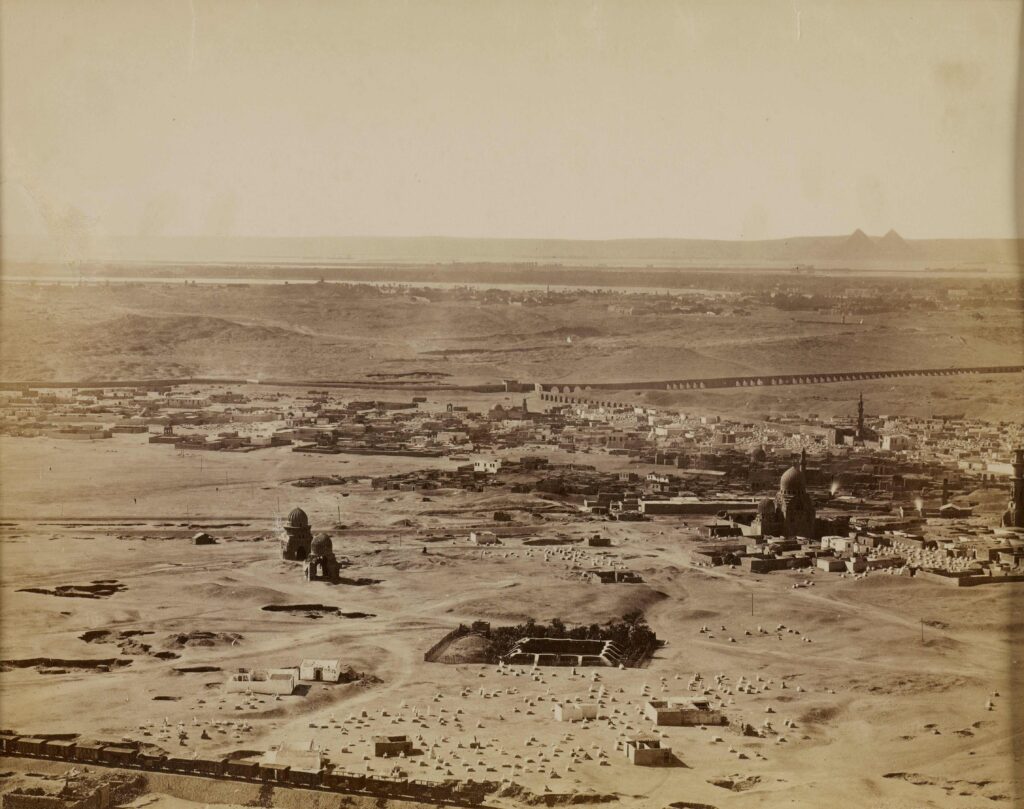
The central part of the exhibition, “The Egyptian Years”, is entirely dedicated to the long stay of Antonio Beato in Egypt, from 1860 to 1905. The photographs, organised by location, trace an ideal route from Cairo to Nubia, accompanied by plans and drawings of the main archaeological sites.
Blessed captures the soul of places – Luxor, Abu Simbel, Giza, Cairo – not as isolated monuments but as a living part of the landscape and culture that surrounds them. In dialogue with his works are the images of other authors such as Pascal Sebah e Felix Bonfils, up to the famous photograph of the Great Pyramid of Cheops taken by Lee Miller in 1938. The latter creates an ideal bridge between Beato's nineteenth-century documentary work and the visions of the twentieth century.
After Beato: Contemporary Photography in Egypt
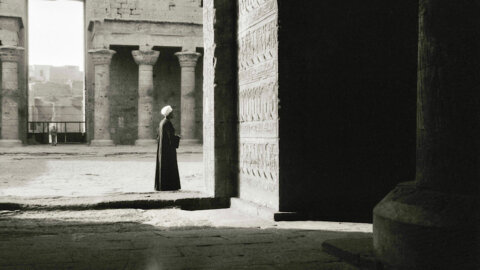
The final section, “After Beato”, explores the transformations of photographic language up to the present day. On display are works by contemporary authors such as Anthony Hamboussi, Paul Geday, Denis Dailleux e Bryony Dunne, which tell a Cairo in constant change, between social, cultural and political dynamics. Alongside these works, a room is dedicated to the trip to Egypt made in 1938 by Mariano Fortuny e Henriette NigrinPhotographs, notebooks and sketches document a country suspended between tradition and modernity – from the oasis of El-Fayyum to Wadi Halfa – and reveal how those visual motifs inspired Fortuny in the creation of his famous printed velvets, a timeless dialogue between East and West. The journey ends with a video interview with Italo Zannier, a photography historian, who recalls the importance of the Beato brothers forty years after the first exhibition dedicated to them in Venice, at the Ikona Gallery. The original prints come from prestigious international institutions, including Alinari Archives, Foundation of Venice, Lee Miller Archives and Egyptian Museum of Turin, together with reproductions from collections of the Getty Research Institute and National Gallery of Art of Washington and the New York Public Library.
Edited by João Magalhães Rocha and Marco Ferrari, with Cristina Da Roit. In collaboration with the IUAV University of Venice and the University of Évora. Under the patronage of the Portuguese Embassy in Italy.
Cover image: Mariano Fortuny: Edfu. View of the Courtyard from the First Pylon of the Temple of Horus, 1938, 35mm Negative. Fondazione Musei Civici di Venezia – Museo Fortuny