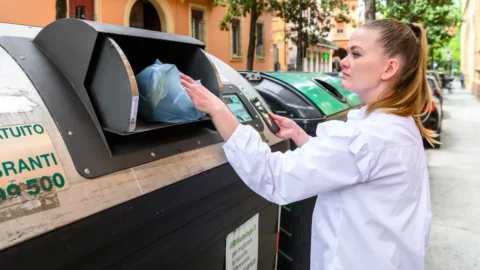
Thirty-four projects, 23 million euros of investments and a network of environmental services that changes face: in Emilia-Romagna the Hera Group led a program of interventions is completed funded under the National Recovery and Resilience Plan (NRRP). New and modernized collection centers, underground recycling centers, smart bins, and computerized houses are some of the solutions introduced to make urban waste management services more efficient and innovative.
The interventions fall within the Mission 2 of the PNRR, "Green Revolution and Ecological Transition," and in Component 1 dedicated to the circular economy and sustainable agriculture. Overall, the projects have mobilized €23 million, of which 15,8 million covered by PNRR contributions provided by the Ministry of the Environment and Energy Security through Atersir. According to Hera, the portion financed by the Plan will not lead to rate increases for users.
From collection centers to intelligent systems
The program involved both the physical infrastructure of the collection both technologies for management and monitoring services, from the construction and modernization of collection centers to underground recycling centers, from Smarty systems to computerized houses. Investments also included digital tools for the collection and thedata analysis, to support activity planning, monitoring and operational management.
All projects were carried out in compliance with the Dnsh principle, “Do No Significant Harm”, envisaged by the PNRR to prevent the funded interventions from causing significant damage to environmental objectives. Where possible, solutions have also been adopted to improve energy efficiency, reduce consumption, use renewable sources, and increase the capacity to adapt to the effects of climate change.
“Overall, the investments involved territories that differ in size, location and characteristics – commented Giulio Renato, Central Director of Environmental Services and Fleets for the Hera Group -, from provincial capitals to coastal centers, from the plains to the municipalities of the Modena Apennines. The distribution of the interventions reflects the Group's desire to broadly strengthen the infrastructure and services supporting the recovery of urban waste."
For Vito Belladonna, Director of Atersir, the NRRP resources have allowed "to increase and accelerate investments, building on an already positive framework and contributing to improving the quality of waste collection, control, and monitoring." The implementation of the 34 projects, adds Belladonna, was "the result of significant teamwork between Atersir, local governments, and the Hera Group, which allowed us to integrate different skills and responsibilities and meet the Plan's deadlines. These achievements also demonstrate the effectiveness of a supply chain that, from the Region to Atersir, in its role as the area governing body, all the way to the operators, has been able to work in a coordinated manner throughout the NRRP."
Collection centers, intelligent systems and digital
One of the main lines of intervention concerned the strengthening the network of collection centers, with new structures built in Ravenna, San Lazzaro di Savena and in several municipalities in the Modena area, including Modena, Savignano on Panaro, Montese e Polinago, and the adaptation and modernization of 17 existing collection centers, seven in the province of Modena and ten in the province of Ravenna. In the Modena area, the projects involved Modena, Formigine, Castelvetro di Modena, Serramazzoni, and Pievepelago, while in the Ravenna area, one center was involved in the municipality of Faenza and nine in the municipality of Ravenna, including some facilities in the coastal districts. The work also included regulatory and system upgrades, safety equipment, and new technologies to support operational activities and waste disposal.
The program also funded underground ecological islands in Faenza and Cervia, with containers placed below street level and delivery systems accessible from the surface, in addition to the systems Smarty smart collection, introduced in several areas, including Modena, Ravenna, Faenza, Brisighella, and Cervia. The devices allow for user identification and waste collection, producing data useful for monitoring and managing the service. In Romagna, devices have also been installed computerized houses for the controlled disposal of waste, equipped with digital systems for managing access and monitoring equipment, present, among others, in Cervia, Ravenna, Faenza, Lugo, Alfonsine, Massa Lombarda, Bagnacavallo and Castel Bolognese.
The digital component has finally affected the evolution of the Dual System, Used by Hera to monitor and manage operational activities. The interventions involved data collection, processing, and analysis tools to support the planning and control of environmental services, thus complementing the infrastructure upgrade with dedicated tools for data and operational process management.