18 million tons are consumed every year, almost double compared to 10 years ago: pasta, the humblest food of the poor of the past, has returned to being the transversal protagonist of the tables, from the noble ones to the simpler ones, above all in times of pandemic that have brought to the fore the need for a healthy diet inspired by the Mediterranean diet, it is celebrated all over the world on 25 October with World Pasta Day, now in its 23rd edition this year.
In Italy, pasta is something closely related to its history. Every Italian consumes an average of 23,1 kilos a year. After us unexpectedly come the Tunisians who eat 11,4 kg each, followed by the Chileans with 9,5 kg per capita. And there is still Latin America in the ranking of great pasta eaters with Peruvians consuming 9,3 kg each. Followed by the United States (8,8 kg) and Argentina (8,6 kg), France (8,3 kg), Germany (7 kg), Poland (9 kg), Spain (4,2. 3,6kg), United Kingdom (3,5kg).
Scrolling through the list, a certainly unexpected fact emerges clearly: in the world ranking of pasta eaters, China, considered the homeland of spaghetti, even if made with soy, does not appear at the top, nor does India, the most populous countries in the world. Countries to which Italian pasta producers look with great interest, which have world leadership in this field with 3,51 million tons followed by the United States with 2,00 million tons and Turkey with 1,78 million tons, Egypt with 1,20 million tons, Brazil with 1,11 million tons and Russia (1,08 million tons.
World Pasta Day in Italy is celebrated with particular attention to issues of solidarity. According to OXFAM, 2021 million people reached extreme levels of food insecurity in 20, bringing the total to 155 million people in 55 countries.
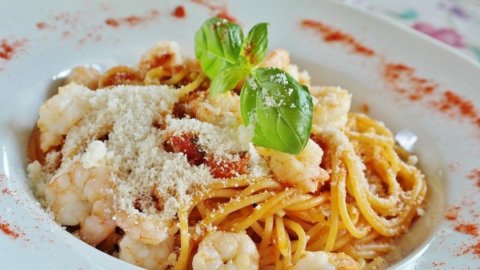
This is why Unione Italiana Food has organized the #Haveagoodpasta initiative, involving Italian pasta makers who turn to lovers of pasta par excellence to donate a plate of pasta to the less fortunate. To take part, all you have to do is post a shot of a plate of pasta with the hashtag #Haveagoodpasta on your social media channels until 25 October.
Each shared shot will be uploaded to the dedicated "Al Dente" website and will swell an online counter until 300 pasta dishes are reached, which Italian pasta makers will donate to Caritas canteens in four major Italian cities: Milan, Rome, Naples and Palermo. A way to ideally unite the Peninsula in a solidarity spaghetti dinner.
Chefs and restaurateurs have also been involved in the initiative. In 150 Italians and foreigners have joined the project, with a recipe inspired by the #haveagoodpasta theme proposed in paper and shared on social channels to involve their community.
And since we're on the subject, it's worth debunking a fake about consuming pasta in the evening because it's considered too caloric.
Dr. Martina Gozza, a Humanitas dietician, answered this question by dispelling all fears: eating pasta in the evening is not bad for our health.
First of all – emphasizes the dietician. pasta, like rice, bread and other cereals, contains a certain amount of carbohydrates which must not be missing at every meal, as they constitute our primary energy source: if absent, our body is forced to recover energy from other nutrients , such as from proteins.
There is no nutritional reason to avoid pasta in favor of other complex carbohydrates, on the contrary: being rich in durum wheat semolina, pasta has a much more favorable glycemic index than bread or rice, especially the wholemeal type.
However, there are some precautions to pay attention to: pasta is always served with a sauce, which can improve or worsen its nutritional balance. A pasta with sautéed vegetables will never have the same calories and nutritional values as a pasta rich in butter, béchamel, cream or cheese.
And it is also a false belief that pasta weighs down digestion if consumed in the evening meals: pasta - Dr. Gozza clarifies - is digested much more easily and quickly than meat or cheese and could, therefore, also promote better quality of sleep . Furthermore, it has been demonstrated by several studies that eating foods particularly rich in fat at dinner worsens rest and increases the likelihood of running into sleep apnea.