
La demography It is almost an exact science, because it works on existing data whose evolution over time can be predicted using actuarial criteria. Historically considered a subservient science to other more formal sciences such as economics, for years it has become the treadmill upon which the complex social processes of a given historical phase are driven, proceeding in a predetermined direction. Changing trends is difficult and requires a long time, assuming, for the most part, that it is possible to reverse life's cycles and choices.
We know that a progressive reduction of the resident population, which according to Istat is expected to increase from approximately 59 million on 1 January 2023 to 58,6 million in 2030 and 54,8 million in 2050. The decline in the resident population is accompanied by a constant decrease in the share of those of working age (15-64), which currently represents 63,4% of the total. At the same time, the share of over-65s in the total Italian population has reached 24,7%, accompanied by an increase in the share of over-80s (currently 7,7% of the total) in a context of a historic low in the birth rate (1,18 children per woman in 2024).
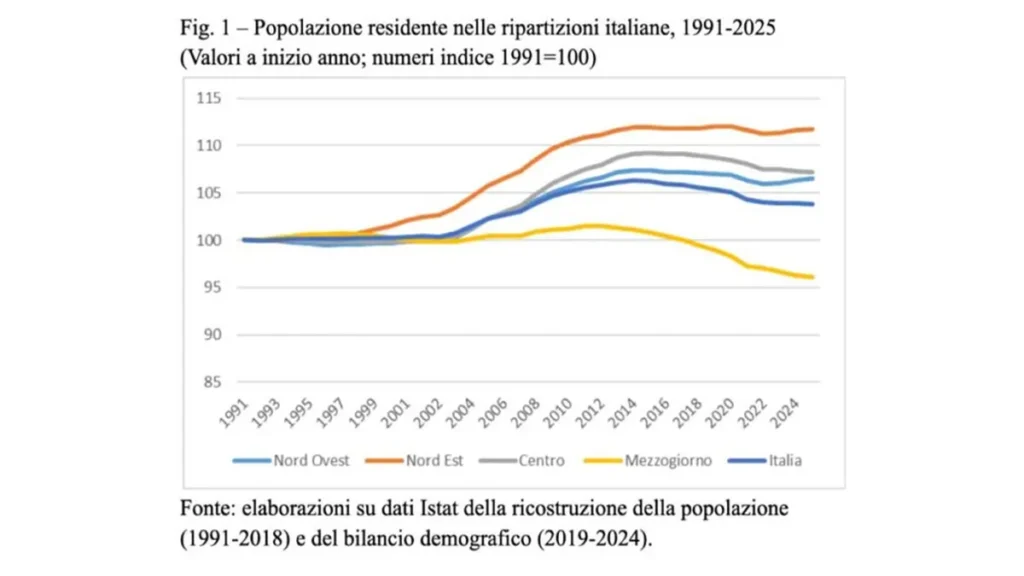
According to the OECD Employment Outlook 2025 In Italy, the working-age population aged 20-64 will decrease by approximately 34% by 2060. Compared to the OECD average, it is expected to decline by approximately 8%. The loss recorded in Italy between 2014 and 2025, according to the authoritative Neodemos, is attributable to almost three-quarters of the Southern Italy, while the Center contributed 15%, the Northwest 10%, and the Northeast only 1,4%. Demographic factors played a highly differentiated role at the territorial level, with a clear contrast between the Central-Northern regions and the South. During the 1990s, population changes were essentially of the same order of magnitude, although towards the end of the decade, the Northeast of the country began to show more sustained growth rates than the other regions.
The situation changed radically in the first quarter of the century, when, thanks to foreign immigration, the Center-North recorded much higher growth rates than the South. In the current phase of decline, substantial stability in the North-East they corresponded small drops in the North-West and in the Centre and a much more substantial decrease in the southern regions. This result is the result of internal migration that continues to be completely unbalanced, to the detriment of Southern Italy, which, in relative terms, is also less attractive to influxes from abroad. Essentially, immigration has represented a major driver of development.
In the context of the "demographic winter" that Italy is facing, in recent years the foreign component has given - according to Neodemos - a decisive contribution to stem the decline in the population: the indigenous componentIn fact, over the last five years, the population has shown negative values in both the natural balance (more deaths than births) and the net migration (more departures than arrivals). On the contrary, immigrants have shown positive values in both cases.
However, the demographic contribution of the immigrant population is also decreasingForeign births are decreasing (both in absolute terms and relative to the population), for two main reasons. On the one hand, it's due to lifestyles adapting to their country of residence, with immigrant families having more children than Italian families but fewer than they would in their homeland. Furthermore, the growing number of Italian citizens granted Italian citizenship is "reducing" (statistically speaking) the number of "foreign" parents and, consequently, the number of foreign births.
Furthermore, foreigners in Italy are progressively getting older (even if the average age is still much lower than that of Italians), so, albeit slowly, their mortality is increasing.
Having become increasingly crucial in the European political debate (and not only), the issue is addressed with ambiguity which are never fully clarified. Also because, often for instrumental reasons, two structural aspects overlap, embodied in different situations, meaning that one cannot resolve the other, but, at the same time, the other cannot be avoided. Let's try to clarify the reasoning. Europe has to deal with migratory processes from the Southern Hemisphere to the Northern Hemisphere, which involve the entire planetThis poses serious governance and reception problems that are very difficult to address and resolve, and which are giving rise to real cultural, political, economic, and social transformations in the developed countries receiving migration.
At the same time, these countries present some growing demographic deficits, due to the aging population and the worrying decline in the birth rate, jeopardizing their future both in terms of labor supply and the sustainability of welfare systems that have become an essential part of families' daily lives, ensuring their well-being and protecting their needs. So what's the point? Western societies – especially European ones – need constant flows of foreign workers to integrate, but this indispensable contribution cannot, in itself, come from those who land on our shores to escape tragedy or seek a better life. It's true that the origins of legally present migrants are often periods of clandestinity, more or less long, legitimized in recent years through amnesties.
But the substance is another: you cannot turn back the boats of the "damned of the earth" without finding an alternative (which for now is only theoretical); at the same time, it cannot be denied that there is a need for manpower, intelligence, sweat, and toil, capable of compensating for the disruptive effects of a demographic trend that is out of line with natural trends.
But the two phenomena – typical of a modernity without prospects – do not integrate. This results in a competitive advantage for populist and sovereignist forces, identitarian and all in all a little racist towards those more open to welcomingThe results of the elections have demonstrated this, not only in Italy. The demands for "openness" and solidarity end up being overwhelmed by the brutality of their opponents, who do not limit themselves to promising to resolve the problem with the simple closure of ports and borders, or with forced deportations (copyright Donald Trump) is an unsolvable problem, because it is determined and conditioned by unstoppable structural phenomena and unavoidable characteristics, as if the history of humanity were to move within a system of communicating vessels: the northern hemisphere of the planet is frozen in an implacable "demographic winter", while the southern hemisphere is largely made up of young people fleeing hunger, thirst, disease, and starvation.
As the problems become more complicated, the forces that offer it end up having an easy game. simple and quick solutions, all of which can be traced back to a fundamental position: that of initially denying, as a normal and useful process, the need for a multiethnic society or for regular and integrated immigration, which, according to their ideological prejudice, would instead deprive Italians of jobs. More recently, this extremist position has been shelved because the denial of the facts leaves no room for doubt. In this field, in fact, "fasting was more powerful than pain"; in the sense that the effects of the demographic crisis on the labor market are too evident to be considered irreversible. According to Confindustria, the need for manpower should be covered by an increase in the number of foreign workers entering the country by approximately 120 thousand units per year., if we want to prevent the lack of availability of workers (it is no longer just a question of mismatch) from limiting – the observation is disturbing – the growth of economic activity.
It is a paradoxical phenomenon: the work is there, but there is a lack of workers with the appropriate skillsBut all the considerations made thus far pale in comparison to the mother of all paradoxes. In a Europe experiencing demographic winter, a labor supply crisis, and requiring transfusions of foreign blood to prevent it from becoming a chronic den where only importers of carers plundered from increasingly distant places do business; in a Europe that, if it closes its borders, will sooner or later be forced to close its factories as well, the issue of migration has become the driving force behind the advance of "democrature" and far-right parties.
Democratic political forces are forced to act to contain this avalanche, but they must demonstrate to their public opinion that they are looking for alternative solutions to the demagogic and easy ones of the right which, when put to the test, prove impracticable, but which impress voters with their radicalism. Extremists never engage in rational analyses of the facts; they simply accuse their opponents of incompetence and even complicity, and therefore of being unable or unwilling to solve the problems they would address with determination. But they don't know how, because they too are unaware of it. Certainly, a new approach has entered the Italian debate—for now, with a logic of minority provocation. unacceptable proposal for practical reasons even before ethical ones, which has been defined as "remigration" and "reconquest", a second definition that explains the objective of the first by evoking the “expulsion of the Moors” from Spain by El Cid Campeador.
A would be established Voluntary Remigration Pact Based on an agreement between the State and the individual, it allows foreigners legally residing in Italy to receive financial assistance for their return to their country of origin in exchange for the definitive and irrevocable renunciation of all rights of residence and citizenship in Italy.
The savings resulting from the drastic cut in public spending on immigration would be entirely allocated to a fund aimed at financing voluntary remigration agreements, logistical and administrative costs and all measures connected to the remigration policyThis is ideology in its purest form and would therefore constitute a loss-making operation, because it would make no sense to invest resources in alienating workers so desperately needed by the country's productive activities. If we were to make a somewhat forced comparison on a different scale of problems, it would be like encouraging a brain drain. As the saying goes: the mother of fools is always pregnant.