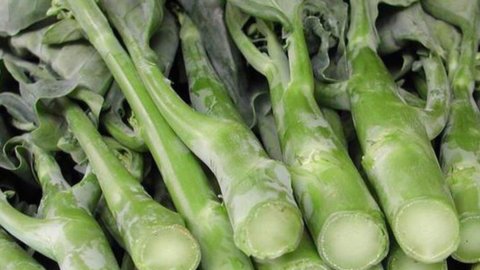
Watch the label! Even when we go to the fruit and vegetable market. There are not only industrial products to threaten our health but also harmless vegetables that we see displayed on the counters of markets or greengrocers. The alarm is raised by the EFSA Report on Pesticide Residues in Europe. Well i broccoli, for years now considered by authoritative international studies as one of the most effective anticancer weapons, hide, if coming from China, chemical residues harmful to health. In fact, 92% of the samples examined by the EFSA Report are polluted.
And other widespread components of our food preparations appear in the dock. There Coldiretti drew from it a Black List presented in Naples on the occasion of the mobilization of thousands of Italian farmers in defense of the Mediterranean diet, "Oral and intangible heritage of humanity" which in Campania was studied and attested by the American biologist and nutritionist Ancel Keys who died significantly one can say, at the venerable age of 100 years.
So here are two other very common herbs under accusation in the kitchen: the parsley originating from Vietnam was found to be irregular for 78% while basil imported from India is non-standard in as many as 6 out of 10 cases.
If the excess presence of Acetamiprid, Chlorfenapyr, Carbendazim, Flusilazole and Pyridaben has been found in the majority of Chinese broccoli, in Vietnamese parsley the problems derive from Chlorpyrifos, Profenofos, Hexaconazole, Phentoate, Flubendiamide while Indian basil contains Carbendazim which is prohibited in Italy because deemed carcinogenic.
You can not rest easy even with one of the most popular products for its antioxidant qualities of the blood, the pomegranate, whose juice is advertised in many bars as a highly healthy drink. Those coming from Egypt exceed the limits in one case out of three (33%) and 11% of strawberries and 5% of oranges also coming from Egypt are outside the norm. The Black List then continues with chilli peppers from Thailand in which 21% of irregular chemical residues were found and with peas from Kenya contaminated in one case out of ten (10%).
We then continue with the fruit coming from South America such as melons and watermelons imported from the Dominican Republic which are non-standard in 14% of cases due to the use of Spinosad and Cypermethrin.
And irregular for 15% was also the mint of Morocco, another country which has been granted concessions by the European Union for the export of oranges, clementines, strawberries, cucumbers, courgettes, garlic, olive oil and table tomatoes, strongly contested by agricultural producers precisely because in the African country the use of pesticides which are dangerous to health is permitted and are banned in Europe.
Italian agriculture - comments Coldiretti which organized the Naples event in support of the Mediterranean diet - is the greenest in Europe with 281 products with designation of origin (PDO/PGI), a ban on the use of GMOs and the more companies biological, but it is also at the top of world food safety with the lowest number of agri-food products with irregular chemical residues (0,4%), almost 4 times lower than the European average (1,4%) and almost 20 times that of non-EU products (7,5%).
"There is no more time to waste and it is finally necessary to make the commercial flows of raw materials from abroad public in order to make consumers aware of the names of companies that use foreign ingredients", underlined the president of Coldiretti Roberto Moncalvo adding that "Italian companies must be freed from the unfair competition of foreign products made in conditions of social and environmental dumping with concrete risks for the food safety of citizens".
To integrate the data from the EFSA Analysis and for informational correctness, it is also worth reporting the results of the Shopper's Guide to Pesticides in Produce drawn up by the "Environmental Working Group" which examined 45 types of fruit and vegetables among the most common on our tables to draw up a ranking of the most genuine foods and a parallel one of the least genuine as they are most contaminated by pesticides, regardless of their origin. In first place are apples, another historical must of healthy eating, followed by celery, chillies, peaches, strawberries, nectarines, grapes, spinach, lettuce, cucumbers, blueberries and potatoes.
Conversely, the classification of vegetables that boast a lower presence of pesticides he sees the onion on his head. Followed by corn, pineapple, avocado, kale, sugar snap peas, asparagus, mango, eggplant, kiwi, cantaloupe, sweet potato, grapefruit, watermelon, and mushrooms.
The Environmental Working Group however despite having noted the dangers of harmfulness to fungicides and fertilizers used in agriculture recognizes that the benefits associated with the consumption of fruit and vegetables are greater than with other food components. In short, what is required of the consumer is to make informed and careful choices, inquiring well about the countries of origin of the products being purchased.