The International Monetary Fund has revised upwards the economic growth forecasts for Italy, and it has done so in a more consistent manner than has happened for the global economy as a whole. Now on 2015, the Washington institution estimates a 0,5% increase in GDP, which will be followed by an acceleration to +1,1% in 2016. The data, published in the latest edition of the World Economic Outlook, are respectively 0,1 .0,3 and 0,7 points higher than the update made last January, but remain lower than those contained in the recent Def of the Italian government (respectively +2015% in 1,4 and +2016% in XNUMX).
According to the IMF, the improvement in the Italian economy will also be reflected in the trend of the labor market. In 2015 unemployment will decrease to 12,6%, from 12,8% in 2016, and in 2016 to 12,3%. In the meantime, our country will maintain a substantial current account surplus in foreign trade, equal to 2,6% of GDP in 2015 and 2,5% in 2016. Finally, inflation will remain weak: growth in consumer prices to zero this year and 0,8% in 2016.
GLOBAL GROWTH AND THE EUROZONE
As for global growth, the IMF left its forecast for this year unchanged at +3,5%, while it raised its forecast for 0,1 by only 2016 points, to +3,8%. On the Eurozone, on the other hand, the Fund made more substantial revisions: +1,5% for this year (0,3% more than previously forecast) and +1,6% for the next (with a change by 0,2%).
The risk of deflation – measured by the decline in prices over a four-quarter period – is of concern "primarily" for the Eurozone in the period from the third quarter of 2015 to the second quarter of 2016, but the likelihood that such a risk will check “it has fallen below 30%”.
USA
The IMF, on the other hand, cut its growth estimates for the United States for this year and for next year. According to the World Economic Outlook, US GDP will rise by 3,1% in both 2015 and 2016. The data compares with the WEO estimates updated last January, which were higher by 0,5% and 0,2 respectively, XNUMX%.
The Fund also expects the Federal Reserve to begin raising interest rates for the first time since 2006 in the "second half" of this year. This is a stark contrast to what is expected for example in the UK, where monetary normalization “is not expected before mid-2016” or in the Eurozone and Japan, where “very accommodative” monetary policy is expected to continue to be implemented.
CHINA
As regards China, in 2015 GDP is expected to increase by 6,8%, the same percentage calculated last January in the update to the WEO, but down by 0,3% compared to the October report. The figure is lower than expected by Beijing, which expects an expansion of around 7%, the lowest for 11 years. For last year, China had forecast a +7,5%, a target that was narrowly missed with a +7,4% (it was the slowest growth for 24 years). In 2016, the IMF forecasts a further slowdown with a GDP seen rising by 6,3%.
RUSSIA
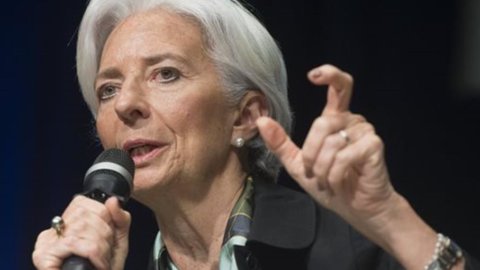
Finally, bad news for Russia. According to the institute led by Christine Lagarde, the economy in Moscow will contract this year by 3,8% after +0,6% in 2014 and +1,3% in 2013. The estimate has been worsened by 0,8 2016% compared to last January's update of the Weo. For 1,1 a -0,1% of the economy is expected, a contraction of 750% larger than that calculated at the beginning of the year. The Fund considers the measures taken by the Russian Central Bank to be "appropriate", which in response to a significant depreciation of the ruble last December raised rates by 17 basis points to XNUMX% and also adopted a more flexible exchange rate regime.