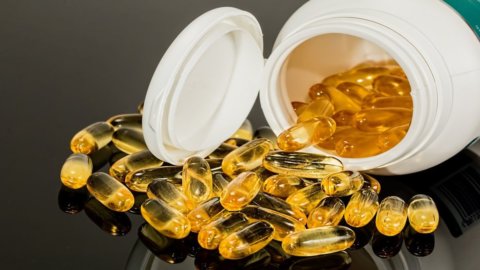
The absolute protagonists of the supplements market, thanks to one of the most widespread marketing campaigns ever conceived, with an ever-growing market that reaches tens of billions of dollars a year, Omega three have held the scene for about thirty years. Only in 2021, thanks to an authoritative revision study, what was current knowledge on the subject was somewhat reduced.
We begin by describing them for what they are and which we are sure will not change no matter what studies are done. The ω-3 acids (or PUFA 3) are a small group of polyunsaturated fatty acids composed of linolenic acid (ALA), the main one, eicosapentaenoic acid (EPA) and docosahexanoic acid (DHA).
Let us cite them from now on by their abbreviations, since this is how they are generally referred to. When we think of ω-3, we usually think of them together with another group of fatty acids, ω-6 (PUFA 6). Now, ω-3 and ω-6 are two sides of the same coin, but they are not the same thing, and therefore their function and benefit are also different.
Generally it is recommended to maintain their intake ratio at 5:1 in favor of ω-3, and since these fatty acids are defined as essential, we introduce them only with the diet, we do not have the ability to synthesize them. What are the best sources of these fats? ω-3 have both vegetable and animal origins, as they are found in some types of fish and in the oils derived from them, such as sardines, mackerel, sea bream, sea bass and above all in fish from cold seas such as salmon (and possibly not farmed, as the difference in fatty acid content is substantially different from the "wild" ones, which is decidedly better), but also in butter and eggs.
On the vegetable side we can draw ω-3 from olive oil, linseed oil, soy, peanuts and sesame. ω-6 find more presence in legumes, nuts and vegetable oils such as corn, sunflower and soy (as for ω- 3).
In the first years of research and discovery of these compounds, ALA, LA and arachidonic acid were considered and highlighted as vitamin F, so much was their usefulness and effectiveness estimated. We remain on ω-3. For about 30 years some beneficial, almost miraculous effects have been pointed out to these nutrients. Surely the effects at the vascular level are the best known, and therefore indirectly also on the heart. The benefit we can derive from it on cholesterol and triglyceride levels, on diet-resistant subjects has been studied and confirmed for decades, as well as the anti-inflammatory effect (as opposed to ω-6, which instead are pro-inflammatory).
Its use in the primary prevention of atherosclerosis, and subsequently in the secondary one, was reflected in a decrease in sudden cardiac deaths in subjects who had already suffered a stroke. Furthermore, their usefulness on the nervous system in conservation and development was appreciated.
Since we have been able to encapsulate these fatty acids, our daily life, especially after a certain age, involves taking some supplements. I remind you that supplements and drugs based on ω-3 are different, especially in composition and assimilation.
But the Umberto Veronesi foundation highlights this review conducted by Cochrane Heart Group 1, in which the function and utility of these ω-3s are redimensioned. According to this review, the knowledge we have today and the methodologies that allow us to carry out research somewhat debunk the beneficial effects we have mentioned above. Let's simplify this study with words.
Let's start from what are the confirmations we have:
– The anti-inflammatory use is also taken up in this review. This quality is therefore not questioned, it could be for quantity and how much they can really lend a hand on an inflammatory process;
– The ability to lower cholesterol, especially for cholesterol fractions. Increased HDL, decreased LDL and especially VLDL and triglycerides. The quality has been confirmed, but the effectiveness is certainly being reviewed. If until today the data told us that the fractions of cholesterol could drop up to 20-50%, today a "modest" anti-cholesterol reducing power is attributed and certainly not the one previously declared;
– The use of drugs containing ω-3 can be considered valid if supported by a nutritional plan.
– Mortality (number of deaths within a population expressed as a percentage) and morbidity (the frequency with which the disease occurs) in subjects at high cardiovascular risk is not changed.
What, on the other hand, has this study denied?
– Having a supplementation with ω-3 supplements does not bring any benefit, or almost, compared to those who do not use them. Medicines and a correct diet are the key to avoiding relapses and doing prevention;
– The positive maintenance action on the nervous system seems to have no effect in subjects of advanced age or with cognitive decline pathologies;
– In secondary prevention the risk of sudden coronary death in subjects who have already had an event is not modified by the use of ω- 3 supplements;
– The same ω-3 taken through a supplement are very different when taken through the ingestion of fish.
Everyone is free to draw their own conclusions at this point