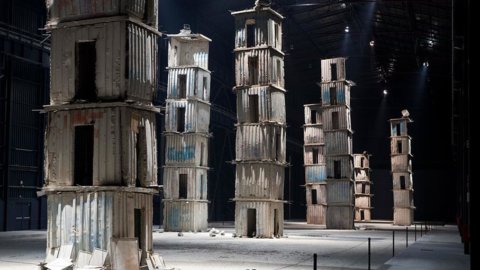
The new layout, curated by Vicente Todolí, consists of an extension of the permanent work I Sette Palazzi Celesti, which was conceived and presented for HangarBicocca in 2004 from a project by Lia Rumma. Five large-scale pictorial works, still unpublished and produced between 2009 and 2013, will form, together with the "towers" – now made accessible to the public – a single installation entitled I Sette Palazzi Celesti 2004 – 2015.
Five large canvases, among the most significant works of Kiefer's recent production, will be set up in the space of the "Navate" which houses The Seven Heavenly Palaces, enriching the permanent installation and giving a new meaning to Kiefer's masterpiece. In fact, the works recall, through the pictorial language, some themes already present in The Seven Heavenly Palaces – the great architectural constructions of the past as man's attempt to ascend to the divine; the constellations represented through astronomical numeration – and add some central reflections in the artist's poetics, such as the relationship between man and nature, references to the history of Western thought and philosophy.
The dialogue between these five paintings and the installation offers the public the possibility of enjoying a complex work of art that can be covered in its entirety where different perspectives give life to a single multiform landscape.
The works are: Jaipur, 2009; two works from the series Cette obscure clarté qui tombe des étoiles created in 2011; Alchemy, 2012; Die deutsche Heilslinie, 2012-2013.
The installation The Seven Heavenly Palaces, 2004, created by Anselm Kiefer for HangarBicocca, owes its name to the Palaces described in the ancient Kabbalistic Jewish treatise Sefer Hechalot - the Book of Palaces/Sanctuaries dating back to the 14th-18th century. AD, where the symbolic path of spiritual initiation of man towards God is narrated. The towers (Sefiroth, Melancholia, Ararat, Linee di campo magnetic, JH&WH, Torre dei Quadri Cadenti) have variable heights between XNUMX and XNUMX meters and are made of reinforced concrete using angular modules as construction elements obtained from containers for the transport of goods. Each tower is characterized by different elements and materials that refer to Kiefer's poetics: the neon writing, the piles of lead books, the ship, the film, the frames without images.
Anselm Kiefer (Born in 1945 in Donaueschingen, Germany) exhibited for the first time at the Kunstverein in Hannover in 1969. Over the years, various international institutions have dedicated personal exhibitions and retrospectives to the artist: Stedelijk Van Abbemuseum, Eindhoven, Holland (1979); Musée d'Art Contemporain, Bordeaux, ARC/Musée d'Art Moderne de la Ville de Paris, Paris (1984); The Art Institute of Chicago, Philadelphia Museum of Art, Philadelphia, MOCA, Los Angeles and MoMA, New York (1987); Neue Nationalgalerie, Berlin (1991); Museo Nacional Centro de Arte Reina Sofía, Madrid, The Metropolitan Museum of Art, New York (1998); Gallery of Modern Art, Bologna (1999); Muséè d'Art Contemporain de Montréal, Canada, The Hirshhorn Museum and Sculpture Garden, Washington DC and San Francisco Museum of Modern Art (travelling exhibition 2005-2007); Guggenheim Museum, Bilbao, Musée du Louvre, Paris (2007); Royal Academy of Arts, London (2014). He has participated in two editions of Documenta (1977; 1988) and in two editions of the Venice Biennale. In 2007 the Musée du Louvre commissioned Kiefer to create an unpublished work for its permanent collection and in the same year he created a site-specific installation at the Grand Palais in Paris on the occasion of Monumenta.
The new rearrangement of Anselm Kiefer's works will launch, as a "special project" the new programming planned for the next three years and conceived by the artistic director of HangarBicocca Vicente Todolí. The program until 2018 includes nine solo exhibitions dedicated to international artists and produced by HangarBicocca: Philippe Parreno, Petrit Halilaj, Carsten Höller, Kishio Suga, Laure Prouvost, Miroslaw Balka, Lucio Fontana, Maria Nordman, Matt Mullican.
HangarBicocca and Pirelli
HangarBicocca, the contemporary art space supported by Pirelli, is the natural continuation of a long tradition of attention to culture, research and innovation that has accompanied the company since its foundation more than 140 years ago. Thanks to Pirelli's commitment, HangarBicocca makes a program of high-level exhibitions, a series of cultural events and a series of activities for children and families accessible to the public, making HangarBicocca a flexible space and a point of reference for international visitors.