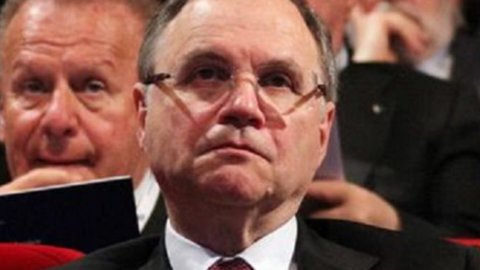
Under the guise of technical arguments, the Governor of the Bank of Italy Ignazio Visco in his Final Considerations read to the Bank's assembly, harshly criticizes the management of the economic crisis made by the Brussels authorities and the shortsightedness of various countries which has nailed the 'Europe at low growth rates for a long time. This does not mean that Visco hopes for a recovery in public deficit spending or a general return of statist dirigisme, but that we need to find a "balance between rules and discretion: not arbitrariness, but not even uncritical and short-sighted application of the rules". In short, we need to find an effective synthesis to manage the common rules in a politically responsible way in order to "accompany the evolution of the market without harnessing its strength".
Visco certainly does not give in to populist and demagogic shortcuts which lead to a rejection of the European construction and in fact push towards a resurgent nationalism (which is different from love of country) which caused so many losses to Europe during the last century. But he sees the shortcomings of a European construction stopped halfway through and indicates the ways to overcome them and proceed on the path of integration, which is the only possible perspective for the Old Continent if it wants to play a role in the globalized world.
On monetary policy, Visco spares no criticism of the Bundesbank for the fact that QE does not envisage complete risk sharing or for the dangers that some continue to fear regarding the emergence of speculative bubbles in the financial or real estate sectors. Without QE we would have faced much greater risks - says the Governor - as "the main threat to financial stability came from the prospects of stagnating production and low inflation". And again on Greece Visco called (adding some off-the-cuff considerations to the written text) both the Athens authorities to better define the necessary reforms, and the Community authorities to find a way to manage the situation which otherwise could be a source of serious tensions .
Again, on the Community economic policy Visco wanted to underline what the Commission has repeatedly hoped for, namely that countries with low debt and solid public finances could make a greater contribution to the growth of the entire continent by increasing investments. But it is on the banks that the Governor peremptorily reminds the European authorities of the need to "guarantee the solidity of the various banking companies, without reducing their overall capacity to disburse credit to the economy". And this is in fact the problem on which the criticisms of the Italian banks focus, also reported at the meeting by Gros-Pietro, president of Intesa SanPaolo who spoke on behalf of all the shareholders.
As far as the Italian situation is concerned, Visco was very clear: the government's work is well underway, and it would be sheer madness to interrupt it or even just to weaken it due to political quarrels within the party system. The Governor 's words are eloquent . “To remove the obstacles to the country's development – he said – an internationally recognized reform action has been launched by institutions and markets; in order not to disappoint the expectations of change, it is necessary to broaden its spectrum and accelerate its implementation”. In other words, Italy is doing the right things and we are starting to see some results. Even the pension reform, much criticized today, is defended as the pillar that allowed our country to emerge from the dramatic emergency in which it found itself. Schools are also doing well, where change cannot be separated from a systematic and in-depth evaluation of the services offered and the knowledge acquired.
A large part of the Governor's report is dedicated to the banks with very technical and also critical considerations - as we have said - of the work of the European authorities. The new law on popular banks is good for Italy and above all it will be necessary to proceed quickly with the creation of a bad bank to put the banks in a position to resume lending. The meaning is that the time has now come to proceed with interventions, including public finance interventions, on Italian banks which, moreover, have been disadvantaged compared to those of other European countries which have been able to benefit from massive injections of public money. And this with all due respect to the Grillini and other populists who accuse our banks (which certainly have some critical issues) of non-existent faults.
Ultimately Visco told the Italians that the worst is behind us. Consumption is restarting, as are investments. Exports are doing well, testifying to the rediscovered competitiveness of some of our companies. Much can and still needs to be done. But this is certainly not the time to go back to the old Italian vices of easy spending and predatory corporations.
Attachments: Visco: "There is recovery, but reforms need to be speeded up"