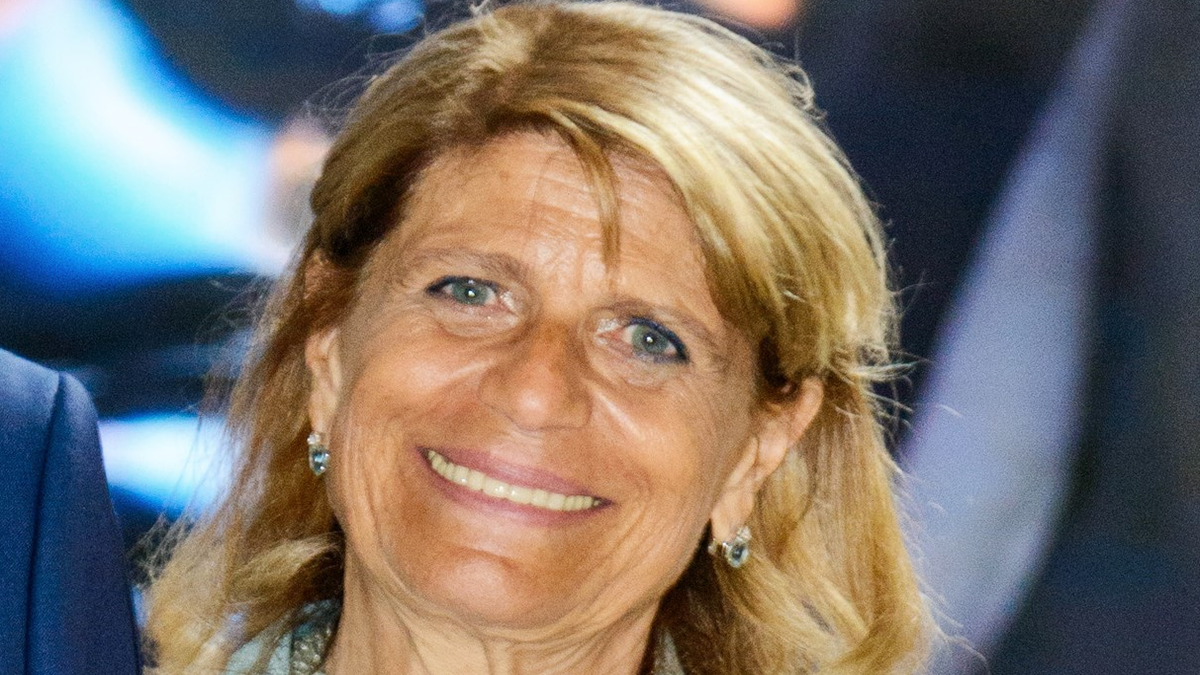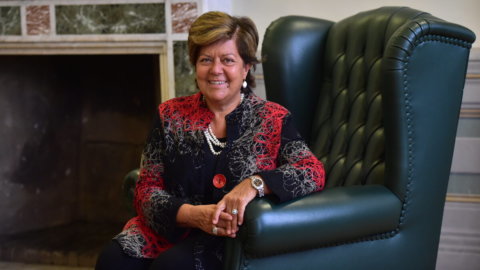
Margaret Cassano currently deputy chairman of the court of cassation, will be the first woman in Italian history to lead the Supreme court.
The appointment of the judge to the role of president it was proposed on Tuesday unanimously by the Commission for managerial positions of the Superior Council of the judiciary. There ratify by the plenum (the complete body) will arrive on March 1, in a session chaired by the head of state, Sergio Mattarella. Cassano will succeed Pietro Curzio, appointed in 2020, who is about to retire.
Who is Margherita Cassano
Florentine of Lucan origin, Cassano è in the judiciary since 1980 and she is a daughter of art: her father, Pietro, was also a high magistrate, engaged in the fight against red and black terrorism in Florence. Cassano started in Public Prosecutor's Office in Florence, where he was also part of the District Directorate Anti-mafiaand then move in Cassation in 2003, after a mandate from lay councilor at the Csm with the conservative current of independent Judiciary. Before the vote, the fifth commission heard the two candidates, in addition to Cassano, also Giorgio Fidelbo, also wearing the Cassation robe, defined by his own colleagues as a "jurist of the highest level", president of the sixth criminal section from which the most important verdicts especially in terms of legal orientation on the interpretation of the laws, which however did not obtain votes. Apart from already being additional president, Cassano prevailed thanks to his recent experience as president of the Court of Appeal Florence.
50 years after the law that allowed women access to the judiciary (Law 66/1963), the path of women towards a full equality in the world of work and now women represent more than half of Italian judges. In 2013 the place that is now assigned to Cassano escaped Gabriella Luccioli, protagonist of the sentence on Eluana Englaro. And ten years have passed since then with all-male presidencies. Including the latest, that of the jurist Pietro Curzio ready to retire.
Why the appointment of Margherita Cassano is important
Being the first woman, in the history of Italy, to lead the highest court of our judicial body is an important step. Women were able to enter the judiciary in the 60s and only after sixty years was a woman recognized as capable of reaching the apex of the priamid. In the meantime, about half of the magistrates are women and it can rightly be said that Cassano, who has already been deputy president for two years, has managed to conquer the most masculine of the pyramids. Before her, Marta Cartabia became president of the Constitutional Court for an interim period, before becoming Minister of Justice with the Draghi government. Cartabia's appointment set the standard and today the Consulta is chaired by Silvana Sciarra.
“The day will come when an appointment like mine will no longer be news, and then yes, for real, that will be a great day for all women,” Cassano declared on the occasion of his appointment as deputy president.
What does the Supreme Court do?
In Italy the Supreme Court of Cassation is at the top of the ordinary jurisdiction; among the main functions that are attributed to it by the fundamental law on the judicial system of 30 January 1941 n. 12 (art. 65) there is that of ensuring “the exact observance and uniform interpretation of the law, the unity of national objective law, respect for the limits of the various jurisdictions”. One of the fundamental characteristics of its mission, aimed at ensuring certainty in the interpretation of the law (in addition to issuing third degree sentences) is constituted by the fact that, in principle, the provisions in force do not allow the Court of Cassation to know of the facts of a case except when they result from the documents already acquired in the proceedings in the phases preceding the trial and only to the extent that it is necessary to know them in order to evaluate the remedies that the law allows to be used to motivate an appeal to the Court itself".
Supreme Court of Cassation, its functions
The Court of Cassation is the last of the three levels of judgment of our legal system. If he repents of a defect in the previous levels, he "rejects" (rejects) the contested sentence and indicates to the judges of the lower level the principles he will have to comply with when he will re-examine the quashed case.