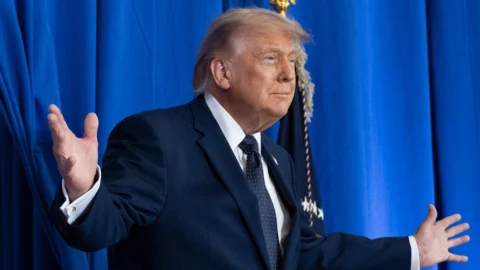
In his speech at the foot of Mount Rushmore on July 3, opening the official celebrations for the 250th anniversary of the signing of the Declaration of Independence, President Donald Trump he stated that, at the moment, “the communism is a mortal threat to American freedom", greater of those represented in the past by the two world wars and the attacks of the11 September 2001The next day, however, in another speech on the National Mall in Washington, the tycoon also wanted to reassure Americans that, under his presidency, “America will never be a communist nation.”
Thirty-seven years have passed since the fall of the Berlin Wall and 35 since the implosion of the Soviet Union, while even the People's Republic of China, while maintaining a one-party political regime, has long since adopted a de facto capitalist economy. The few residual experiences of communism are confined to narrow marginal realities, like Cuba and North Korea. It would seem, therefore, impossible that the specter of communism, evoked by Karl Marx and Friedrich Engels with regard to Europe in the incipit of the celebrated Communist Manifesto published way back in 1848, continues to haunt even across the Atlantic, in the nation that more than any other is identified with capitalism.
However, the Trumpian rhetoric she succeeded in the arduous task of resurrect communism from the graveyard of discredited and essentially devoid of following ideologies, bringing it back from that "dustbin of history" into which Republican President Ronald Reagan had intended to sink it (to quote his famous speech to the British Parliament in 1982). In the half-hour speech at Mount Rushmore alone, The Donald mentioned communism a full fourteen times.
The Donald's Anti-Communism's Background
This is not the first time that Trump has lashed out against the communism, a term that – in vocabulary of internal politics of the tycoon – it is to be considered above all a synonymous with “anti-American” and “traitor to the country”.
Le charges of communism targeted, for example, the former Democratic president Joe Biden and her vice president, who is also a candidate for the White House in 2024, Kamala Harris. During the election campaign that year, The Donald nicknamed his challenger “comrade Kamala” after his opponent had pledged to take measures to curb the rising cost of foodstuffsTrump predicted food rationing, widespread malnutrition, and even the emergence of a black market in consumer products, similar to the dark ages of communist Russia, if Harris succeeded Biden in the Oval Office.
On the eve of the opening of the 2024 Democratic National Convention, The Donald went so far as to post on X (formerly Twitter) an AI-generated image of a woman from behind, resembling Harris, facing a crowd gathered under a giant red flag with the hammer and sickle, the emblem of the dissolved Soviet Union. In the background, the word Chicago, the host city of the convention, was also written in red letters. Furthermore, last year Trump established the “anti-communism week”, making it fall between November 2nd and 8th, so as to include the 7th of the month, the anniversary of the Bolshevik Revolution of 1917 according to the Gregorian calendar adopted in the West.
Anti-communism as a demagogic tool of political struggle
After the precedent of 2024, Trump is once again playing the anti-communism card looking for votes to avert a probable defeat of the Republican Party in the elections midterm elections on November 3rd. After all, the instrumentalization of communism for electoral purposes is a topos in the political history of the United States. Between 1919 and 1920, the Attorney General of the United States (the equivalent of the Attorney General of a European country) A. Mitchell Palmer He ordered arrests and roundups of radical immigrants who had not naturalized as American citizens to prevent the United States from being destabilized by a Bolshevik-style revolution, inspired by the one that had allowed Lenin to seize power in Russia in 1917. Palmer's initiative was actually a pretext to fuel his ambitions to be elected president in 1920.
Foreign communists—such as the Italian Louis C. Fraina, alias Lewis Corey, originally from Galdo degli Alburni, in the province of Salerno—were, however, few in number. It's no coincidence that those who were loaded onto what Palmer grandiosely called the "Bolshevik ark" on December 21, 1919, for deportation to Russia were primarily socialists and anarchists like Alexander Berkman and Emma Goldman. Furthermore, contrary to the Attorney General's predictions, on the previous November 7th, the second anniversary of the Bolshevik Revolution, there had been no attempted communist insurrection in the United States. Palmer's demagogy became so evident that his own party, the Democratic Party, refused to nominate him for the White House.
Similar maneuvers of manipulation of anti-communism characterized the electoral campaign of 1936. The reactionary circles accused the democrat Franklin D. Roosevelt that he was a crypto-communist, in a vain attempt to prevent his confirmation as president. Two weeks before the election, publicist Elizabeth Dilling published a collection of out-of-context Roosevelt quotes (The Roosevelt Red Record and Its Background) with the unrealistic aim of using excerpts from the president's public speeches to demonstrate that the White House occupant was a supporter of communism and favor the victory of Republican Alfred Landon, who instead lost by a landslide.
On the other hand, in 1946 the Republican Richard M. Nixon He snatched one of California's seats in the House of Representatives in Washington from five-term Democrat Jerry Voohris, claiming his opponent was a dangerous communist. Four years later, Nixon used the same ploy to defeat Helen Gahagan Douglas, a former Broadway star and incumbent congresswoman, in the Senate election. On that occasion, Nixon nicknamed Douglas "the pink lady," a color intended to reflect the fact that his opponent was a woman and his hypothetical, slightly toned-down communist leanings.
In 1952, the Republican Party managed to conquer the White House with Dwight D. Eisenhower, capitalizing on the accusations launched since 1950 by one of its members, Senator Joseph R. McCarthy of Wisconsin, against the outgoing Democratic President, Harry S. Truman. According to McCarthy, who shared the advice of lawyer Roy Cohn with Trump, Truman's alleged fault was his failure to prevent the infiltration of the federal administration by over two hundred Communist Party members and Moscow sympathizers, whose names he never disclosed. However, after the senator began targeting the new president as well, Eisenhower By making the same accusations against him, the Republican Party realized that such insinuations were becoming counterproductive. In 1954, the Senate passed a motion of censure of McCarthy's actions and put an end to the so-called McCarthyism, that phenomenon of a real "witch hunt" that had influenced the internal political debate in the United States in the previous four years, spreading an inquisitorial spirit based on conjectures devoid of any supporting evidence.
The Specter of Communism to Undermine Progressive Initiatives
Anti-communism has been used not only to smear opponents but also to delegitimize progressive policies. For example, the equation of New Deal, the federal government's program of economic intervention to lift the United States out of the depression of the 1930s, associated Republican Senator Thomas D. Schall of Minnesota with communism and the reactionary newspaper magnate William Randolph Hearst (the figure on whom the protagonist of Orson Welles' 1941 film Citizen Kane is modeled).
I promoters of workers' rights They were accused of communism from the beginning of the Cold War to such an extent that a 1947 law, the Taft-Hartley Act, required union leaders to swear an oath of non-membership of the Communist Party. Even today, conservative commentators such as Douglas V. Gibbs maintain that increase the minimum wage at $15 an hour is a communist measure. Even the supporters of racial integration they were slandered as sympathizers of the Soviet Union.
According to J. Edgar Hoover, the infamous director of the Federal Bureau of Investigation, the main African-American leader of the civil rights movement in the 1960s, Martin Luther King Jr., he would have even been an undercover Moscow agent that he would have fought against legal discrimination against blacks only to embarrass the Washington government in the eyes of world public opinion.
In a longer-term perspective, the project of Health cover Universal health care for Americans, supported by Truman in 1945 and reiterated by the president in 1949, was stigmatized by the American Medical Association, the main professional association of doctors, as a form of creeping communism in order to undermine it. The same accusation helped derail the Democratic Party's health care reform. Bill Clinton in 1993, but was unable to prevent the passage of the Affordable Care Act of 2010, the law wanted by another Democrat, Barack Obama, to significantly expand the number of Americans covered by some form of health insurance.
Even the theorists of man's responsibilities in climate change They are sometimes accused of communism because their proposals for containing global warming are seen as threats to the market economy and free competition.
The Historical Irrelevance of Communism in the United States
Yet communism it never was specifically rooted in the United States. Two communist-oriented formations arose in 1919: the Communist Party of America, formed by radicals expelled for extremism from the Socialist Party of America, and the Communist Labor Party, Made up of former socialists who abandoned their party after being defeated at that year's national convention. These two groups merged under pressure from Moscow in late 1921, forming the Workers Party of America, the legal expression of a structure that had immediately gone underground to escape the final throes of arrests and raids initiated by Palmer. After the underground apparatus was dissolved, the Workers Party of America took the name Communist Party USA in 1929. Until then, communism was seen as an ideology and socioeconomic model alien to American political tradition.
Only after the stock market crash of October 1929 and at the onset of a decade of depression, with capitalism that seemed on the verge of sinking into an abyss, communism acquired some consensus, thanks to the determination to organize unemployed and evicted to enable them to better express their demands as well as their commitment against the racial segregation. At the time, its general secretary, Earl Browder, argued that communists were the last heirs to the ideals of the 1776 American Revolution, which Presidents Thomas Jefferson, Andrew Jackson, and Abraham Lincoln had tried to keep alive, but from which the Republican and Democratic parties had gradually distanced themselves. Communism, however, remained predominantly a movement of opinion.
In thirties The party never surpassed 100.000 members, and in the presidential elections of 1932, 1936, and 1940, its candidate for the White House received just 0,26%, 0,17%, and 0,10% of the popular vote, respectively. In homage to the alliance between the United States and the Soviet Union during World War II, and to avoid suspicion that the Communists were subversive toward the main government aligned with Moscow against Nazism, Browder dissolved the party in May 1944 and transformed it into the Communist Political Association.
With the looming of the cold war Even before the end of the Second World War, the Communist Party USA was reconstituted in July 1945, but was unable to make a political impact. In the 1948 presidential election, it was unable to nominate its own candidate and supported the Progressive Party's candidate, Henry A. Wallace, Roosevelt's running mate during his third term (1941–1945). It barely survived McCarthyism, even being hit by a 1954 measure that outlawed it, although ambiguous legal language and a 1961 Supreme Court ruling effectively interfered with the measure's implementation. It then suffered a hemorrhage of its few thousand remaining activists as a result of its stance against Mikhail Gorbachev's structural reforms of the Soviet economy, before suffering a further decline in membership following the dissolution of the USSR. The Communist Party USA still exists, but for years it has almost never presented its own candidates in elections and, especially during the White House elections, tends to support those of the Democratic Party, a trend that has consolidated following Trump's entry into politics.
Social Democrats are not communists, but they scare Trump
It is estimated (the party does not provide official data) that the members of the Communist Party USA are wandering around today 15.000 members, with an increase of several thousand during the years of Trumpism. Therefore, given the fact that the total population of the United States is about to reach the 350 million inhabitants, As in the past, there is no communist threat in today's United States either.
What Trump fears, rather, is a growth in the following of Democratic Socialists of America, a development he intends to prevent by labeling them as communists. The Social Democrats are a political group that arose in 1982 in response to Reaganite conservatism on the initiative of political scientist Michael Harrington who, since the early 1960s, had denounced the growing economic and social inequalities in the United States after the 1960 census data revealed that one fifth of Americans were forced to survive on an income below the poverty line (The Other America. Poverty in the United States, New York, Macmillan, 1962).
Unlike the Communists, the Democratic Socialists of America do not advocate state ownership of the means of production, but rather government interventions federal and local governments to reduce inequalities, also through equalising taxation, to strengthen the welfare state especially in the field ofhealth care, to ensure the free nature of the public transport, to enhance thepublic housing, to calm the rents and to place on the market foodstuffs at a controlled price. They also intend to facilitate the transition to renewable energy and ensure thefree public education from nursery schools to university education, canceling previous debts incurred by students for enrollment in colleges and universities. They did not establish a party, but they tend to act in theinside the democratic one, especially when choosing candidates in the primary elections, to shift it towards more progressive positions and less aligned with the interests of large corporate and financial groups.
Among the Social Democrats, one can identify with Senator Bernie Sanders, elected in Vermont on the Democratic Party ticket and already a candidate for the nomination for the White House defeated by Hillary Clinton in 2016 and by Biden in 2020, as well as the congresswoman of Puerto Rican descent Alexandria Ocasio-Cortez, who has been sitting in the House for the 14th district of New York State since 2019, and her colleague Rashida Tlaib, Muslim and daughter of Palestinian immigrants, who has represented the 12th district of Michigan since the same year.
The growth of the electoral influence of the Social Democrats
Although i social democrats have represented for decades a largely minority component within the Democratic Party, have suddenly leapt to the political limelight, not so much for the surprise election of Ocasio-Cortez, who against all odds snatched the Democratic nomination from Joe Crowley in the 2018 primaries, who had been in Congress for twenty years, but for the victory of Zohran Mamdani in the race for the office of Mayor of New York City last year, when he defeated moderate and seemingly much more authoritative Democratic candidates such as former Governor Andrew Cuomo.
The increase in the cost of living – due to the rise in inflation, which last May reached 4,25% on an annual basis, the highest level since April 2023 – has made the Social Democrats' proposals particularly attractive to a growing number of voters. According to a poll by Fox News Last March, the percentage of Americans who would like the nation to move away from capitalism and toward socialist policies was 38%, an increase of six points from 32% in 2022 and a full 20 points from 18% in 2010. An initial result was seen in the Democratic primaries of recent months, in which 36 candidates supported by the Democratic Socialists of America emerged victorious.
The victories of two thirty-year-olds in the consultations for the nomination to the House: Melat Kiros, an Ethiopian immigrant and doctoral student at the University of Colorado, defeated Diana DeGette, incumbent since 1993, in Colorado's 1st District; Darializa Avila Chevalier, the daughter of immigrants from the Dominican Republic and a doctoral student at the City University of New York, prevailed over Adriano Espaillat, the leader of the Hispanic Democratic caucus, in the 13th district of New York State. These are the types of candidates capable of to increase votes for the Democratic Party – particularly among young people, recent immigrants, and the female electorate – and consequently cause the loss of the Republican majority, especially in the lower house of Congress.
Beyond Congress
The Social Democrats, however, are not only running for the Chamber of Deputies and the Senate. For example, Janeese Lewis George won the Democratic nomination for the office of Mayor of Washington. Francesca Hong is running on the same party's ticket to succeed the moderate Tony Evers as Governor of Wisconsin.
Thanks to a program based on worker protections and free childcare and public education, the following that Hong has gathered to become the Democratic candidate is proof that, the Republican Party's involution towards reactionary positions since Trump entered politics, is not corresponding to the search for the moderate vote (as happened with the candidacies of Biden in 2020 and Kamala Harris in 2024) but the emergence of a specular progressive orientation within the ranks of the Democrats.
It is precisely this last outcome that Trump would like to nip it in the budThe tycoon is raising the spectre of a communist movement, which in reality does not exist, in the United States, to bring reactionary voters to the polls, frighten moderates into supporting Republican candidates, and prevent the Democratic Party from winning a majority in Congress and control of state and local governments on November 3.
...
Stefano Luconi He teaches US History in the Department of Historical, Geographical and Ancient Sciences at the University of Padua. His publications include The “Indispensable Nation.” A History of the United States from the Colonies to Trump's Second Presidency (2026), US Institutions from the Drafting of the Constitution to Biden, 1787–2022 (2022), The Black Soul of the United States. African Americans and the Difficult Path to Equality, 1619–2023 (2023). The Race for the White House 2024. The Election of the President of the United States from the Primaries to Beyond the Vote of November 5 (2024).