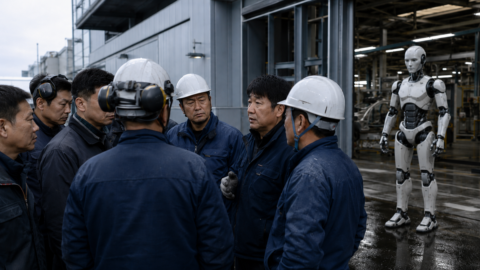
One of the first greats AI-era strikes have begun in South Korea. The Hyundai Motor workers have crossed their arms Monday, July 13th for a three-day partial protest, following the failure of negotiations on the contract renewal. But this time the confrontation is not just about wages, bonuses, and pensions: the factory also enters humanoid robot theme.
At the heart of the dispute is Atlas, the robot developed by Boston Dynamics, of which the South Korean group is the main shareholder, intended to debut in Hyundai factories in the United States by 2028. For unions, the point is not to stop innovation, but to prevent it from being imposed without protections. Workers are demanding that the introduction of robots and artificial intelligence systems be preceded by a formal negotiation and accompanied by precise guarantees regarding employment, income, and working conditions. The protest thus becomes a test case for who should govern the timing, methods, and social consequences of automation.
The tensions are also reflected on the stock market. Hyundai Motor shares fall around 3%, with shares falling to 441.000 won and a decline of 16.500 won.
Hyundai strike: production reduced until July 15
La The mobilization will continue until Wednesday, July 15thDay and night shift workers will stop production for two hours each, resulting in a total of four hours of downtime per day. Some workers are also taking part in the protest. sales employees, maintenance, and the Namyang R&D center. Negotiations between the union and the company began in May, but the fifth meeting, which concluded on July 8, failed to produce an agreement.
Over 86% of the union members, which represents approximately 40.000 employees, had voted in favor of the strikeAt the end of the three days of mobilization, worker representatives will have to decide whether to continue with new initiatives.
A new protest has arrived in the Asian country after a dispute which in the previous months had Samsung Electronics involved, where the strike had been suspended following a preliminary agreement on wages and bonuses. Now the confrontation has moved to the automotive sector and takes on a broader significance, because it directly puts the effects of AI on industrial work are being discussed.
Bonuses, wages and pensions at the centre of the negotiations
The main economic issue concerns the result awardThe union is demanding that it be calculated based on 30% of the previous year's consolidated net profit. Workers are also demanding a base pay increase of 149.600 won per month, an increase in regular bonuses from 750% to 800% of monthly salary, an extension of the retirement age, and the reinstatement of some laid-off employees.
Hyundai had proposed a wage increase of 89.000 won, a one-time bonus equal to 350% of the monthly salary, an additional 10 million won, and the award of 15 shares in the group. The union rejected the offer, considering it insufficient.
The claims were further strengthened by huge bonuses awarded by major South Korean semiconductor groups such as Samsung Electronics and SK Hynix, boosted by profit growth linked to the boom in artificial intelligence.
The Atlas case opens the employment front
Hyundai plans to use the first Atlas robots in the US plant in Georgia starting in 2028. In an initial phase, humanoids will be used in the preparation and sequencing of components intended for production. By 2030 their use could extend to assembly activitiesEventually, robots could also perform more complex tasks, including those requiring heavy lifting or repetitive movements. The group claims that Atlas will be able to reduce risks and physical strain on workers. Hyundai also assured that workers will continue to be needed to train, monitor, and maintain the machines.
The union fears, however, that automation could reduce staffing or the hours worked, with direct consequences on wages. For this reason, it calls for prior negotiation and formal guarantees before introducing robots into factories.
More than a real "strike against robots", the Hyundai protest is therefore one of the first major conflicts over how artificial intelligence will enter industrial workEmployees don't necessarily contest the innovation, but they demand the right to negotiate its timing, methods, and employment consequences, before the cost of the transformation falls entirely on workers.
How much could the strike cost Hyundai?
The protest risks having heavy effects on productionAccording to estimates reported in the South Korean press, each hour of the strike could cause losses exceeding 18,7 billion won, equivalent to approximately 10,9 million euros. A previous 16-hour strike reduced production by approximately 7.000 vehicles, resulting in lost revenues exceeding 300 billion won, approximately 175 million euros. For the ongoing strike, overall losses of close to 200 billion won have been estimated. The potential impact is amplified by South Korea's importance in the group's production network. Nearly half of Hyundai's global sales depend on domestic plants, and each year, more than a million cars produced in the country are exported.
Domestic production manager Choi Yeong-il expressed "deep regret" over the protest, saying the line shutdown comes at a time when Hyundai is banking on new models in the second half of the year to improve its financial results. The company also excluding new concessions and has made it clear that it does not intend to compensate for the hours lost during the strike. The discussion therefore remains open and could set a precedent for the entire global automotive industry.