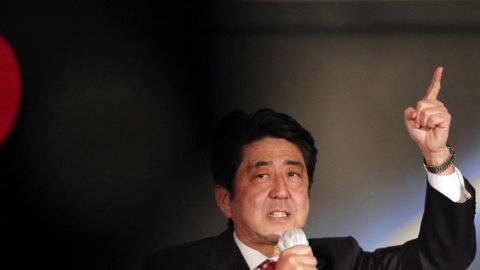
The speech by Japanese Prime Minister Shinzo Abe was not at all appreciated by the Tokyo Stock Exchange, who today announced his plan for a medium-long term sustainable recovery of the Japanese economy, based on liberalization and incentives, setting a growth objective Annual real GDP of 2% per year for the next decade and 3% of the nominal one.
The Nikkei responded to the third phase of Abenomics (after the ultra-expansionary monetary policy launched on April 4 and the fiscal stimulus approved in February) with a loss of 3,83%. Nonetheless, here are the main points of the reform program announced today, which has as its general objective an average growth of real gross domestic product of 2% and nominal gross domestic product of 3% over the next decade, compared to real growth of 0,89 .0,46% and the contraction of 10% of the nominal GDP recorded in the last decade. Over the next 3 years, the annual per capita GDP will have to grow by at least 1,5%, with an increase in the average per capita income of at least 3,8 million yen (today it is about XNUMX million yen).
The main measures to achieve this economic recovery are:
1) Increase the percentage of Japan's foreign trade that falls under Free Trade Agreements to 2018 percent from the current 70 percent by 19. Tokyo also hopes to play an important role in defining new liberalizing rules for international trade. The government has recently begun FTA negotiations with the European Union and will soon join negotiations for a Trans-Pacific Partnership (with the United States and some Asian and Latin American countries), while it will seek similar pacts with China and Korea of the South.
2) Proposed cuts to the corporate tax, particularly in relation to capital investments and R&D expenses
3) Establishment of special economic zones where deregulation will be more intense, also in order to increase foreign direct investment to 35 trillion yen by 2020 from the current stock of 17.800 trillion yen
4) Facilitation of M&A activity (mergers and acquisitions) through tax benefits and labor mobility facilitations in sectors where the number of companies appears excessive, undermining their profitability and international competitiveness.
5) Reform of the agricultural sector with the promotion of the entry of new businesses, the export of food products made in Japan and the consolidation of small businesses in larger lots: the goal is an increase in businesses (not households) operating in the agricultural sector to at least 50 by 2020, four times the current number.
6) Reform of the utility sector: separation of distribution from generation, full liberalization of the retail electricity market, increase of 50% in 10 years of capital expenditure of utilities to 30 trillion yen.
7) Promotion of a recovery of nuclear energy with the declared aim of reducing electricity costs for businesses and households (after the Fukushima accident, currently only 2 out of 50 reactors are functioning in the country).
8) Promotion of women's work and professional growth of women, mainly through measures to support a balance between family life and occupational commitments.
9) Encouraging the movement of workers from mature sectors to growing sectors.
10) Relaxation of building regulations in urban centres.
11) Partial liberalizations in the medical and pharmaceutical sector. Admission of online sales of over-the-counter drugs.