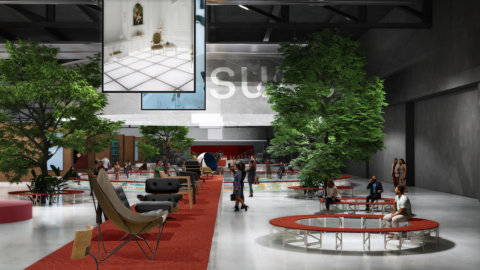
Investing in sustainability pays off and it was finally certified today, with statistical details, by a research by Intesa Sanpaolo presented on the occasion of the meeting "Sustainability and circularity in the home system” at the Arena of the Design with Nature space” of Furniture expo of Milan of which the bank is an institutional partner.
Home system: higher turnover and profitability for those who have invested in sustainability
Intesa Sanpaolo's research, presented by Stefania Trenti, offered the starting point for a very interesting debate introduced by Daniele Pastore, general manager of Intesa Sanpaolo Casa, followed by a greeting from the starchitect, designer of the Design with Nature space, Mario Cucinella, and in which the head of Sales&Marketing Enterprises of the bank, Anna Roscio, also took part. The numbers, as Stefania Trenti, Head of Industry Research at Intesa Sanpaolo reported in her report, confirm that investing in the environment is not an expense, but a real accumulation of skills, savings, human resources and wealth.
“For the Home System our ceiling is 1,5 billion euro, out of 88 billion provided for in the 2022-2025 Business Plan to promote the ecological transition, the green and circular economy. According to our research, the furniture companies most sensitive to the issue of sustainability, identified by the attainment of environmental certifications, in the period 2008-19 have created jobs and achieved better results compared to those without certifications, both for growth in turnover (+20,7% on the median vs -6,9%) and for profitability (in the same period EBIDTA margin +0,6% vs -0,7% for the others" .
The green transition: it's an emergency for the Italian housing system
A pressing series of particularly valuable data to be considered authentic sustainability guide, since the advantages and problems regarding the virtuous path of furniture manufacturing and its supply chain have been highlighted.
A positive portrait but which contains decidedly “pressing” advice because – was the common emphasis – invest in green and digital transformation of companies in the wood sector has become an emergency. A necessity for the survival of Made in Italy, an urgency to export. In fact, there are more and more requests for certifications and detailed documentation of eco-sustainability with ever lower CO2 emissions on every continent.
This is a real urgency because the housing sector "stocks up", so to speak, with cost increases and delays in supplying the entire supply chain which, unfortunately, will be felt for some time to come with further price rebounds.
What are the strategic levers to adopt? More research and development, more green and digital technologies (here the home system is further behind than the others) and more investments in human capital and in the well-being of the working environment and the home.
Where does the industry have big advances? In saving on raw materials and on the recovery of waste and processing products. But compared to foreign competitors the Italian sector has an extraordinarily useful competitive barrier when, in the face of the messy reshoring that is disrupting other manufacturers, it makes use - because it has maintained it - of the short supply chain of the districts, of skills, patents and creativity of these precious chains which constitute the made in Italy of living and living, unique in the world.
The sustainability champions of the home system: companies and entrepreneurs
Andrea Tagliabue, vice president of Tabu, which supplies wood to furniture makers, confirmed it by declaring that having invested years and years in this direction has led the company to a position of great advantage. Gianni Caimi, CEO of Caimi Spa, he declared that for several decades the company has chosen to engage in the production of furnishing components dedicated to people's well-being, a long and successful tradition of which Caimi has declared himself very proud and aware. And that has led to several patents in the soundproofing of any piece of furniture or object leaving the factory: everything captures noise, even the lamps, in the name of a quality of life that increasingly requires a pleasant environment to "inhabit".
One of the companies which is considered an extraordinary example worldwide is Padua LAGO Spa which, according to what Antonio Lago revealed during the debate following the research, managed to create a stand at the Salone almost with Zero Co2 emissions. “From the 7 trucks that were needed to create the traditional stand of the other trade shows, we went down to Zero, with Zero waste. If this path were also followed by other furniture makers, it would result – commented Lago – in a reduction of CO2 equal to that emitted by 240 medium-sized families”. Lago was explicit: here we have to change everything, we have to do it together, not each company on its own. To get out of the environmental and general crisis we must be and operate as a community".
The same very strong motivation drove Tiziana Monterisi, CEO and Co-founder of Rice House, to create his “ecological native” company. A revolution in the home since it is based on the use only of rice processing waste to make all the products needed to make a building, excluding, for the moment, the structure. Everything but absolutely everything with nature. “This is our way and we are not willing to compromise on total eco-sustainability”.
It is these entrepreneurs, these SMEs that often export 50 to 90 percent of manufacturing, that Intesa Sanpaolo has been actively supporting for years. And with a series of additional resources aimed at reducing the environmental impact of companies and developing their activities abroad. The initiative pertains to the wider collaboration with the FederlegnoArredo system and with the Salone del Mobile in Milan and is part of Motor Italy, the strategic program of Intesa Sanpaolo launched in 2021 to support SMEs with new credit and liquidity.
Foreign visitors return to the Salone del Mobile
As for the Salone, the numbers that arrive from the digital entries of the entries register more foreigners than expected initially by the organizers and companies. A return that confirms ithe world record of the house and building system of Italy. With negative notes, however, as they had anticipated on FIRSTonline for exports to Eastern European countries due to the sanctions against Russia and Belarus. The NATO-Russia conflict it will produce heavy effects for the wood supply chain also in the following months.