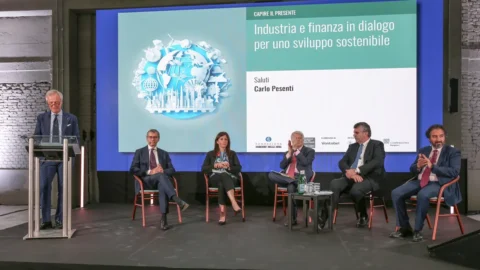
What strategies can promote a sustainable energy transition in our industries? What is the role of collaboration between industry and finance for a sustainable future? How can we ensure a fair and prosperous future for future generations? These are some questions to which the event “Industry and finance in dialogue for sustainable development”, organized by Pesenti Foundation and Corriere della Sera FoundationIn partnership with Vontobel, and with the patronage of Bergamo Chamber of Commerce e Confindustria Bergamo. The meeting highlighted the need for a combination between industry and sustainability to guarantee a greener and more sustainable future.
The event took place at the Gres Art 671 cultural center in Bergamo, a new art and culture center born thanks to the initiative of Italmobiliare and the Pesenti Ets Foundation. This space, an old industrial area now reactivated, represents a symbol of sustainable transformation, restoring utility and historical memory to the community.
The conference was opened by Carlo Pesenti, president of the Pesenti Ets Foundation, and Christel Rendu de Lint, co-CEO of Vontobel. Pesenti underlined how urgent and indispensable collective action is to achieve the objectives of the 2030 agenda. He insisted on the fact that industry and finance must take a central role in this path, not only for their potential impact, but also for their responsibility. “Industry and finance can give a great boost to the sustainable transition path and it is essential that they commit to doing so, in full awareness of their responsibilities and the fundamental role they play,” said Pesenti.
Christel Rendu de Lint highlighted the need for a resilient consensus between politics, business and civil society for a transformation towards a sustainable, low-carbon future. He explained how Vontobel is committed to providing investors with the tools necessary to integrate sustainability criteria into their investment decisions, thus contributing to building a better future.
Roundtable: visions for the future
The round table, moderated by Ferruccio de Bortoli, president of the Corriere della Sera Foundation, saw the participation of important representatives of the various sectors.
According to recent data, never have so many fossil resources been consumed as this year. The research and use of renewable resources therefore remains necessary and central, especially for high-impact companies. Nicholas Monti, CEO of Edison, discussed the central role of energy in achieving sustainability goals. He explained how energy is a key factor in achieving a fair and environmentally friendly future, arguing that innovation and investment in the energy sector are essential for this transition.
Among the elements necessary for the construction of a correct "business-future" combination, there is the Green Deal theme. Bernardo Sestini, vice-president of Confindustria Bergamo and Federchimica, spoke about the commitment of the Italian chemical industry, which has already achieved some of the European objectives on CO2 emissions. He underlined the need for investments and adequate support from European institutions and finance to help companies integrate ESG (environmental, social and governance) criteria into their business models.
Martha Texts, CEO of Elite (Euronext Group), emphasized the role of small and medium-sized enterprises (SMEs) in achieving sustainability objectives. He explained that SMEs, thanks to their agility and innovative capacity, can quickly implement sustainable practices and positively influence the entire supply chain.
The conference concluded with the speech of Zacharias Sautner, professor of Sustainable Finance at the University of Zurich, who explored the link between finance and sustainability. Sautner highlighted how banks and investors play a crucial role in the green transition by actively addressing sustainability risks in their lending and investment processes.
Finally, in a rapidly aging society, it is necessary to develop policies promoting inclusion for young people. Francesco Billari, rector of Bocconi University, underlined: “We are talking about sustainability in a broad sense, in a country that is among the oldest in the world. We do little to include younger generations and address demographic change. We are not number one in exploiting young resources, also due to the few graduates. A change of pace is needed: to include, invest in new resources and train them as best as possible."
Lectio Magistralis by Enrico Giovannini
The meeting was enriched by lectio magistralis di Enrico Giovannini, co-founder and scientific director of ASviS, who underlined the urgency of making crucial decisions for our future, highlighting the importance of intergenerational justice. Giovannini declared: “It is a question of justice, and this is the key point: justice between generations. We can define sustainable development as that which allows a generation to satisfy its needs without preventing future generations from doing the same."