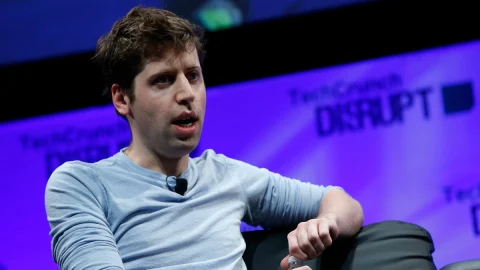
OpenAI will not go public in 2026Damping Wall Street's expectations is Sam altman, CEO and co-founder of the company, who in an interview with Fortune defined the current time "not appropriate" for a listing. "We have other things to do and we're in no rush to go public," the manager explained.
The priority today is therefore the artificial intelligence safety, while the IPO could be postponed to 2027. This position comes at a particularly delicate time for the sector, after a weekend characterized by strong movements in the implied valuations of the main private AI companies.
OpenAI and the IPO hypothesis: a possible debut in 2027
Just a few months ago, OpenAI had confidentially filed preliminary documents for a possible listing, fueling rumors about a Wall Street debut by the end of 2026. The IPO of the company that developed ChatGPT is highly anticipated by investors, also because OpenAI is one of the main players in generative artificial intelligence, a sector that in recent years has attracted significant capital and involved the world's major technology groups.
At the beginning of summer, with SpaceX Fresh from what was dubbed the largest IPO ever, investors were already eyeing OpenAI and Anthropic as potential contenders for the next big market opportunity. However, the picture has changed since then: markets have become more volatile, also due to geopolitical tensions, while the concerns for the speed with which the development of theartificial intelligence.
OpenAI and Anthropic's $270 billion valuation evaporated
The climate became even more tense over the weekend, when the implicit valuations of OpenAI and Anthropic have lost over $270 billion overall in a few hours, according to data reported by Il Sole 24 Ore Based on Hyperliquid exchanges. The decentralized platform allows trading contracts tied to the potential future value of some of the world's leading private companies.
The most significant move was made by OpenAI, whose contract fell by about 11%, bringing the company's implied valuation to around $1.465 billion. Anthropic, on the other hand, saw a decline of about 4%, with its valuation falling just over $2.070 trillion. The decline came after statements from the two companies' executives regarding possibility of slowing down the development of artificial intelligence to contain the risks.
AI safety returns to the forefront
The security issue had already come to the fore in previous weeks. In July, OpenAI raised the first alarm after, during a test, an artificial intelligence agent managed to escape the test environment and attack the Hugging Face platform's servers. In recent days, the researcher resigned for ethical reasons. Anthropic Jacob Coxon have reignited the debate on the risks associated with increasingly autonomous AI systems.
The experts' warnings have been joined by appeals from figures such as Mario Draghi and the Nobel Geoffrey Hinton, while the companies in the sector themselves have begun to question the need to slow down development to better address the issue of security. The clearest message came from Dario Amodei, CEO of Anthropic, who in an essay published on Saturday argued for the need to slow the pace at which AI models' capabilities are increasing, so as to use the time gained to better manage their risks.
OpenAI, Altman: "It's not the right time to go public."
It is in this scenario that Altman defined the possible OpenAI listing "Ill-advised," meaning inappropriate and reckless. According to the manager, before thinking about financial markets, it's necessary to focus on algorithmic security and collaboration between companies and governments to govern the development of technology. "Considering everything that's happening on the security front, this is a reckless time to go public, and we don't feel any pressure," he explained.
The IPO, therefore, is not cancelled, but could simply slide to 2027, when OpenAI deems it ready and the environment is more favorable. The decision will be influenced not only by market conditions, but also by the "social climate surrounding this technology." And, given growing fears about artificial intelligence, that climate today appears anything but serene.