What until a few years ago seemed only an ambitious project, is now in an advanced stage of realization: the “Europe's Metro” takes shape and runs on the high-speed rails. Ferrovie dello Stato (FS), through Trenitalia, has announced a new important stage in its journey towards the railway integration of the continent. In cooperation with Deutsche Bahn and ÖBB, the first ones will be activated by 2026 international connections direct between Italy, Austria e Germany.
The new Frecciarossa services will connect Milan and Rome to Munich, and as early as December 2028 the network will be extended to Berlin and Naples. An initiative that fits fully into the FS strategy for a Europe connected by trains fast, sustainable and capable of competing in terms of comfort and travel times with air transport. It is no coincidence, in fact, that the European Commission has included this connection between Italy, Austria and Germany among the Pilot Projects of his Commission Action Plan, dedicated to strengthening cross-border rail connections.
Four new connections coming soon: to Munich and Berlin
La first stage of the commercial offer includes four new daily trains: two on the Milan – Munich route and two between Rome and Munich. The journey from Milan will last about six and a half hours and includes intermediate stops in Brescia, Verona, Rovereto, Trento, Bolzano and Innsbruck. The journey from Rome is longer, taking eight and a half hours, passing through Florence, Bologna and then following the same route as the Milan connection.
The Opening of the Brenner Base Tunnel, planned for the end of the decade, will reduce travel times on both routes by approximately one hour. Always starting from December 2028, the offer will be increased to include ten daily connections between Italy and Germany. In addition to the connections already mentioned, the lines Milan – Berlin, Rome – Berlin, Naples – Munich and Naples – Berlin will also be activated.
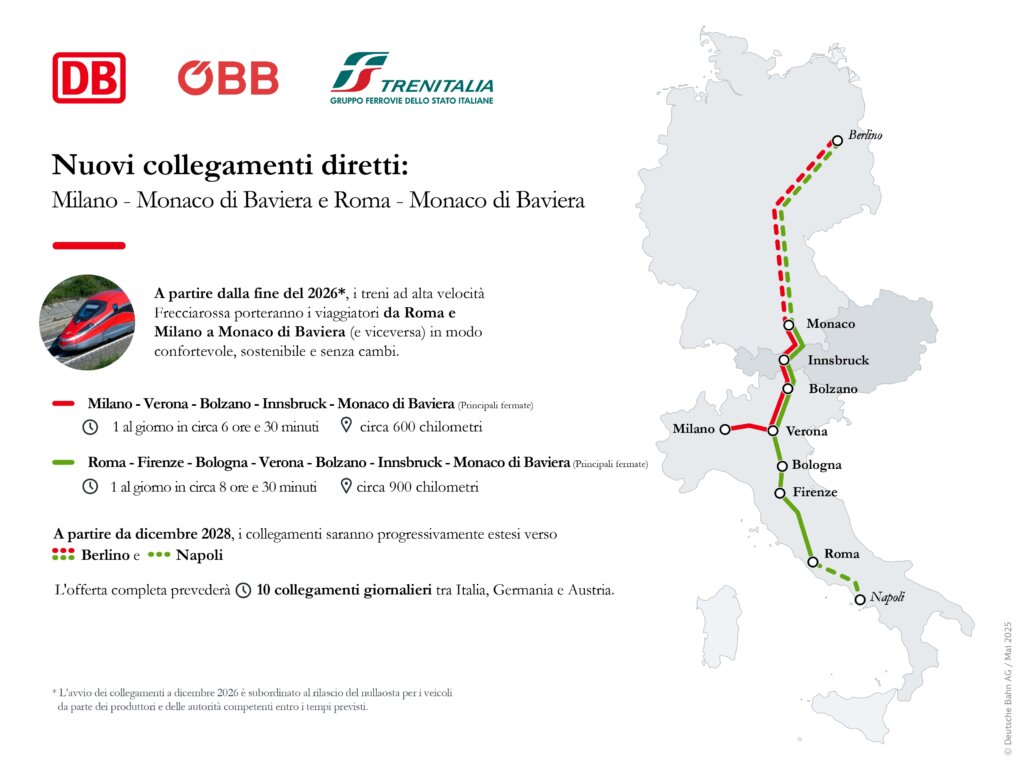
Thanks to the connection with the German railway network, the new routes They will also intercept the demand for mobility to and from other European destinations, such as Frankfurt and Krakow, further expanding the project's impact on continental mobility.
Frecciarossa 1000: Italian technology for Europe
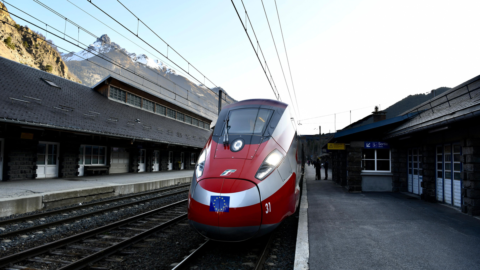
The new services will be operated by Frecciarossa 1000, the flagship of the Trenitalia fleet. It is a high-speed train designed not only to travel in Italy, but to adapt to the railway networks of many European countries, including France, Germany, Austria, Spain, Switzerland and the Netherlands. It is in fact approved for operate with different electrical and signalling systems, an essential condition for cross-border transport.
But its qualities do not stop at technical versatility: the Frecciarossa 1000 is also a highly sustainable train, with low emissions and high performance in terms of comfort, silence and reliability. It is the means with which FS aims to make the experience of competitive High Speed at European level, and not just national.
High Speed Europe takes shape
The official announcement of the new connections arrived from Munich, in the presence of the heads of the three companies involved: Gianpiero Strisciuglio for Trenitalia, Michael Peterson for Deutsche Bahn and Sabine Stock for ÖBB. Remotely also intervened Tzitzikostas Apostles, European Commissioner for Sustainable Transport and Tourism.
With the expansion of Frecciarossa services also in Germany, after entering France and Spain, Trenitalia consolidates its position in the European railway panorama.the goal is clear: to offer acredible alternative to the airplane in connections between the main cities of the continent.
"Connect Italy with the main European cities by train – underlined the CEO of Trenitalia Gianpiero Strisciuglio – is one of the strategic objectives of the FS Group. The Frecciarossa confirms its leading role also on international markets, with the ambition of becoming the train of Europeans and not only of Italians. These new connections are will add to those already operational between Milan and Paris. Furthermore, between Switzerland, Austria and Italy there are Eurocity connections active ed Euronight, realities that improve and make more sustainable connections for work, study and tourism with the rest of Europe”.