"The European economy has entered a phase of greater weakness than expected." This is the reason that pushed the European Commission to revise downwards, in some cases by a lot, GDP growth forecasts of the Eurozone, the European Union and some member countries, including Italy. The broad stagnation in 2023 has translated into a weak momentum at the beginning of the year, explains the EU Commission, according to which the expectation is for a gradual acceleration this year.
The new forecasts from the EU Commission
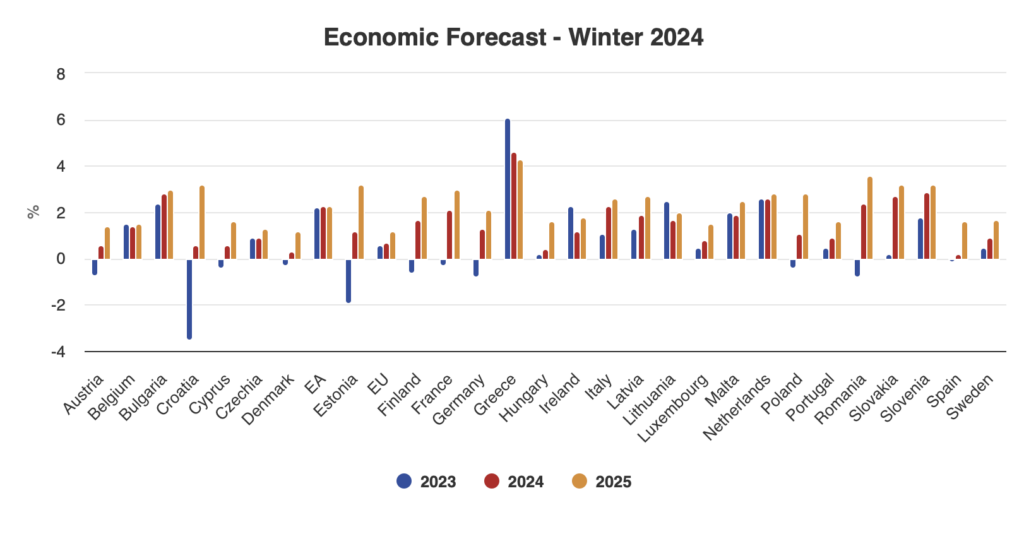
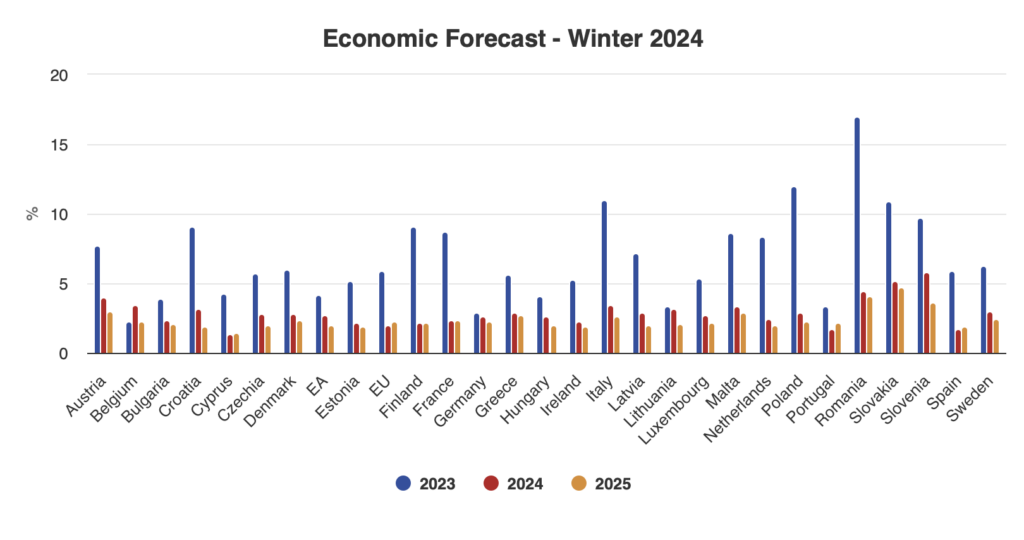
What are the new estimates? Let's go in order. Compared to the estimates made last November, the growth ofEurozone for 2024 it goes from +1,2% to +0,8%, while that for 2025 drops to +1,2% from +1,6%. The growth ofEuropean Union drops from +1,3% to +0,9% for 2024 and is confirmed at +1,7% in 2025.'Italy? In 2024, according to the new forecasts, our country's GDP will increase by 0,7%, 0,2% less than what was estimated three months ago. In 2025, however, Italian growth will be 1,2% compared to the previous +1,3%.
As for the other Member States, the one that will grow the least will be the Germany, whose gross domestic product will rise by 0,3% this year, followed (in the euro area) by Netherlands with 0,4%; Estonia, Austria e Finland with 0,6%. Instead they will do better than us there France (+0,9%) and above all the Spain (+1,7%). The biggest growth? It will be that of Malta which in 2024 could score a nice +4,6%.
EU Commission: new inflation estimates
Good news however on inflation, which could be lower than the estimates presented three months ago. In detail, the European Commission estimates l. in its winter forecastsEurozone inflation to 2,7% in 2024 and 2,2% in 2025. ForItaly it is expected at 2% in 2024 and 2,3% in 2025. For'Eu it is seen at 3% in 2024 and 2,5% in 2025. In the autumn forecasts, inflation expectations were higher both in the Eurozone (at 3,2%) and in Italy (at 2,7% ) and was seen at 2,2% in 2025 in the euro area and 2,3% in Italy.
Gentiloni: “Exceptionally high uncertainty, with Red Sea crisis shipping costs +400%”
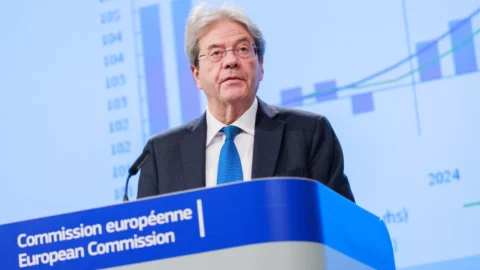
In the European Commission's forecasts “the balance of risks is unbalanced towards more adverse outcomes. Uncertainty remains exceptionally high, in a context of prolonged geopolitical tensions and the risk of a further expansion of the crisis in the Middle East“, said the EU Commissioner for Economic Affairs Paolo Gentiloni presenting the winter forecasts of the community executive.
Because of crisis in the Red Sea “Delivery times for shipments between Asia and the EU have increased by 10-15 days and costs have increased by approximately 400%“, indicated Gentiloni, specifying however that “at least so far, neither the global nor the EU supply chains appear to be under tension”. “The increase in shipping costs is expected to exert limited upward pressure on inflation in the EU,” he underlined.
During the press conference following the presentation of the new estimates, Gentiloni was asked to clarify whether the difference between the Italian GDP growth estimates published by the Commission this year compared to the Italian government's programmatic objectives required a financial maneuver already this spring " It's not our way to talk dcorrective measures on public accounts even more so in the face of zero point changes to this or that economic forecast."
The EU commissioner then added: “We can certainly say that the estimates for Italy they are largely within the European average as has happened since the period following the pandemic and I believe this is an assessment that can also give confidence to the Italian economy".
The EU Commission's forecasts for Italy
In the winter forecast for Italy, the Commission specifies that in our country “the economic output will continue to grow slowly in 2024, with the purchasing power of families expected to benefit from disinflation and rising wages, in a resilient labor market context.
Good news about investments that “are destined to recover, driven by government- and government-funded infrastructure projects Pnrr which offset the drag resulting from lower spending on housing construction." The expectation for investments is that they will “accelerate in 2025, as the implementation of projects supported by the PNRR accelerates, stimulating both infrastructure spending and the purchase of tangible and intangible assets of businesses, which are expected to benefit also from the improvement of financial conditions. This surge in capital spending is set to translate into stronger import growth, above the slightly improving outlook for exports.”
Taking a look at the past, GDP growth in 2023 was 0,6% “slightly below the autumn 2023 forecast, as private consumption moderated and investment slowed significantly, due to rising financing costs and the phasing out of tax credits for property renovation housing".