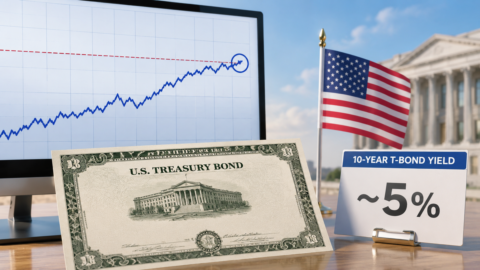
Is the rate hike cycle over? It's the million dollar question that international markets have been asking themselves for weeks. Between disappointed expectations and growing concerns, according to Alessandro Fugnoli, Kairos strategist, this time there could really be "a serious possibility" that September's rate hikes were the last.
In his podcast “On the 4th floor”, Fugnoli analyzes the scenario relating to monetary policy and underlines that, although the hypothesis of a stop is increasingly concrete, the Quantitative Tightening will continue to put pressure on the prices of longer maturities of the Government bonds. “The American economy is strong and the Fed could continue to push to contain inflation expectations. The effect on growth will be a brake, but it will not necessarily translate into a recession,” says the strategist.
Quantitative Tightening
Monetary policy has two arms: on the left there are rates, on the right Quantitative Tightening, with the Federal Reserve withdrawing 95 billion from circulation of dollars every month by selling securities and collecting liquidity from the market. And it does so precisely at a time when the US Treasury is trying to place "the largest quantity of securities in its history", explains Fugnoli.
To date, the system is still very liquid, but Quantitative Tightening, by placing securities on the market, "will continue to exert a pressure on prices of longer maturities”, predicts the economist, according to whom “the effect of these 95 billion is roughly equivalent to that of an increase in rates of 6 basis points. It's a small thing in itself, but, month after month, the effect is felt,” he underlines.
The decline in bonds is nearing its end, we are moving towards a change of pace
“The good news – says Fugnoli – is that, given this offer of securities by the Treasury at auction and by the Fed with Quantitative Tightening, the demand for these same securities will be stimulated not only by the attractive yield they offer, but also from the evidence that inflation continues to fall".
As regards core inflation and wage inflation, in particular, both send reassuring signals, despite the fact that the latest data published today, Thursday 12 October, by the US Department of Labor have disappointed expectations. In September, prices increased by 0,4% compared to August, against expectations for a rise of 0,3%. The "core" figure grew by 0,3%, in line with expectations.
“However, the strength of the American economy is such as to induce the Fed to take advantage of it to press on the brakes for a while longer and contain inflation expectations in a convincing way,” analyzes the strategist.
What will happen in the near future? “The effect on growth of this slow continuation of monetary normalization will be a brake, but it will not necessarily result in a recession. In the worst case, that of a recession, this will be superficial and short”, predicts Fugnoli, according to whom for the stock markets the decreasing inflation and the profits starting to grow again will compensate for the monetary restriction.
“The best scenario remains one tepid growth accompanied by an inflation that no longer causes too many worries. In a scenario of this type, in fact, the Fed will maintain a certain pressure on rates, but the market will at a certain point be able to look ahead and see into perspective the beginning of a cycle of rate cuts. It will be then – predicts the Karios strategist – that it will make sense to start again buy long-term bonds. For now, what is reasonable to hope for is a stabilization of these long bonds. We can already see the first signs in this sense." The yield curve, in fact, is still inverted. That is, it pays more to stay short than long.
And Europe?
In the Old Continent, growth is modest and there are still pockets of recession in manufacturing. However, European stock markets have valuations that already largely reflect a negative scenario.
“In conclusion, at the point we are at, it seems reasonableand stay invested and wait patiently that the slow but decisive course of monetary normalization completes its course and leaves room for a new cycle of rate cuts,” advises Fugnoli.