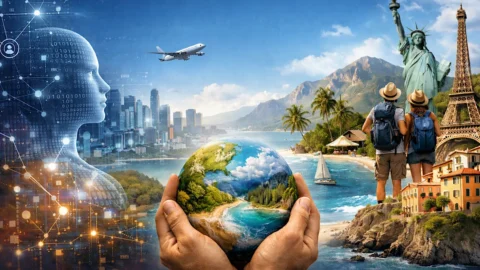
The 46th edition revolved around the Travel Makers Fest, a format that, at least in its intentions, aimed to bring the people who "make" the journey back to the forefront—operators, storytellers, creators, and travelers—through talks and workshops on digitalization, sustainability, and new forms of storytelling. A laudable intent, even if not always fully realized in its content.
Space for sports tourism
In conjunction with the Milan-Cortina 2026 Winter Olympics, The fair gave ample space to sports tourism, seeking to capitalize on the long-term impact of the Olympic event. This was an understandable choice, but partly predictable: many initiatives seemed more focused on institutional promotion than on a genuine reflection on how sport can lastingly transform local communities.
The presence of our Regions
On the territorial front, Italy's regions showcased their excellence: Campania with "Spazio Campania" and the America's Cup theme, Basilicata with Matera as a Mediterranean cultural hub, Lazio with immersive experiences on the Etruscans, and Lombardy with the artistic project "The Lake Within" on Lake Maggiore. These were interesting proposals, but they sometimes gave the impression of a showcase rather than a true laboratory for new tourism practices.
The participation of foreign countries
Internationally, BIT confirmed its global reach with Poland as a partner country and the participation of non-European destinations such as Egypt, Jordan, Korea, and the United States, as well as networking tools such as "Speedy Meetings." Here too, however, the commercial dimension often prevailed over the strategic one: a lot of business, less debate.
Artificial intelligence takes center stage
AI was mentioned in almost every panel as the key to the future of tourism: from flow management to experience personalization, to demand forecasting. It was also presented Duolly, an Italian conversational AI solution designed to make travel portals more "intelligent" and interactive. However, this relentless emphasis on AI has risked devolving into a somewhat uncritical technological fascination. At times, it seemed as if algorithms had become the new protagonist of travel, almost replacing the role of people. And here lies the crux: tourism, and hospitality in particular, is not (and should not become) a problem of mathematical optimization. With so much talk of algorithms, automation, and intelligent platforms, isn't there a risk of losing sight of what truly makes tourism unique? Hospitality is not (and shouldn't be) just a problem of optimizing traffic flows or automatic responses in natural language.
The beating heart of the journey must remain human
The human element—welcome, empathy, the relationship between host and guest, the ability to tell the story of a region through living experiences—must remain the beating heart of the industry. AI can be a useful support tool, but when it takes center stage, we risk forgetting that what makes a trip memorable isn't a chatbot, but rather the encounter with people and places. This trade fair captured a tourism industry increasingly enamored with technology and data, yet still searching for balance: innovation, yes, but without losing sight of the fact that hospitality is, above all, a profoundly human experience.
"Technological innovation took center stage at Bit 2026. Perhaps, however, a few more moments would have been useful to remind everyone that technology should serve hospitality, not the other way around."