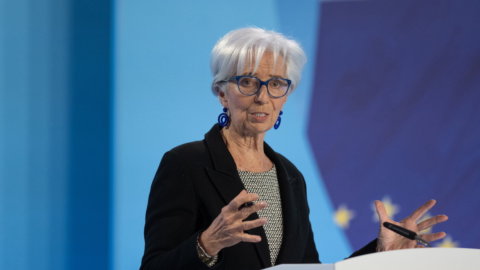
Christine Lagarde, Chairman of the European Central Bank, sound the alarm: I'Europe must absolutely bridge the gap which separates it from the United States, and the best way to do that is to make theCapital Markets Union (CMU), an initiative that could transform Europeans' savings into a strategic resource for economic growth. Speaking at the 34th European Banking Congress in Frankfurt, Lagarde highlighted that the CMU project is struggling to take off due to legislative fragmentation that is hindering the flow of savings towards investments that are crucial for the continent's competitiveness.
Lots of savings, but poorly distributed
“We will not succeed without mobilising private capital much more effectively,” said the head of the ECB. Europeans save a lot – about 13% of income in 2023, versus 8% for Americans – but these assets remain largely locked in low-yielding deposits. In Europe, in fact, approximately 11,5 trillion euros are held in cash e deposits, equal to one-third of total household financial assets. In the United States, this figure is about ten times lower. If Europeans aligned their savings behavior with that of American households, we could see an influx of €8 trillion into capital markets, with an annual flow of about €350 billion, which could make a big difference.
The difficulties of a project that didn't take off
Despite the urgency of creating a unified capital market, Lagarde noted that the project of Cmu is struggling to take offThe main cause of this stalemate is a fragmented legislative approach and weak. Since 2015, more than 55 legislative proposals and more than 50 non-legislative initiatives have been presented, but the implementation of these measures has been hampered by vested interests that are holding back any attempt at reform. “This has two main consequences for our economy,” said the ECB president: on the one hand, European households are much less wealthy than they could be, and on the other, the flow of savings into capital markets is significantly lower than potential.
The law of “push and pull”
Lagarde then recalled that the main cause of this fragmentation is the divergence of legal frameworks within the European Union. Each country has its own regulations, and every attempt to harmonize the system has run afoul of vested interests. “In Europe, we will not be able to make progress by promoting one country’s legal system over another,” he noted, pointing to the need for a more pragmatic approach, which could include adopting a “28th regime” or a two-tier system to overcome legislative deadlocks.
A Single Market for Savings: Lagarde's Solution
All this brings us to Lagarde's proposal: to introduce a “European Savings Standard“, a tool that would allow investors to move towards simpler, more transparent and low-cost solutions. This standard, according to Lagarde, would be the key to unlocking the hidden economic potential in Europe, finally creating a unified capital market that stimulates growth. If the ECB's vision were to materialize, Europeans could see a new form of wealth generated by their own savings, which could be reinvested in the local economy, thus increasing domestic demand and creating a virtuous circle of growth.