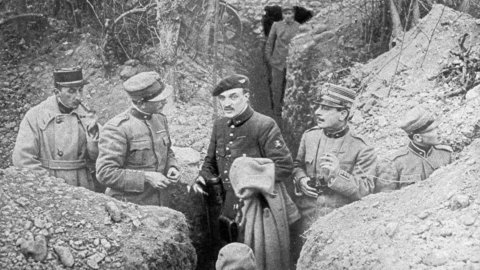
Il 24 October it is a very important date in the Italian history of the twentieth century. During First World War, this was precisely the day in which the two most important battles for our country began, the ones that are remembered even when school books slip away from memory. Let's talk about Caporetto and Vittorio Veneto: the first took place from 24 October to 12 November 1917; the second, from 24 October to 4 November 1918.
The one of Caporetto it is such a well-known story that the name of the small municipality where it all began - today in Slovenian land - has entered the common language as a synonym for "defeat". Here, 104 years ago, an Austrian army reinforced by seven German divisions attacked the Italian lines on the upper Isonzo and broke through them. Austrians and Germans advanced deep into Friuli, while a good part of the Italian troops, in order not to be surrounded, hurriedly abandoned the positions they had held since the beginning of the war.
Only after two weeks the Italian army, almost halved, managed to regroup on the defensive line of the Piave. With the attack of Caporetto, Austrians and Germans conquered 10 thousand square kilometers of Italian territory, in addition to 300 thousand prisoners and a huge amount of weapons, ammunition and resources.
The ruinous defeat scored the end of General Cadorna, who – before being replaced by Armando Diaz at the supreme command of the troops – blamed what happened on his soldiers, accusing them of having surrendered without a fight. The reality, however, was very different: it was above all the incompetence of the commanders who had caused the breakup of the front, who had let themselves be taken by surprise by the attack on the upper Isonzo.
The maneuver devised by the German strategists, which they used for the first time, was also decisive the tactic of infiltration, which consisted in rapidly penetrating enemy territory without worrying about consolidating the positions reached, but exploiting the surprise to force the adversaries into a disorganized retreat.
Just a year later, on 24 October 1918, Italian troops launched an offensive on the Piave front. Defeated in the battle of Vittorio Veneto, the Austrians failed to organize a line of resistance due to the defection of the blind and Hungarian units. Thus, on 3 November Austria signed an armistice with Italy at Villa Giusti, near Padua, which would come into effect the following day, 4 November.