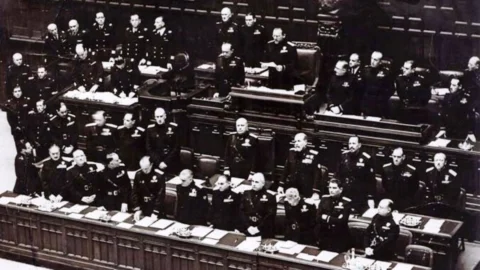
Today is exactly one hundred years from historical speech pronounced by Benito Mussolini at the Chamber of Deputies on January 3, 1925, an intervention that marked a definitive turning point in Italian politics and which, in fact, marked the beginning of the twenty-year fascist period. That day marked not only a declaration of power, but the affirmation of an authoritarian regime that would forever change the destiny of the nation.
In that room, Mussolini did not limit himself to "taking on political, moral and historical responsibility" of the Matteotti murder, but he decided to break all hesitation. With his speech, the Duce transformed fascist violence from an informal tool of intimidation as the declared foundation of a new political order.
It was not just a vindication of past actions, but a programmatic manifesto for the future. Through a rhetoric that apparently saw him “playing defense,” Mussolini managed to impose his vision of a unified Italy under the absolute control of the regime, effectively inaugurating the fascist dictatorship.
An Italy between tensions and opposition against the fascist regime
In 1924, Italy was crossed by strong political tensions. Mussolini's fascism, which came to power after the March on Rome in 1922, was facing growing opposition. The murder of socialist MP Giacomo Matteotti, assassinated on June 10 of the same year, had shocked public opinion. The case had called into question the legitimacy of the fascist regime, accused of being involved in the murder. The opposition, including the Italian Popular Party and the Socialist Party, had reacted with the “Aventine secession”, leaving the Chamber of Deputies to protest the integrity of the government.
Mussolini's speech: "I take responsibility"
On January 3, 1925, Mussolini he went up to the rostrum of the Chamber of Deputies to address the issue that had kept Italy in turmoil for months: the murder of Matteotti. In an atmosphere of great tension, the Duce began with these words, which would mark a point of no return in the history of the country:
"I declare here, before this Assembly and before all the Italian people, that I assume, I alone, the political, moral and historical responsibility for all that has happened.. "
With these words, Mussolini took charge of the fascist violence, in particular the assassination of Matteotti, although avoiding any direct accusation on the material level. He recognized that the political climate of Italy in the 1920s, characterized by violence and intimidation, had been fueled by him, but he presented it as a necessity for the consolidation of the fascist state.
"If Fascism was nothing but castor oil and truncheon, and not instead a superb passion of the best Italian youth, it's my fault!” he declared, concluding his speech with an open challenge to the opposition: “You believed that Fascism was finished… But the Party is strong, and there will be no need for anything else. "
The veiled threat and the political consequences
What seemed like an act of self-absolution turned out to be in a real declaration of power. Mussolini openly threatened anyone who wanted to oppose the regime, stating that the government was capable of “to crush” every sedition. This intervention marked the beginning of the most authoritarian phase of fascism, with the end of any hope of parliamentary opposition and the beginning of a real dictatorship.
Within a few days, the political situation changed radically. On January 4, 1925, Luigi Federzoni, Minister of the Interior, sent circulars to prefects throughout Italy, starting a unprecedented repression against political opposition. Left-wing clubs, associations and newspapers were closed and dissidents arrested. The fascist government rapidly consolidated its power, making any form of opposition increasingly difficult.
An Italy without opposition
The speech of January 3, 1925 was the end of the "Aventine secession", and with it thelast formal resistance of the parliament against fascism. In January 1925, in fact, the Chamber approved numerous decrees that consolidated Mussolini's power, eliminating the last vestiges of democracy. The Chamber of Deputies, under the control of the Fascist Party, approved without discussion a series of authoritarian laws, the “fascist laws”, which led to the establishment of a totalitarian regime.
Mussolini's speech not only resolved the issue of the Matteotti murder, but laid the foundations for theaffirmation of the fascist regime in Italy, which would last until 1945.
A century after January 3, 1925, Mussolini's speech to the Chamber of Deputies remains one of the most significant acts in Italian political history of the twentieth century. January 3rd actually marks the beginning of the twenty-year fascist period, a period in which the Mussolini regime imposed his control on all institutions and the daily life of Italians.
To delve deeper into the content of Mussolini's speech of January 3, 1925, it is possible consult the text full version available here on Wikisource.