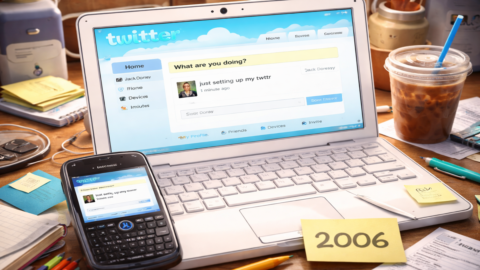
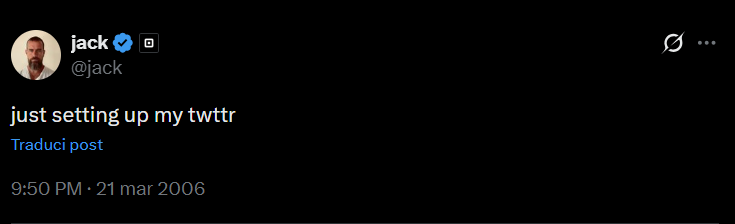
March 21, 2006, 9:50 a.m., California. Jack Dorsey writes"just setting up my twttr“It's not a slogan, it's not an announcement. It's a test. And yet it is the first tweet in historyAt the time, Twitter didn't really exist yet. It was called "twttr," born within the startup Odeo, and took shape almost by accident, after the original project—a podcast platform—ran aground. The idea came to Dorsey while he was imagining a simple system for communicating via SMS with small groups of people. From there, everything changed.
Today, twenty years laterThat intuition has become one of the most influential platforms in the digital world. Or, rather, what's left of it: X, the chosen name after the turning point brought about by Elon MuskSocial media is still alive, but profoundly transformed. More controversial, more unstable, surrounded by increasingly aggressive competition – from Telegram a Threads, up to Instagram. Yet it continues to occupy a central place in global public debate.
According to the most recent estimates, the The platform has over 360 million monthly active users. and approximately 200 million monetizable daily users. Numbers that tell a story of a less dominant reality than in the past, but still decisive. In the meantime, since that first chirping theecosystem has changed: new monetization logics and, above all, a growing role for artificial intelligence, with the integration of tools like Grok.
Twitter – or X – isn't what it used to be. But it still matters.
Why Twitter was born: say little, say it now
Twitter officially launched on July 15, 2006.It's a microblogging service, a word that meant little at the time, but soon became central. The concept is radical but innovative: very short messages, initially limited to 140 characters, because they had to work via SMS. A technical constraint that became a cultural identity.
We are in an era in whichsocial media has yet to really explodeFacebook is still far from the global diffusion that will arrive only a few years later, while YouTube – born in 2005 – is in the early stages of its development. In this context, Twitter establishes itself as a forerunner: a different model, more essential, almost minimal.
Unlike platforms that will come later, it doesn't focus on images or building complex profiles. No photo albums, no visual storytelling. Just words. Quick, immediate, public.. Not by chance, Dorsey himself will say that the The name "Twitter" was born while browsing through a dictionary: the definition is "a short burst of irrelevant information," a tweet. And that's exactly what it would become.
The Twitter Boom: When the World Started Tweeting
For months, Twitter remained little more than an experiment among insiders. Then comes 2007 and the decisive moment: the South by Southwest festival in Austin. Users' messages scroll across the screens in real time. It's a simple yet powerful demonstration. In just a few days, traffic explodes, and the social network goes from 20 to over 60 tweets a day. It's the point of no return.
From there on, growth is rapid and constantTwitter is gradually transforming into one of the main places where news is born and circulates, to the point of being called "the SMS of the Internet".
In 2012, it had hundreds of millions of users, and in 2013, it became one of the ten most visited sites in the world. Within a few years, become a platform with hundreds of millions of active users and a billion-dollar business. And its nature is changing. It's no longer just a technological product but is becoming a global conversational infrastructure.
For better or worse, from that moment on, the world no longer just tells its story. It begins to do it in real timeAnd it is in real moments, often sudden or of crisis, that all his strength on Twitter emergesDuring the 2009 L'Aquila earthquake, the first reports circulated on Twitter, even before traditional media. The following year, a NASA astronaut sent the first tweet from space, transforming the platform into a symbolic bridge between Earth and orbit. In 2012, in Italy, news of Oscar Luigi Scalfaro's death spread on Twitter well before the news agencies, marking one of the first clear cases of grassroots information overtaking traditional media.
Then there is politics which is becoming increasingly social. Protests, revolutions, election campaigns: Twitter becomes a central tool in the mobilizations in Iran, Egypt, and Tunisia, to the point that in some cases it has been defined as a real means of social organization. And then there are leaders and governments who use Twitter as a direct megaphone, without mediation. the most emblematic case is that of Donald Trump, whose use of the platform marked an era and helped redefine the relationship between power and digital communication. But this precisely led to an unprecedented clash: after the assault on the Capitol on January 6, 2021, his account was blocked, sparking a global debate on the role and limits of platforms.
Twitter thus becomes much more than a social network, becomes a central space for public debate. And, inevitably, also of conflict.
Twitter and words: a language born from users
One of the features The most surprising thing about Twitter is that it wasn't built by its founders alone. Many of its most iconic features – hashtags, mentions (@), retweets – weren't born in the company's labs, but directly from users' daily useThese are spontaneous solutions, invented to navigate the flow, to respond, and to give visibility to content. Only later are they adopted and officially integrated into the platform.
It is, in this sense, a social network built "from below", where the community doesn't just use the tool, but defines its language. 2017 also saw one of the most anticipated changes: the character limit was increased from 140 to 280. This breakthrough marked the end of one of the most iconic constraints, without truly changing its nature. The style remains the same as its origins: direct, fast, and often sharp.
With growth, however, contradictions also emerge. Twitter becomes one of the main global channels of real-time information, but also one of the spaces most exposed to spread of fake newsEspecially during the Covid-19 pandemic, the platform finds itself at the center of this fragile balance, introducing verification and reporting systems in an attempt to stem misinformation.
Musk's Earthquake: $44 Billion to Buy Twitter
Il October 27, 2022 marks a new watershed in the platform's history. Elon Musk completes the acquisition of Twitter for $44 billion and, within a few weeks, brings about a radical transformation. The transformation is immediate. Internal rules are changed, thousands of jobs are cut, the verification system is rewritten—transforming it from a symbol of authority into a paid service—and new fronts are opened in content management.
It's not a simple evolution, but a clear discontinuity. Twitter ceases to be the product of its history and becomes a laboratory in real time, driven by a personal, ambitious, and often controversial vision. For some, it's a necessary relaunch attempt. For others, the beginning of a phase of instability and progressive decline, with a portion of users increasingly looking to other platforms.
The landscape, however, had already shifted. At the same time, the founders' cycle had come to an end. Jack Dorsey, the iconic face of Twitter's birth, had definitively stepped down from the company's leadership in 2021, after years of exits and returns to the top.
Its exit marks the end of an era and paves the way for a transformation that, with Musk, becomes total, starting with the name.
Goodbye Twitter: X is born
The change brought about by Musk doesn't stop at the platform's internal structure. It extends to the very identity of the social network. In the summer of 2023, Twitter ceases to exist. name is abandoned, the little blue bird disappears, and in its place X is bornIt's a radical choice, reflecting a broader project: to transform the platform into an "everything app," modeled after Asian super apps like WeChat. No longer just a social network, but an integrated ecosystem capable of encompassing communication, content, services, and—hopefully—even payments.
Il change is also linguistic"Tweets" become "posts," marking a symbolic break with the past and with one of the web's most recognizable lexicons. A transition that deeply divides users and observers: for some, an inevitable evolution, for others the erasure of one of the most iconic brands in digital history.
And then, at the same time, another piece of Musk's strategy is taking shape: the integration of artificial intelligence. With Grok, developed by its xAI, the platform enters a new phase, increasingly oriented towards merging social networks and AI. Thus X is no longer just a place where you write but a system that tries to respond, interpret, generate.
Twenty years later: what remains of that first tweet
Twenty years later, that message, "just setting up my twttr," is still there. Simple. Essential. Almost naive. And yet, within those few words, everything is already there: the idea of immediate, unfiltered communication, capable of transforming an ordinary thought into a global message. From there a revolution was bornA new way to stay informed, to tell stories, to react in real time.
Today it's called X, and it has changed name, ownership, rules, and ambitions. It's more controversial, more fragmented, perhaps even more fragile. But its essence remains recognizableA continuous flow of short words that flow without stopping and that, put together, they end up telling, for better or for worse, the world that changes and evolves.