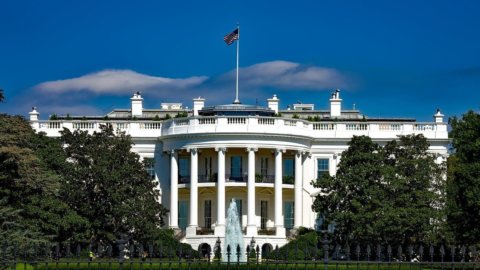
Trump surpasses Trump. The fifteenth shutdown of the United States government since 1981 has established a new record As of today, Sunday, November 9, a total of 40 days. The previous record was held by Trump himself, in his first term, when he stopped at 35 days, while Republicans and Democrats in Congress continue to blame each other for the stalemate.
The death toll is rising day by day.food assistance for the poor was first interrupted, federal employees from airports police andarmyor they are not paid even though they are forced to work, while the economy is sailing blindly, without the publication of the public data. All this also has repercussions on investors who, worried, move towards safe assets in gold and precious metals next to the bonds.
Democrats' Leverage to Support Health Subsidies
The standoff between Republican President Donald Trump and congressional Democrats triggered last first octoberWith the start of the new fiscal year, the fifteenth shutdown since 1981, a familiar situation, one that many thought could be resolved quickly, has hit the headlines. Instead, the standoff persists.
I Democrats they don't have much power because Trump's Republicans control both the Camera of the Representatives that the SenateBut Republicans need at least seven Democratic votes to pass any spending bill. Senate, Where 60 votes are needed to advance most bills in the 100-seat House. So Democrats are using this lever to promote the continuation and expansion of the health benefits for those who purchase health insurance through the Affordable Care Act, refusing so far to support a plan of public spending law that does not address the issue. Their proposal would make permanent the tax breaks that would otherwise would expire at the end of the year, Making them accessible to more middle-income families. If Congress fails to act, health insurance costs will rise dramatically for many of the 24 million Americans covered by the ACA, according to the Kaiser Family Foundation, a nonpartisan organization.
Congress and President Donald Trump have blocked a number of federal programs, including those providing aid to low-income Americans, U.S. military salaries, and airport operations. Thousands of federal employees have been furloughed, and approximately $1,7 trillion in discretionary funds, representing about a third of total annual U.S. spending, has been frozen.
Shutdown casualties pile up
The food assistance For approximately 42 million Americans, the benefits of the SNAP program ended last Saturday. Many families are no longer receiving food stamps, which average about $180 a month. On Monday, the Trump administration said it would partially fund November's food subsidies, but warned that it could take weeks or months for the aid to be distributed. Some learning programs for low-income children are also at risk of being closed, as no new funding was available on November 1.
Federal employees, such as law enforcement and military, no longer receive their salary, as do the workers in the airport security and air traffic controllers, resulting in staffing issues and travel delays. More than 3,2 million U.S. air passengers have experienced delays or cancellations since the shutdown began, an airline group said Monday.
The Congressional Budget Office has estimated that the shutdown could cost the economy US 11 billion dollars if it were to last another week. The lack of federal funding means that the Federal Reserve The Fed will have limited government data to interpret the U.S. economic situation and guide its monetary policy. The American Federation of Government Employees, the largest federal employee union, is pushing for a stopgap funding measure, but Democrats voted against it.
The Trump administration is testing the limits of the shutdown.
During the shutdown, Trump focused on foreign policy, from Gaza to Russia to Asia. But recently he returned to the topic, trying to force the issue and asking Republicans to abolish the 60-vote threshold in the Senate, the only lever in the hands of the Democrats, for fear of losing the mid-term elections next year. Republicans, however, opposed Trump's request on Wednesday, saying that eliminating the quota would undermine the Senate's traditional role as a bastion of bipartisan compromise.
A recent Reuters/Ipsos poll It suggests that Americans blame the shutdown on both parties in Congress: 50% say Republicans bear most of the blame, and 43% say Democrats bear most of the blame. Three moderate Democratic senators voted with Republicans to reopen the government, arguing that the immediate harm of the shutdown outweighs any long-term benefits.
Meanwhile, Trump's chair creaks
Meanwhile, Trump is having to endure a few bumps in the road: from his declining popularity among Americans to a landslide victory for Democrats in Tuesday's unseasonable elections to signs that members of the US Supreme Court, which is otherwise dominated by conservatives, have become skeptical of his tariff policy.
This week a new generation of democrats, Democrats, including 34-year-old New York City Mayor-elect Zohran Mamdani, won elections in New Jersey, New York, and Virginia, while California voters overwhelmingly approved a new congressional map aimed at improving Democrats' chances of winning the U.S. House of Representatives next year.
Il approval rate Trump's approval ratings have dropped in recent days, reaching the lowest level of his term, as a growing number of Americans have expressed disappointment with his handling of the cost of life, according to a new survey Reuters / IpsosThe three-day poll, which concluded last Sunday, showed that 40% of Americans approve of the Republican leader's job, down from 42% in the October 15-20 poll and a far cry from last month's 57%.