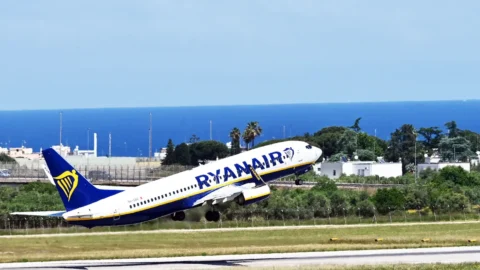
Traffic continues to grow, but thefuel price increase , Fare cuts are holding back Ryanair's resultsIn the first quarter of the 2026-2027 financial year, between April and June, the low-cost airline recorded a Net income of 538 million euros, down by 34% Compared to €820 million in the same period of the previous year, the figures were primarily impacted by the increase in jet fuel prices, not covered by hedging contracts, and increased travel caution, which forced the group to reduce fares to sustain bookings.
Ryanair: More passengers, but fares down 6%
In the quarter Ryanair has carried 61,3 million passengers, with a 6% increase on an annual basis and a load factor stable at 94%. However, the growth in traffic did not translate into a similar improvement in revenues. total turnover Revenues from scheduled flights, on the other hand, decreased by 1% to €2,91 billion, penalized by average fares that were 6% lower. Ancillary revenues followed traffic trends and rose to €1,47 billion.
“First quarter fares, which benefited from a full Easter in April 2025, required a boost due to the conflict in the Middle East, which generated consumer hesitation, concerns about jet fuel shortages in the European Union, economic uncertainty and postponed bookings,” commented the CEO. Michael O'Leary.
Ryanair Accounts: Jet Fuel Drives Operating Costs Up
The heaviest voice for the group was that energyThe price of the 20% unhedged fuel more than doubled in the quarter, contributing to an 11% increase in operating costs to €3,81 billion. Ryanair remains hedged for the majority of its needs. Jet fuel is 80% hedged until March 2027 at a price of approximately $67 per barrel. For the following financial year, the airline has already hedged 15% of its forecast consumption at approximately $85 per barrel.
The hedging strategy should mitigate the impact of oil price volatility, but it won't eliminate other cost pressures. The group anticipates a roughly €300 million increase in European environmental taxes, as well as higher salaries and maintenance expenses. "Our jet fuel is 80% hedged through March 2027 at around $67 a barrel, insulating earnings from oil price volatility," the CEO explained, noting that final costs will still depend on the performance of the unhedged portion in the coming quarters.
Ryanair: New bases and investments in the most competitive markets
Ryanair continues to expand your networkDuring the summer season the company opened three new operational bases in Trapani, Tirana and Rabat, accompanying the expansion with the launch of 130 new routesThe group intends to focus aircraft and investments in countries offering more favorable airport taxes and operating costs. Among the markets considered most attractive are Italy, Albania, Morocco, Slovakia, and Sweden. Capacity is being reduced in Germany, Austria, Ireland, and some areas of regional Spain, which are considered less competitive.
La financial position remains solidAs of June 30, Ryanair had over €2,8 billion in gross liquidity, having repaid €1,3 billion in debt and made approximately €500 million in investments. The group also has a €1,1 billion revolving credit line, which is still largely unused.
The company has also completed approximately 90% of the share buyback plan for 750 million euros, purchasing and canceling over 25 million securities at an average price of 26,35 euros.
Ryanair targets 216 million passengers, but remains cautious on profits
For the full financial year 2026-2027 Ryanair confirms a 4% traffic growth, up to 216 million passengers. The increase is expected to be more sustained in the first half of the year, with a 6% increase, before slowing to 2% in the second half. The company also continues to focus onfleet expansion and the arrival of the Boeing Max-10, expected from spring 2027. The new aircraft should guarantee reduced fuel consumption and an increase in available seats compared to previous models.
Regarding financial results, however, management is currently refraining from providing a precise forecast. "It's still too early to provide meaningful forecasts for fiscal 2027," O'Leary stated. Final profit will remain dependent on the evolution of conflicts in the Middle East and Ukraine, the price of unhedged fuel, the stability of demand, and potential disruptions caused by strikes and disruptions to European air traffic management.