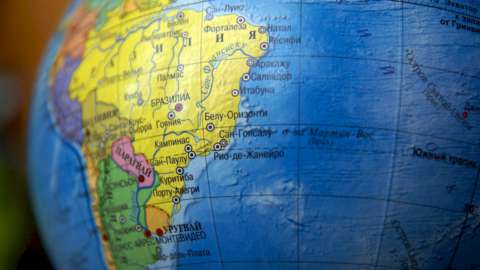
The first half of 2026 ended with a Overall positive results for the main stock markets in Latin AmericaThe markets were supported primarily by the recovery in raw materials prices, the weakening of the dollar, the return of international flows to emerging markets, and, in some countries, the improving macroeconomic outlook. Brazil and Chile were the undisputed leaders in the first half of the year, while Argentina and Mexico recorded more moderate performances characterized by greater volatility.
Brazil: Ibovespa shares hit all-time highs thanks to energy and foreign capital.
The Sao Paulo Stock Exchange closed the semester with an improvement in the order of 7%, with a slowdown right at the end of the semester, in June. The Ibovespa index repeatedly updated its all-time highs, supported by strong foreign capital inflows, rising oil, mineral, and agricultural commodity prices, and the strengthening of the real against the U.S. dollar. Reuters and the Financial Times highlight how the Brazilian market has been among the main beneficiaries of the international rotation toward emerging and commodity-linked assets.
Among the best stocks of the semester are several names linked to natural resources and heavy industry, with the Petrobras oil and Vale mining among the main contributors to the index's performance, while some cyclical and retail companies benefited from expectations of interest rate cuts. Some discretionary consumer goods and utilities sectors, however, performed weaker.
On the macroeconomic front, the Brazilian economy continues to show a fair amount of resilienceAfter GDP growth of 2,3% in 2025, the International Monetary Fund estimates a 1,9% expansion for 2026. Inflation remains above the central bank's target, but Selic has begun a gradual path of reducing interest rates, fueling favorable expectations for the second half of the year. Brazil has one of the highest benchmark interest rates in the world, but this semester it has been cut twice, dropping from 15% to the current 14,25%.
Argentina: Rally slows, but Milei's bet remains positive
After the success of the last two years, the Argentine market has experienced a more complex semesterThe Buenos Aires Merval index nevertheless closed the first half of 2026 in positive territory, with a rise of more than 2% in local currency.
The market continued to reward Milei therapy, therefore the companies most exposed to privatizations, infrastructure and energy, while some financial stocks suffered profit taking after the strong runs of 2024-2025. The main driver remained the stabilization program of President Javier Milei, accompanied by the support of the IMF and the progressive withdrawal of theinflation, which fell to 2,1% on a monthly basis in May, the lowest level in the last 8 months.
Argentina's economy has entered a recovery phase after the 2024 recession.GDP grew by 4,4% in 2025, and the international consensus forecasts 3,5% growth in 2026, supported by private investment, construction, and exports. However, risks related to foreign exchange reserves and medium-term financial sustainability remain high, as do poverty levels that appear to have improved but still affect one in three Argentines. In the second half of the year, investors will continue to monitor the disinflation process, the liberalization of the foreign exchange market, and relations with the International Monetary Fund.
Mexico: Moderate performance awaiting industrial recovery
The S&P/BMV IPC index of the Mexican Stock Exchange has recorded a growth of 4,5% in the first half of the yearThe index was supported by the strength of the peso and expectations of a recovery in the US economy, a crucial factor for the Mexican manufacturing industry. Among the most dynamic sectors were construction materials, infrastructure and some industrial companies linked to the nearshoring phenomenon, while the airport sector and part of the consumption sector showed a weaker trend.
From a macroeconomic point of view, Mexico remains the country with the most modest growth among the major Latin American economiesAfter an expansion of nearly 1,5% in 2025, the International Monetary Fund forecasts a similar increase in 2026. The central bank has slowed its monetary easing cycle, and the market is primarily focused on the prospects of the USMCA trade agreement and demand from the United States. Consensus believes that an acceleration in industrial and logistics investments could support a better performance for the stock market in the second half of the year.
Chile: IPSA leads the way thanks to copper and political change
The surprise of the semester came from Santiago, where the new far-right government, led by Trumpian and Pinochetian José Antonio KastThe IPSA index extended the strong rally that began in 2025, proving to be one of the best markets in the entire region. The recovery in copper prices supported the price list., improved sentiment following the change of administration, and the return of international investors to Chilean assets. The market had already accumulated gains of over 60% in the last year.
Among the brightest stocks, it is no coincidence that mining groups figure, banking, and infrastructure companies, while utilities posted more subdued performances. On the economic front, the picture is less bright than the stock market. After growing 2,3% in 2025, Chilean GDP is expected to increase by 2,4% in 2026 according to the IMF, although the central bank recently revised some estimates downwards due to weakness in agriculture and tourism. For the second half of the year, the outlook will largely depend on the performance of copper, which continues to be the main driver of the Chilean economy and financial market.
Outlook for the second half of the year
The consensus remains constructive on Latin America. The main supporting factors are represented by possible continuation of the rate-cutting cycle in Brazil, the macroeconomic normalization process in Argentina, the industrial recovery in Mexico, and the strength of the Chilean mining sector. On the risk front, however, evolving geopolitical tensions, commodity volatility, and uncertainty about global growth weigh heavily.
In terms of expected economic growth for 2026, the International Monetary Fund estimates: Argentina +3,5%, Chile +2,4%, Brazil +1,9% and Mexico +1,5%A picture that confirms how the continent continues to offer selective opportunities to international investors, despite marked differences between individual countries.