Eighty years ago, on June 6, 1946, in New York the Basketball Association of America was born, the league that would change the fate of professional basketball forever. NBA name would come later, on August 3, 1949, after merging with the rival National Basketball League. But the seed had already been planted: building a league capable of filling arenas, attracting spectators, creating rivalries, and transforming basketball into a stable, recognizable, and marketable product.
From that first intuition one of the most profitable sports ecosystems in the worldToday the NBA moves a estimated turnover over 14 billion dollars It is based on an industrial portfolio of 30 increasingly valuable teams, with an average valuation of around €5,5 billion. This growth is supported by billions of television rights, next-generation facilities, merchandising, global sponsors, and an international pipeline that has pushed the business well beyond the parquet.
The path, however, has not been linear. From the initial eleven teams, the current structure, with 29 teams in the United States and one in Canada, has evolved through mergers, territorial expansions, and city relocations. This is where one of the most distinctive features emerges. deeper differences compared to the European sports model: no promotions or relegations, but a closed system in which each club is an asset controlled by the league, capable of changing its headquarters, commercial identity, and catchment area while maintaining its history, titles, and asset value.
This mechanism is one of the pillars of the NBA economy. Board of Governors evaluates New cities, arenas, and relocations based on growth potential: audience size, infrastructure, commercial appeal, and returns for sponsors and broadcasters. The logic has remained the same for eighty years. go where basketball can generate attention, revenue and value.
The 24 seconds, the logo and the dynasties: when the show becomes value
The NBA didn't become great just because it had extraordinary champions. It is It became big because it was able to modify the productIn the 1950s, to make the game faster and more spectacular, the 24-second rule to shoot hoops. A technical choice, but also an industrial one, because it led to more dynamic games, higher scores, more pace, and bigger crowds. From that moment on, the league built its fortunes. alternating innovation and narrationGeorge Mikan's Minneapolis Lakers were the first dynasty. Then came Bill Russell's Boston Celtics, who won eleven titles in thirteen seasons. In the 1960s, the rivalry between Russell and Wilt Chamberlain became one of the great stories of professional sports. In 1962, Chamberlain scored 100 points in a single game, a record that still stands.
The image also played its part. NBA logoDesigned by Alan Siegel and unchanged since 1971, it represents Jerry West's silhouette in full force. A simple, immediate, global brand. A curious fact that speaks volumes: even before the social media and streaming era, the NBA had already understood the importance of being recognizable everywhere.
From the ABA merger to globalization: basketball as an exportable product
1976 was another decisive stepor. The merger with the American Basketball Association brought four franchises to the NBA: the New York Nets, Denver Nuggets, Indiana Pacers, and San Antonio Spurs. The league grew to 22 teams and incorporated talent, markets, and ideas that would impact the future of the game. Among these, the three-point shot, introduced in the NBA in 1979 after being used in the ABA.
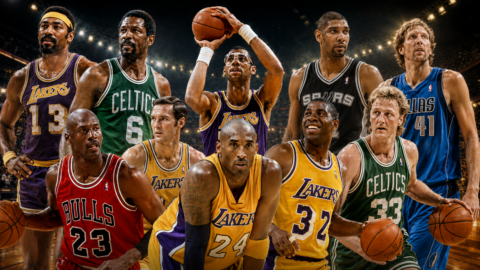
Also in 1979 they entered Larry Bird and Magic Johnson on stage. With them, the 80s became the decade of great Celtics-Lakers rivalry, but also the period in which the NBA began to truly speak to the world. The appointment of David Stern as commissioner in 1984 and the Draft of the same year, with Michael Jordan drafted by the Chicago Bulls, opened the modern phase of the league: no longer just sport, but entertainment, marketing, merchandising, television.
The 1990s completed the transformationThe 1992 Barcelona Olympic Dream Team brought NBA stars to a global audience. And Michael Jordan became the face of an entire industry. His Chicago Bulls won six titles in the decade, and the league began playing preseason and regular-season games outside the United States, from Japan to Mexico to Europe.
Globalization was not only geographical, but also technical and commercial. More and more international players entered the NBA: from Hakeem Olajuwon to Dirk Nowitzki, from Pau Gasol to Yao Ming, up to to "our" Andrea Bargnani, the first European to be selected with the number one overall pick in the 2006 draft. In 2007, a game between the Houston Rockets and the Milwaukee Bucks, featuring Yao Ming and Yi Jianlian, was watched in China by over 200 million people on 19 different networks. A sign that the NBA market was no longer just an American one but a global phenomenon.
TV rights, streaming, and tickets: the real game is played off the court.
The data that best describes the NBA today is not a record of points, but a contractThe league finalized an agreement in July 2024 from $76 billion in media rights with ESPN, NBC, and Amazon Prime Video. The agreement, valid for 11 seasons starting in 2025-26, represents a huge leap from the previous 24 billion contract. It confirms that the NBA is now a global content platform.
even the price of the live experience This confirms the product's commercial strength. In 2022, the average ticket price was $77,75, but the range could vary from $10 to $100.000 depending on the market, the stage of the season, and the type of event. The parquet remains the center of attention, but the economic value multiplies around it: rights, streaming, arenas, sponsors, international audiences, digital content.
Eighty Years Later: The League of Parity and the 30 Markets
In 2004, with the entry of the Charlotte Bobcats, the NBA reached thecurrent 30-team format. A balance that may not be definitive: there has been discussion for some time about a possible new expansion, with Seattle's return and Las Vegas' entry among the most likely possibilities. Meanwhile, the machine continues to race. The regular season remains built on 82 games, the playoffs accompany the calendar until June and the Finals They are now a global event, halfway between sport, entertainment and premium television product.
In the 2000s and 2010s the league experienced new eras: the Lakers of Kobe Bryant and Shaquille O'Neal, the Spurs of Tim Duncan, Manu Ginóbili and Tony Parker, the Miami Heat of LeBron James, Dwyane Wade and Chris Bosh, the Golden State Warriors of Stephen Curry. Then came a different phase, defined as greater competitive equality, with seven different champions in seven years between 2019 and 2025. Parity, however, it's not just a sporting issue. The new collective agreement The 2023 NBA Draft has tightened the rules for teams that exceed certain luxury tax thresholds, making it more difficult to build rosters filled with superstars on maximum contracts. The goal is to avoid excessive concentrations of talent, better distribute the chances of winning, and keep the championship race alive across multiple cities. In other words: more balance on the court, greater market value off it.
La nba, since that 6th June 1946, it has become much more than a championshipIt is an economic and media ecosystem that brings together sports, entertainment, technology, finance, and the geopolitics of the public. Born in New York as the BAA, it became the NBA in 1949, and grew through mergers, rivalries, new rules, and global superstars. Today The league is worth above all for its ability to transform every match into content and every content into revenue. And to think that it all started with a balloon, a hardwood floor, and a few arenas to fill. Eighty years later, the NBA continues to score: not only on the scoreboard, but also in the balance sheet.