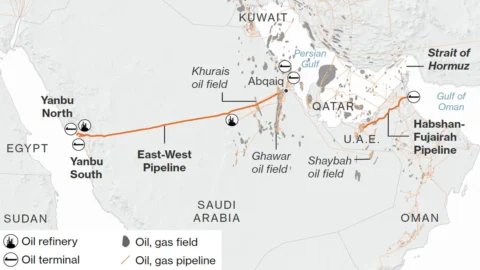
While maritime traffic through the Strait of Hormuz is virtually halted, attention and hopes are for theEast-West oil pipeline ofSaudi Arabia, alternative, albeit less consistent, to Hormuz: In recent days this pipeline was also affected, but there are reassurances that it will be restored soon. Thanks to this, the Oil prices fell from its highs, but remained above $100, also helped by the Trump's statements who now says, contradicting what was said a few days ago, that the war in the Middle East will end soon. Meanwhile, however, concerns about the international transit are worsening and extending from the Persian Gulf to the Panama Canal.
Oil prices fall, though remain above $100, on hopes of restoration of East-West pipeline
Brent oil futures are down more than 2% this morning, falling below $104 a barrelOil prices fell from weekly highs after the United States Secretary of Energy, Chris Wright, said yesterday at Cnbc that there will be more Saudi Arabia's East-West oil pipeline to return to service soon, while Saudi efforts to maintain shipments through additional loads off the coast of Oman have eased supply concerns.
Over the last six months, theSaudi Arabia, the world's largest exporter, has used the pipeline which crosses the desert across the Arabian Peninsula from East to West, to redirect approximately 4 million barrels per day, equal to approximately 4% of global supply, to the Yanbu port on the Red Sea, thus partially compensating for the closure of the Strait of Hormuz During the war. Before the conflict, approximately 20% of the world's oil and LNG were transported through Hormuz.
Oil prices hit a four-month high earlier this week, after a attacks on the East-West pipeline, some sources have reported the suspension of loads of crude oil at the hub of Yanbu and cancellation of some deliveries of goods from Riyadh to European customers. To compensate for this, Saudi Arabia then offered greater quantities of crude oil to Asian refineries via ship-to-ship transfersoff the port of Sohar, in Oman.
The situation remains worrying. But Trump says the war "will end soon."
But, of course, the situation is rather unstable and concerns remain for theescalation of the conflict in the Middle East.
The Iranian-backed Houthis' lightning-fast advance across the Red Sea in Yemen and their attacks on Saudi Arabia and its East-West oil pipeline have extended the scope of the war against Tehran, now in its seventh month, and increased the risks to global oil supplies.
The president of the United States Donald Trump he said he hoped that the end of the war against Iran is near, but meanwhile he tightened travel restrictions on Saudi Arabia, banning government employees from traveling within 30 kilometers of the border with Yemen. "Well, hopefully we're close to the end of the war," Trump told reporters last night, adding: "They want to reach a deal. We'll see how it plays out," he said, referring to Iran and adding that he had received communications "directly" from Iran, without providing details. Trump provided fluctuating goals and timelines regarding the unfolding of the war that began on February 28, when the United States and Israel attacked Iran and Tehran struck Israel and US bases in the Gulf states.
Middle East turbulence is also affecting the Panama Canal
But disruptions in the Strait of Hormuz area are changing trade patterns energy and pushed a greater number of oil tankers, LNG carriers and other vessels towards alternative routes, END across the Atlantic. The title that has captured international attention in recent days concerns a shipowner that would have paid more than 5 million dollars for a single space of transit through the Panama Canal, as reported by ReutersBefore tensions in the Middle East escalated, auctions for available berths on the Panama Canal typically attracted bids between $135.000 and $140.000, according to data from the Panama Canal Authority.
This could mark just the beginning of a historic surge in sea freight costsThe ship was a oil tanker for the transport of liquefied petroleum gas (LPG) operated by the South Korean company SK Gas. The toll wasn't for the canal itself, but rather a premium paid to secure passage through one of the world's most important maritime chokepoints. The shipowner prevailed over competitors who offered "only" $4 million.
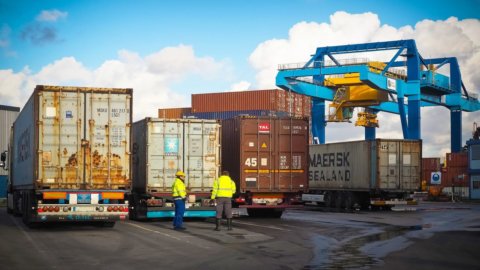
But the bigger story may be what happens next, as energy transportation is only part of the equation. The next challenge for global logistics will likely be maritime container transport. Each year, the retail cycle in the Northern Hemisphere creates a peak in demand freight transport, as retailers move products in view of Black Friday and Christmas. The period from August to October is traditionally the busiest for container shipments, with importers rushing to secure supplies. The Panama Canal Authority reported a traffic increase and increased demand for transit bookings. According to LSEG, from March to May, traffic through the canal averaged about 44 vessels per day, compared to about 37 vessels per day for the entire year 2025, representing an increase of about 17% in average transits through the Panama Canal since the US-Iran conflict began.
The Panama Canal lies more than 8.000 miles from the Persian Gulf, yet it is increasingly becoming one of the clearest indicators of how the turmoil in the Middle East is impacting the global economy.