AfD wins again in eastern Germany, the Left Party takes Berlin , CDU suffers an unprecedented defeatThe September 20 vote in Mecklenburg-Western Pomerania and the capital has thrown Chancellor Friedrich Merz into crisis. In the Baltic state, the results put the historic Christian Democrats below the 5% threshold, leaving them out of the regional parliament for the first time in their history. In Berlin, however, the Chancellor's party has been significantly overtaken by Elif Eralp's left-wing coalition.
Two weeks after their success in Saxony-Anhalt, the far-right secured another first place, but this time without a concrete chance of governing. Merz acknowledges the gravity of the result and asserts his desire to remain in power. The answer to the crisis, he argues, lies in reforms.
The far right of AfD wins another victory in eastern Germany, the Linke wins in Berlin , CDU suffers historic defeatThe September 20 elections are reshaping the political balance in two states and putting pressure on Chancellor Friedrich Merz. In Mecklenburg-Western Pomerania, the Christian Democrats are excluded from the state parliament for the first time in their history. In the capital, they have lost their lead, significantly overtaken by the left-wing party led by Elif Eralp.
Two weeks after success in Saxony-AnhaltThe far right returns to victory, but fails to secure the majority needed to govern alone. Merz acknowledges the electoral failure, but rejects the prospect of a retreat and relaunches the reform program.
AfD wins again in the east, but the government remains distant
Iin Mecklenburg-Western Pomerania Alternative for Deutschland (AfD) gets 38,2% and surpasses the SPD, which with outgoing governor Manuela Schwesig reaches 35,5%. The Social Democrats thus lose the first place they have held since 1994, while the far-right more than doubles its 2021 result, when it had stopped at around 17%. The overtaking does not translate into automatic access to government. AfD candidate, Leif-Erik Holm, has to deal with theunwillingness of other parties to ally with himSchwesig, on the other hand, maintains a path to remain at the helm of the state, building a majority with the Left Party, at 6,5%, and the Greens, at 5,7%. The Sahra Wagenknecht Alliance remains outside of Parliament, stuck at 4,8%.
For the Social Democratic governor, the recent comeback was not enough to win, but it prevented the AfD from securing an absolute majority of seats. The far-right still claims the right to govern the region. Party leader Tino Chrupalla maintains that the party has "a clear mandate to govern: we will offer talks to everyone." The gap between electoral success and the possibility of governing remains crucial. While the AfD is expanding its support, even in Mecklenburg-Vorpommern it has failed to break its political isolation.
CDU out of Parliament, Merz admits disaster
The most traumatic fact of the electoral round concerns the CDU. With 4,9%, the Christian Democrats miss the 5% threshold and are excluded from Parliament of Mecklenburg-Vorpommern. This is the first time the symbolic value of the region, long linked to Angela Merkel's political career, has been affected. The party's share fell from around 13% in 2021 to a result that deepens the crisis sparked by the September 6 defeat in Saxony-Anhalt. Even in Berlin it is clearly retreating, losing around a third of the consensus compared to the previous consultation.
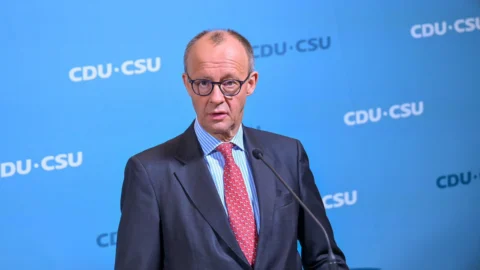
Merz chose to speak immediately after polls closed, anticipating the internal debate over his leadership. "We cannot embellish the result in Mecklenburg-Western Pomerania. It's a disaster“, he declared. Then he clarified that he wanted continue the mandate. “I take responsibility, I would like to take the country forward”. The Chancellor's response comes from reforms, who assured them "they're coming." A promise also addressed to the business community, as political pressure grows on the federal coalition.
The other leader of the far-right party Alice Weidel She wasted no time in directly attacking the chancellor after the result: "Merz should draw the consequences, do it for Germany. We have become the strongest party," the AfD leader declared. Chrupalla, however, criticized the barrier to alliances with the far right, arguing that "We are not the ones who want a cordon sanitaire."
The Left conquers Berlin with the battle over rents
In the capital, the vote rewards the opposing front. The Die Linke collects about a quarter of the votes and surpasses the CDU, which fell to around 19%. The left-wing party more than doubles the result of the previous elections and leads Elif Eralp at the center of negotiations for the future city government.
A lawyer committed to the defense of human rights and daughter of Turkish refugees, Eralp built her electoral campaign around the high-rent, the difficulties of young people, and access to housing. Among her proposals is the expropriation of large real estate groups, a measure destined to become one of the most delicate points of the negotiations with potential allies. "We have written a page of history," she exulted after the vote. The result offers her the opportunity to become the first lady of the Left Party and the first with a migrant family background to lead Berlin.
Even in the capital, however AfD advances, reaching around 16% and consolidating their third place, but still below the 18% predicted by polls the day before. The Greens obtained 14,3%, while the SPD stalled at around 12%, a particularly significant decline in a city long governed by the Social Democrats.
The game of alliances and the pressure on the chancellor
In Berlin there are the numbers for a coalition between the Left Party, the SPD, and the Greens, but an agreement still needs to be reached. The proposal on property expropriations is opposed by the Social Democrats and will require mediation. A majority between the CDU, SPD, and the Greens remains possible, numerically speaking.
In Mecklenburg-Western Pomerania, however, Schwesig can continue to govern involving both forces to its left and leaving AfD in opposition.
The vote delivers like this two different political victories and a common defeat For the Christian Democrats, the AfD strengthens its eastern roots, while the Left Party transforms the capital's social unrest into consensus. These are two severe blows for the chancellor, whose leadership appears increasingly fragile at a delicate time for European power. Merz has announced he will remain in his post, but the CDU's double setback is fueling internal disputes and making it more difficult to regain voter trust.