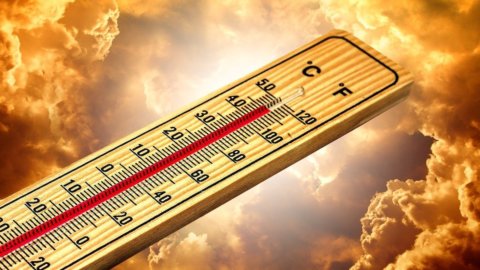
African anticyclone without respite over Italy: the intense heat continues and June is confirmed, in many cases, to be hotter than August. temperature Temperatures remain steadily high across much of the country, with widespread highs between 30 and 38 degrees Celsius (86 and 100 degrees Fahrenheit) and possible peaks of up to 39–40 degrees Celsius (102–104 degrees Fahrenheit) in the hottest areas. Making the situation even more critical is the increasing heat, with high humidity and perceived temperatures higher than actual values. Nighttime is also affected by the persistent heat, with many cities experiencing so-called tropical nights, when lows don't drop below 20 degrees Celsius (68 degrees Fahrenheit) and in some cases even stay above 25 degrees Celsius (77 degrees Fahrenheit).
The second heat wave is expected to continue, according to forecasts. at least until the first weekend of July, with a particularly marked impact on the Po Valley and the main urban areas of central and northern Italy. Lombardy, Piedmont, Veneto, and Emilia-Romagna are among the most affected regions, while the phenomenon is spreading across the continent.
The rest ofEurope is in fact experiencing a phase of exceptional heat: in UK temperatures can reach 36–37°C, while in France Red alert levels have been activated in dozens of departments, with temperatures reaching 41°C and widespread disruption to public events, infrastructure, and transportation. This situation confirms a now structural trend, with increasingly earlier summers and increasingly frequent temperature anomalies starting in June.
Extreme heat and economic impact: declining productivity and rising costs
In addition to the impact on health and daily life, extreme heat is increasingly taking on the shape of a structural economic risk for Europe. According to a study by Alliance TradeHeat stress episodes have increased approximately sevenfold since the 80s, along with an increase in average mortality per event. Both climate factors and structural vulnerabilities are contributing factors: older populations, dense cities that retain heat, and the still limited diffusion of cooling systems compared to other advanced economies.
The effects on the economy become evident above the 30°C threshold. While milder temperatures can have neutral or even slightly positive impacts on energy consumption, above this level the dynamics reverse. labor productivity decreases progressively: between 30 and 35°C each additional degree can reduce the hourly production by approximately 3%, while the energy demand grows by 1–1,2% per degree, increasing costs precisely at times of greatest operational pressure. In the short term, the burden falls mainly on companies, with lower margins which are transmitted over time to wages, consumption e growth overall.
GDP, investments and public finances under pressure by 2030
The most critical estimates outline a scenario that is anything but theoretical: by 2030, in conditions of prolonged climate stress, the Prevention cumulative of GDP in Europe they might arrive up to 5–7% in the most exposed economies. In absolute terms, estimates indicate around 240 billion dollars of losses for the France, 147 billion per Italy, 131 billion for the Germany and 120 billion for the Spain, while the Japan could reach 354 billion.
Not only growth: also the investments are under pressure, with an average contraction of up to 8%. Lower capital profitability reduces incentives to invest, triggering a cycle that weakens future production capacity. Even the public accounts They are feeling the effects, with revenue losses of up to 1,8% in France and 1,3% in Italy and Spain, and an average deterioration in budget balances of around 0,5% of GDP annually. In some cases, such as Italy and Spain, the deficit risks approaching or exceeding European thresholds, while France could face an additional tax burden of 2,2% of GDP.
The result is a picture in which heat no longer affects only daily summer life, but can contribute to scenarios of slower growth and to new economic tensions, with possible dynamics of stagflation and complex challenges for the eurozone's economic policy. According to the report, no major European economy is currently fully prepared to address its effects, while households remain exposed despite high overall financial wealth and housing stock that is still poorly adapted to increasingly hot summers, risking further widening inequalities.