


It is ancient youth issue in Italy. Question understood as difficult insertion into the job market and a tiring search for a accommodation, two aspects closely intertwined by a causal relationship: no work, no home. It had already presented itself in these terms over forty years ago. The long historical series of statistics on unemployment among young people and the high percentage of those who neither study nor work (NEET, which include the unemployed) testifies, beyond any reasonable doubt, to its antiquity. As does the high percentage of those who continue to live in their parents' home.
The demographic crisis and the rarefaction of young people
In recent years two new aspects have been added, both of a demographic nature: the rarefaction of young people, due to the low birth rate, and the their emigration looking for better opportunities.
The rarefaction of young people is the effect of the demographic glaciation, that is, of the Falling birth rate beyond all expectations: not only has the number of births per woman of childbearing age continued to decline (in 2024 it reached a record of 1,18), but this decline is also cumulated with the reduction in fertile women because fewer were born in the past. The result is that people aged 15-24 were 9 million in the 6s and are now 18 million; those aged 34-15 were 1992 million in 10 and have fallen to 2025 at the beginning of XNUMX. And this has happened despite abundant immigration.
Will the rarefaction continue? Will the youth question evaporate with it, due to a lack of human material?
Not so much, because of the other new aspect: theemigration of young Italians. Once upon a time, they, the young, used their voice to express their discomfort. Today, a large number of them resort to the other method indicated by Hirschman: the exit. They leave. In the fourteen years 2011-2024, 632 thousand 18-34 year old Italians emigrated and, net of those who arrived (perhaps born in South America?), they make -442 thousand. Underestimated numbers, the real ones being between 1,5 and 3 times greater. Furthermore, the share of graduates: in 2023, the last year for which data is available, it was 43% for the country as a whole, 49% for the Northern Italy, with a peak of 53% in Lombardia, Veneto at 52% and theEmilia Romagna and Lombardy al 51%.
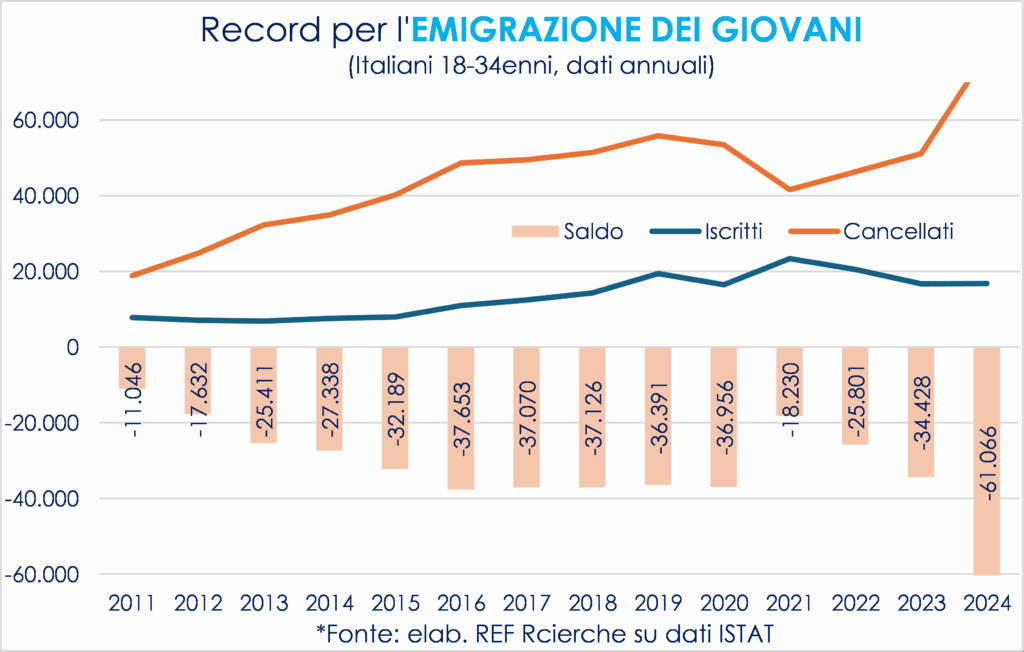
Italy does not attract talent: the youth migration balance is in the red
The fact that they are leaving also and above all from the northern regions richer in income and opportunities and are so educated should already be a alarm bell. Which becomes a screaming siren if we consider that for every 9 young Italians who leave, only one young citizen from advanced countries, European or otherwise, arrives.
Of course, hundreds of thousands of people arrive instead. young people from the South of the World, some even with high education. So much so that in the latest Istat Report we read: +10 thousand the total 2019-2023 migratory balance of young graduates aged 25-34 thanks to the entry of foreign graduates from abroad; the migratory balance of young Italian graduates is -58 thousand, that of foreigners +68 thousand. However, it is one thing to escape poverty or war, another is to aim to grow personally and professionally in a more advanced context than the Italian one. It is however very positive that Istat has turned a spotlight on the new manifestation of the youth question.
To shed light on the issue and its origins, the Cnel has set up a working group to analyse the Italy's low attractiveness for young people from advanced countries; the activity of this group will result in a Report that will be presented in the autumn. A fundamental theme for the future of the country, as the president of the Cnel, Renato Brunetta, forcefully illustrated on The print of June 26th.
Young people on the run: not slackers, just looking for opportunities
However, we can already begin to exclude some reasons for youth emigration: young people are not “choosy” (a term used by former minister Elsa Fornero) nor “big babies” (another former minister, the late Tommaso Padoa Schioppa), otherwise they would stay at home. Nor are they traitors or snakes bred within (the opinion of many, especially, alas, among entrepreneurs), because they do what they have been taught: Aim high. They are not even slackers, another adjective often heard from those who cannot attract them to their company, because they uproot themselves just to achieve their goals.
They simply discovered that elsewhere the work culture is more advanced: it allows you to learn, test yourself and reconcile work and private life; recognizes the merit for results and not for hours spent in the office; gives value and responsibility to young people as bearers of energy, innovation and more up-to-date cultural preparation.
Italian paradox: too many graduates or too little recognition?
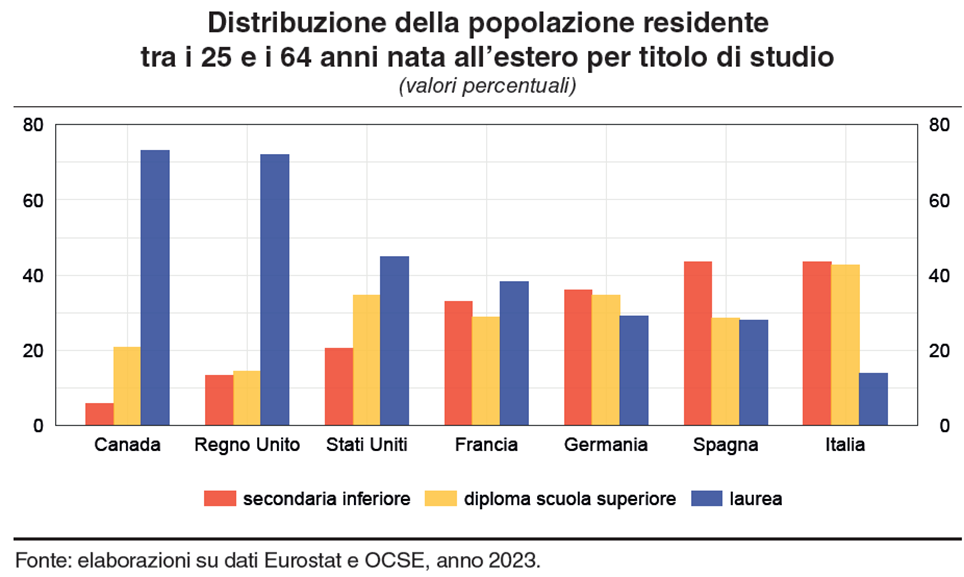
Regarding the latter, there is a schizophrenia in the Italian debate. On the one hand, there are complaints that there are not enough graduates compared to other countries. On the other hand, there is a claim that young people are over educated compared to the occupation they perform. The reconciliation would be in the fact that there are too many humanistic-social science degrees and few Stem. However, elsewhere even graduates in the first type of subjects are well used and better paid because they have acquired methods and skills that high school graduates cannot have. Furthermore, Istat has underlined that young immigrants themselves are overeducated compared to the job they are engaged in.
There is more and worse. In the Final Considerations of the Governor of the Bank of Italy, Fabio Panetta, there is a very significant graph: it shows unequivocally that immigrants in Italy are less educated than in other advanced countries (graph reproduced below). Similia similibus congregantur.
Italian companies short of vision: the problem is not young people
The impression, supported by the stories told by many university professors, is that the business world overall is not able to absorb more educated people. Instead of acknowledging this reality and seeking solutions that will advance the country, sociological studies are pouring in which it would appear that young people are deluded, they create an imaginary of the world of work that does not correspond to reality (Italian, however) and that the connection between the world of school and the world of work is inadequate. With this old-fashioned narrative, however, there is a risk of making them flee, the young people, even more numerous, because they perceive that Italy does not want to change and adapt to the pace of other advanced European countries.
In other words, companies continue to formulate a demand for work that is based on the performance of tasks, which require low education (even if perhaps with high skills), while the supply is of educated work. So we return to a vexed question: the size and specialization of companies. And therefore the mentality of Italian entrepreneurs.
For the country as a whole, the new form of the old youth question poses a crucial dilemma: is it the business world that must adapt to a higher level of education of the population or is it the level of education that must be kept in line with the business world? This is not a rhetorical question at all.
To help find the most advantageous answer for everyone, it is worth highlighting that companies would have everything to gain to adopt the work culture best practice of other countries. And of quite a few companies in Italy: as the CEO of a pharmaceutical company stated, happier people are more productive and profits rise. Change is possible, it is necessary, because it is worthwhile.





Away from Italy forever.