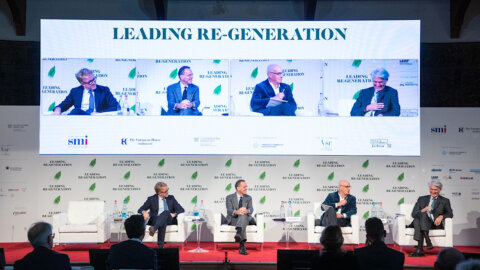
The event held in the Venetian setting saw a great participation with over 350 people including entrepreneurs, Italians and foreigners, representatives of the supply chain and stakeholders annual stage focused on sustainability in the fashion chain.
The first day of Thursday 24 October after the greetings of Sergio Tamburini (President Smi), Flavio Sciuccati (Senior Partner & Diretor Global Fashion Unit The European House Ambrosetti), Leopoldo Destro (President Confindustria Veneto Est, the morning saw speeches by Matteo De Rosa (CEO Lvmh Métiers d'Arts), Alessandro Rosina (demographer) and Manal Azzi (responsible for safety and health at work International Labour Organization) and again Geraldine Wharry and Andrea Rosso. In the afternoon instead the debate addressed the debate on the regulatory framework and much more.
The second day of Friday 25 October the topic of consumerism was addressed: from its origins (Historical Forces in Fashion with the American historian Sofi Thanhauser, author of “Worn”, to the prospects and future scenarios of fashion (Consumerism Unveiled: Trends, Numbers, and the Future of Fashion), traced in collaboration with the research company Kantar and presented by Jonathan Hall, with the contribution of Luca Solca, Managing Director, Luxury Goods, Sanford C. Bernestein and with a focus on new business models with the intervention of Peter Pernot-Day, Global Head of Strategy & Corporate Affairs Shein. This was followed by an in-depth analysis of strategies for an aware and transparent responsibility of companies in the supply chain (Revolutionizing Sustainable Supply Chain Strategies: Responsibility, Transparency and Value Optimization).
The speakers included Hakan Karaosman, Associate Professor, Cardiff Business School; Chiara Morelli, Industrial Sustainability Director, Prada Group; Andrea Sianesi, president, Fondazione Politecnico di Milano, president, PoliHub; Andrea Crespi, vice president of Sistema Moda Italia with responsibility for sustainability and Luca Sburlati, CEO Pattern Group. A special focus was dedicated to pioneering solutions for sustainable transition with several other interventions (The Way Forward: Implementing Sustainable Fashion Solutions).
The 5 proposals of the Just Fashion Transition 2024 study
The 5 proposals and recommendations that emerged from the Just Fashion Transition 2024 study developed by The European House – Ambrosetti, addressed to institutions and actors in the sector, were presented, which are crucial for achieving a fair and effective transition by 2030.
- Closing the regulatory gap quickly
Put pressure at European level to accelerate the finalization of regulatory frameworks, in order to create the conditions for companies to make medium-long term decisions. - Simplifying financial tools for SMEs
Simplify the bureaucratic burden for SMEs, enabling them to invest in sustainability by providing them with easier access to credit and offering favorable shares. - Pushing skills and R&D
Build and disseminate national competences and competence centres, involving universities and research to test scalable solutions, developing initiatives to disseminate among SMEs the skills needed for the transition and create a future-proof workforce. - Promote National Fashion Industrial Plans
Develop a national strategic plan to identify ways to integrate sustainability costs into pricing structures – facilitating the eradication of gangmastering, as well as sharing timeframes, methods and tools to combine public and private funding. - Concentrate the market to increase competitiveness
Fuel the process of market concentration, especially among SMEs, to increase productivity and investment capacity, including through tax breaks and access to credit, but also public funding.
The conclusions of the Venice Sustainable Fashion Forum 2024
In the final session of the Venice Sustainable Fashion Forum, Flavio Sciuccati, Partner & Director Global Fashion Unit The European House – Ambrosetti, Sergio Tamborini, President of Sistema Moda Italia and Alberto Zanatta, Deputy Vice President of Confindustria Veneto Est drew the conclusions that emerged from the two days of the Forum.
Sergio Tamborini, president of Sistema Moda Italia explained: “Venice confirms itself as a fundamental moment of aggregation to unite different worlds and visions. On stage we saw together the history, the future and the pitfalls, regarding transparency and markets, that Textiles and Fashion faces. These are issues that every entrepreneur faces differently, thinking of protecting the company, we as Smi the entire supply chain, even in the face of regulatory inconsistencies. This year we have experimented with a new geography in the forum events, with the addition of more intimate moments dedicated to issues that concern individual companies: finance, circularity, digital or greenwashing. Entrepreneurs want to be protagonists, finance remains a central element and precious ally, while a clothing platform, we have seen, can sell something today and convey a message to millions of consumers tomorrow: this is the task of fashion, creating connections on the topic of sustainability and I believe that this is our true objective”.
Flavio Sciuccati, Partner & Director Global Fashion Unit The European House – Ambrosetti highlighted: “This third edition, which saw a wide participation and involvement, has decreed the full success of the initiative and its relevance for the world of Fashion and sustainability. The combination of these factors has shown that the combination of Fashion and sustainability is now essential and this must be an incentive to set increasingly ambitious goals. We have, moreover, had the testimony of the fundamental role of our supply chains that are demonstrating their excellence and uniqueness and are paving the way towards a “Green Made in Italy” placing, for the first time, at the center of the debate the issue of the redistribution of value along the entire chain from downstream (brand and distribution) to upstream
(production and materials). In this juncture, the greater value recognized upstream, and especially to SMEs, will allow for both the technological innovation and the green transition that are indispensable and urgent”.
Alberto Zanatta, Deputy Vice President of Confindustria Veneto Est declared: “Today the challenge is to combine competitiveness and sustainability, to preserve and support at all costs the strategic supply chains of Made in Italy. And for this, to develop a national industrial vision that promotes close synergy between all the protagonists of the fashion sector, the big brands, the small brands and the entire manufacturing supply chain. A real supply chain pact for a systemic and unitary vision of the sector, for balanced and homogeneous development and to indicate where and how it is necessary to intervene to re-generate competitiveness. This is the appeal that we address from Venice to the public decision-maker, to the financial institutions and to the new European Commission. And, even before that, to ourselves entrepreneurs of the fashion supply chain, to win together the challenge of a fair and competitive transition. An “existential challenge”, to quote Mario Draghi, for which the supply chains of the territories gathered in Confindustria Veneto Est are now candidates to be an industrial laboratory”.
Venice Sustainable Fashion Forum is created with the contribution of the Venice Rovigo Chamber of Commerce and numerous operators in the extended sector: Alperia Green Future, Fondazione Leaf & Consorzio Physis, DB Group, Dnv, Give Back Beauty, Greenberg Traurig Santa Maria, Unisalute, UniCredit, Gruppo Mastrotto, Nice Footwear, Acimit, Assomac, Clerici Tessuto, DedaStealth, Guess Europe, Holding Moda, Mtwh, Pattern Group, Process Factory.