Toyota Motor and the private real estate company Toyoda Fudosan they announced atakeover bid from 4.700 trillion yen, equivalent to approximately 33 billion dollars (28,8 billion euros), to gain full control of Toyota Industries Corporation and withdraw it from the Stock Exchange. It is one of the delisting operations largest ever seen in Japan, and marks a profound turning point in the governance and structure of the Toyota conglomerate.
Toyota Industries it's not a simple controlled: Is the original parent company of the group, founded in 1926 by Sakichi Toyoda as a textile loom company, today also active in the production of forklifts and auto components. From here, in 1937, the Toyota Motor Corporation was born.
Why Toyota Wants to Privatize Toyota Industries
The stated objective of the operation is simplify the shareholding structure of the group and strengthen the control of the founding family, today represented by AkioToyoda, grandson of the founder and former CEO of Toyota Motor, now president.
But behind the move there is also the will to respond to growing pressures of Japanese investors and regulatory authorities, who have been urging for years a easing of cross-shareholdings between conglomerates and subsidiaries. Toyota Industries owns 9,1% of Toyota Motor, while the latter in turn holds 24,2% of the industrial company.
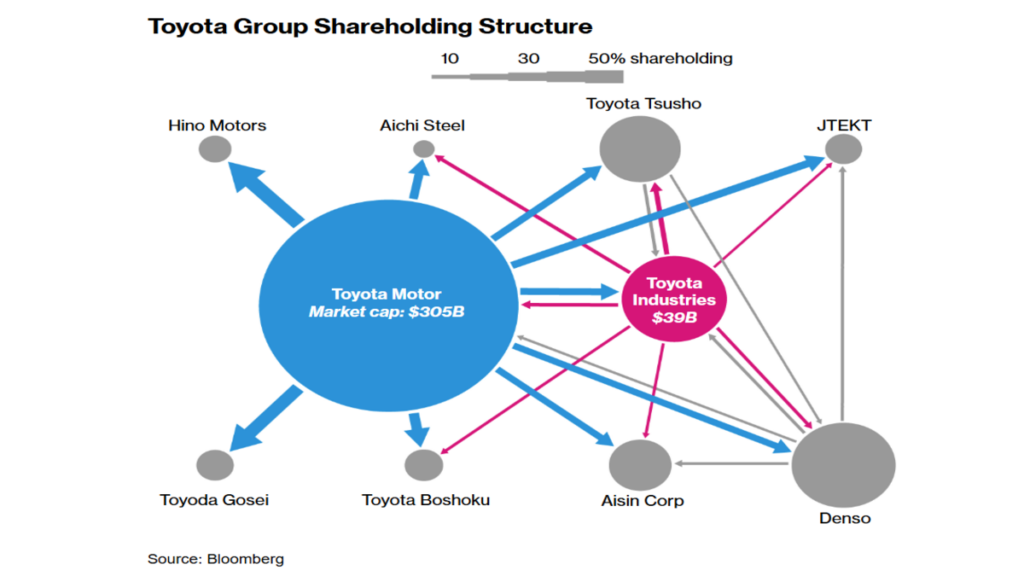
Streamlining this network of intersections should allow for a greater transparency and improve shareholder returns, in line with the Japanese government's corporate governance guidelines.
The price issue: a discounted takeover bid that surprises the markets
What has surprised analysts and investors is the price offered for delisting: 16.300 yen per share, equivalent to a 11% discount compared to the closing price of the stock before the announcement. Although the operation had been expected for months, the market expected a premium, not a decline. Toyota Industries shares had risen more than 40% since the deal was first reported in April.
According to some sources, this pricing would reflect not so much an undervaluation of the company as the willingness to conclude the transaction in family, without excessive resistance from the historical shareholders and the board, which has created a committee to assess its appropriateness.
The structure of the operation
Privatization will take place through the creation of a new vehicle holding in which:
- Toyota Motor to invest 700 billion yen through non-voting preferred shares;
- Toyoda Fudosan will put others on the table 180 billion yen;
- Akio Toyoda to invest personally 1 billion yen, thus symbolically strengthening the personal and family bond with the operation.
In parallel, Toyota Motor and key suppliers of the group (Aisin, Denso and Toyota Tsusho) will sell their stakes in Toyota Industries, helping to simplify the internal shareholding chain. Toyota will also buy back some of its shares currently held by the industrial company.
Corporate Governance and Restructuring: A Japanese Trend
The takeover bid is part of a broader trend affecting Japanese industrial groups: simplify complex structures (Zaibatsu) and often opaque ones born in the post-war period, often based on cross-shareholdings, in order to improve governance and attractiveness for international investors.
Toyota Industries has been at the center of scandals related to quality and certifications in recent months. The operation, therefore, also represents an attempt to relaunch the image of solidity and transparency of the Toyota group, at a time when competition, especially electric with Tesla and Byd, is pushing towards a redefinition of industrial strategies.
The next steps
Toyota Industries' board of directors will officially meet on June 10, while Toyota Motor's AGM is scheduled for June 12. By autumn the operation could be formally launched, with the support of a consortium of financial advisors already responsible for preparing the offer.
If completed, the privatization of Toyota Industries will be one of the largest buyout transactions in the world and will mark the beginning of a new phase for one of the Japanese industrial excellences under the increasingly centralized leadership of the Toyoda family.