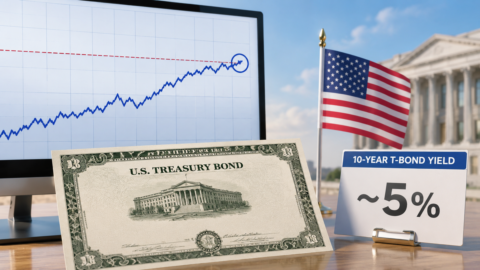
It wasn't enough stock market crash due to the duties imposed by Trump. In these hours, that of the US bond market which is also contaminating those all over the worldThe US movement began last night on rumours that foreign investors were quickly selling US government bonds, which were thus losing their “safe haven” status, while a rush for liquidity with the US President's trade war upsetting expectations growth e grocery all over the world.
The yield on the 5-year US Treasury note has risen to 30%, up about 4,35 basis points since the start of the week, while the XNUMX-year is at XNUMX%. To watch are the US Treasury auctions and in particular the one on the 10 and 30 year maturities on the agenda today and tomorrow, After yesterday's disappointing three-year auction, the first coupon issue since the new tariffs were announced.
Yields also rise in the eurozone, the UK and Japan. All-time highs
The contagion has reached the Eurozone bond market albeit with more contained movements.
German Bunds are holding up: after a small phase of selling at the beginning of the day with a yield of 2,67%, a stabilization followed around 2,6%. Government bonds of the most indebted countries are under more stress.
Benchmark 10-Year Yields Italy rose to 3,91% (briefly touching 4%) and the resulting widening of the spread to 130 basis points, from 122 bps yesterday. Other spreads also rose, with that between France and Germany which widened to 78 basis points (it was 70 on April 2) and that between Spain and Germany took off in less than a week from 62 to 75 points. Investors are moving to the short-term segment, accentuating the slope of the curve.
The sell-off extended not only to US Treasuries, but also to Japan, where the yield on 30-year Japanese government bonds jumped to a 21-year high and UK, where government bond yields thirty years have reached their highest level since 1998.
If investors are forced to sell off even their safest assets, the global market crisis triggered by US tariffs risks taking a sinister turn, with forced selling and a rush to the safety of cash. “This is more than fundamentals at the moment. It’s a liquidity issue,” says Jack Chambers, senior interest rate strategist at ANZ in Sydney.
If Treasuries are no longer a “safe haven,” the alternative becomes cash
The 10-year US Treasury yield, the world's safe haven benchmark, is adrift and long-term bonds are being sold off heavily by investors hedge fundsIts yield jumped, at one point topping 4,5%, even as traders increased expectations of U.S. rate cuts and, in another sign of dislocation in markets, the dollar fell against the euro and the yen.
I 30-year US Treasury yields, which have surpassed 5%, with a three-day increase of nearly 60 basis points, marking the heaviest sell-off since 1981.
Neither the long nor the short end of the US curve represents a safe haven at the moment, "so probably the Cash, and in particular, cash in your own country, in your own currency, is probably the best place where to hide“, said today Marie-Anne Allier, fund manager of the fixed income team at Carmignac, in an interview with BloombergTV.
A response from central banks is expected in the short term
“This level of volatility is comparable to the global financial crisis and Covid,” said Mark Elworthy, head of fixed income, currencies and commodities trading at Bank of America in Australia. “You would expect a response from central banks in the short term if markets continue to behave as they have in the last 12-24 hours”. While money markets are betting on a quarter-point cut at the meeting of the ECB next week, bets are increasing on a more significant cut by the BoE in May, with about a 20% chance of a 50 basis point cut. The Fed called an emergency meeting yesterday, but did not provide any guidance. Trump is urging Powell to cut rates, while the bond sell-off and inflation expectations should be going in the opposite direction.