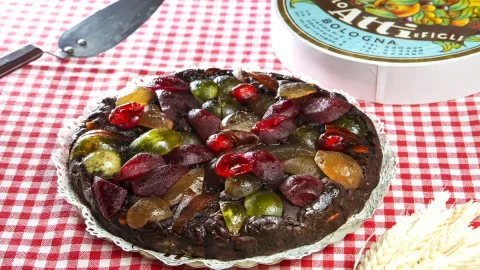
In the Bolognese dialect it has retained the name pan spzièl, a special bread, due to the fact that it is made with 5 Chinese spices plus honey, almonds, pine nuts, dark chocolate and candied fruit. Its origins lie in the medieval mists of time when it was produced by pharmacists or "apothecaries" who traded the spices and exotic aromas needed for the recipe. Subsequently it was the friars of the Certosa, where Bologna's cemetery is today, who started a production that was very successful and they were so good that the dessert changed its name, becoming the Certosino. An unmissable dessert in the homes of the Bolognese at Christmas, thanks to the friars of San Brunone it even reached the papal court in Rome: in 1740, a giant one was delivered to the Vatican to pay homage to Pope Benedict XIV. Nonetheless, its production in reality always remained limited to the Emilian area, its recipe was handed down from mother to daughter. The characteristic that distinguishes it is the colorful mosaic (and here we understand the religious inspiration of the Carthusian friars) of candied fruits and dried fruit that decorates it on the surface like an ancient stained glass window or a rose window of a cathedral.
The dessert has a round and flattened shape with a compact consistency made with a dough made from wheat flour. The ingredients are chocolate (added after the Middle Ages obviously) almonds, pine nuts, honey, Bolognese mustard, cinnamon (and any other spices) and a mix of dried and candied fruit. There are many variations - you know, when we talk about made specialties historically, at home, each family jealously guards its secrets – so it is possible to find them flavored with the addition of other ingredients such as cloves, coriander, anise, dried figs, or hazelnuts, raisins and dates. Depending on the family or pastry chef where you taste it, therefore, you can find cloves, coriander, anise seeds, dried figs, candied citron, almonds, pine nuts, walnuts, hazelnuts, raisins and even dates.
To bring order and safeguard the history of this very particular dessert in June 2001 in Bologna, the delegation of the Italian Academy of Cuisine deposited the official recipe for Certosino (or Panspeziale) to protect it not only from imitations but also to avoid confusing it with Molinella, another confectionery specialty typical of the Bolognese area decorated with candied fruit, chocolate and dried fruit, but it is closer to a leavened cake, while the consistency of Certosino is closer with gingerbread.
If the recipe has been deposited at the Bologna Chamber of Commerce since November 2001, it is above all thanks to a historic bakery: the one founded by Paolo Atti in 1880, and still a large family-run business. Since 1868, the Paolo Atti & Figli company has continued to tirelessly produce bread, pasta, sweet and savory specialties for Bolognese gourmets. Over the years the business has expanded, without ever losing the original philosophy based on quality and the search for the best product. The large store in Via Caprarie was then added to the shop in Via Drapperie at the beginning of the 1900s.
His famous tortellini, the "Navels of Venus", with strictly Petronian "doc" filling of the recipe deposited at the Chamber of Commerce by the Academy of Cuisine and the Tortellino Confraternity: pork loin, raw ham, real mortadella from Bologna, parmesan reggiano, chicken eggs, nutmeg packaged in the original liberty box.
On the Certosino then the Forno Paolo Atti & Figli fears no comparison, those looking for excellence must only go to Via Drapperie where they can find this historic Bolognese dessert made in the same way for 143 years, and it has been a constant presence on the shop counter since Liberty atmosphere also the rest of the year. And even in this case it is sold in the same elegant Art Nouveau box faithfully reproduced on the original model from the 20s.
With this product, Paolo Atti & Figli won the prestigious "Dino Villani" award from the Italian Academy of Cuisine in 2007. At this point all that remains is to test yourself with:
The original recipe from Certosino di Bologna
Ingredients (12 people)
350 grams of flour
300 gr of honey
125 g of whole candied fruit (orange and citron peels, red and green cherries, red pears, figs, apricots)
250 g of fruit cooked in jam or mustard
200 g of shelled and unpeeled almonds
50 g of shelled pine nuts
50 g of cocoa powder
500 g of dark chocolate pieces 1 g of cinnamon
15 g of ammonia carbonate
75 g of wine or Marsala syrup
15 g butter
Preparation
Dice half the candied fruit; put the honey on the heat in a saucepan and add the cut fruit when it is hot.
Arrange the flour on the table in a fountain and in the center place the almonds, pine nuts, cocoa, fruit cooked as jam or mustard, cinnamon, ammonia carbonate, wine syrup or Marsala, honey with candied fruit and knead. Shape the mixture into a donut, place it in a baking tray greased with butter and then place it in a warm place for 3-4 hours.
When putting it in the oven, garnish the surface with the remaining candied fruit and the previously caramelized almonds and cook for 40 minutes over a moderate heat. When the Certosino is cooked and cold, brush with honey melted over the heat. It is best to consume it at least after about ten days. To preserve the product for longer, when the product is matured, wrap the Certosino in foil or parchment paper. In practice, if you prepare it today it will be perfect for the Epiphany when it will be able to develop all its well-blended flavors and tastes.