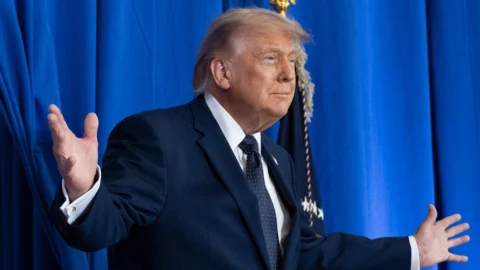
Just over five months from vote for White House, one of the most relevant aspects of today's election campaign is the unpopularity of both candidates of the two major parties According to the website fivethirtyeight.com, at the end of May, even before the conviction of Donald Trump for all 34 charges that had been raised against him in the trial over the payment to the porn star Stormy Daniels, The Donald faced the disfavor of 53,7% of potential voters and the percentage even rose to 56,3% in the case of Joe Biden.
Unpopular, but candidates
Discontent with the political offerings of the Republican and Democratic parties, however, has failed to emerge credible alternatives. Robert F. Kennedy Jr., grandson of former President John F. Kennedy and son of former federal senator and attorney general Robert F. Kennedy, is credited with less than 10% of the voting indications of likely November voters.
Moreover, Biden and Trump's challengers in the primary elections - Dean Phillips, in the Democratic house, and Ron DeSantis and Nikki Haley in the Republican one - quickly left the scene, incapable of attracting those who did not recognize themselves in their names to converge on their names. they had been the clear winners of the nominations of their respective parties for some time. Indeed, in the Democratic primaries, compared to the over 13 million votes collected so far by Biden, more than 600.000 voters preferred to send uncommitted delegates to the national convention, i.e. those who had not formally committed to supporting a specific candidate.
The spread of anti-politics
Biden's repeated gaffes and frequent memory lapses, the president's difficulty in not getting confused even when he finds himself reading a written text, Trump's criminal behavior and above all a dialectic that increasingly ends up in a Manichaean clash typical of logic of the "wall against wall" are causing anti-politics or in any case disaffection towards electoral participation to spread. Analysts' forecasts assume that, after reaching 160 million in 2020, this year the number of actual voters will be between 145 and 150 million, if not even drop to 140 million.
We asked the professor Stefano Luconi, professor of History of the United States of America in the Department of Historical, Geographical and Antiquity Sciences at the University of Padua, sheds light on this phenomenon which is of concern for the democracy of the most powerful country in the world.
. . .
Nicholas Kristof, a respected columnist for the New York Times, wrote that three-quarters of Americans think the country is going in the wrong direction. Now for the first time in the history of the United States we have a former President and candidate for the White House of one of the major parties convicted by a court of criminal offences. This will not be of much help in overcoming the problem of disaffection among American voters which truly seems like a runaway train.
“The disaffection of US citizens towards the elections is destined to worsen after Trump's conviction on May 30th, in the first of the first four criminal trials in which he is in the dock. The media is wondering how many votes the recognition of the former president's guilt will be able to shift from the Republican party to the Democratic party in the November elections."
It seems that this story doesn't move much votes, right?
“Not many affected voters, just 4%, according to an ABC News poll, although another 16% of Republican voters are reconsidering who to vote for. It is, however, presumable, although it is necessary to wait until election day to obtain quantitative data, that the first criminal conviction of a former president in the entire history of the United States accentuates Americans' sense of alienation towards a political system that allows a person - judged guilty, even if for the moment only in first instance, of having interfered with the conduct of the elections - of running again for the same position he had won in the past, also thanks to the fact of having fraudulently bought the silence of those could have damaged him in the eyes of voters by making his extramarital affair public."
Can't America really do better?
“This being the case, the hopes of a return to significant political mobilization seem to lie in candidates who are an expression of civil society and who above all prove to be less divisive than the current contenders for the White House. It is no coincidence that the only challenger to defeat Biden in one of the stages of the Democratic primaries, the irrelevant caucus of the archipelago of American Samoa (which awarded just 6 of the 3.934 delegates for the national convention), was not a political figure but an entrepreneur of new technologies, Jason M. Palmer”.
In fact it seems that the most dynamic sectors of American society, such as that of entrepreneurs, are starting to make themselves heard, albeit with the prudence and circumscription that characterizes these subjects. This is for example the case of Ray Dalio.
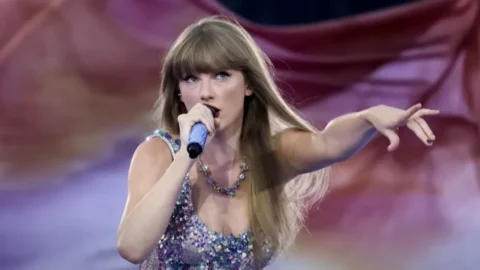
“Ray Dalio, the founder of the Bridgewater hedge fund, in a recent interview with the Financial Times, spoke of needs similar to those that contributed to Palmer's success in American Samoa and said he would vote for Taylor Swift if the singer ran for the presidency. It was obviously a political fantasy joke."
But could Taylor Swift really run for president?
“Swift is not a candidate and, even if it wanted to, it couldn't be. At only 34 years of age, you would not fulfill one of the essential requirements to carry out the mandate of president, i.e. having reached 35 years of age, as established by article 5, section 1, paragraph 5 of the Constitution. Some might argue that she would have her birthday on December 13th; therefore, in time to be sworn in as president on January 20, 2025 as a thirty-five-year-old, but some states of the Union would not recognize this loophole based on the principle that whoever is ineligible at the time of the elections (this year on November 5) is also uncandidate".
But that's not the point, is it?
“Of course, that's not the point anyway. Swift would represent the need to modernize an institutional politics increasingly characterized by gerontocracy: Trump will turn 78 on June 14; Biden already has 81 and will reach 82 on November 20, two months ahead of the start of a hypothetical second term; Kennedy is 70."
Is there only the age factor behind this political fantasy scenario or is there something more substantial?
“In fact, the age factor is not the only positive aspect symbolized by Swift's hypothetical candidacy. Nominated by the weekly magazine Time as "person of the year" for 2023, the singer is one of the most popular figures on the American public scene, with an approval rating that, according to the website yougov.com, is close to 60%. At the beginning of last February, Americans became more enamored of the Japanese itinerary of her Eras Tour and the possibility that her last concert in Tokyo would prevent her from flying to Las Vegas in time to attend the Super Bowl, which featured her boyfriend, Travis Kelce, tight end for the Kansas City Chiefs, is on the field, rather than the progress of the primaries in South Carolina and Nevada".
What could Swift's constituency be?
“Although with a clear prevalence of Democrats (estimated at around 55%), Swift's audience cuts across the two major parties and the singer's concerts have been described by Jessica Bennett in the New York Times as "happy oases" in an America torn and barbaric by culture wars. At her concerts we find spectators from the most disparate ethnic and racial groups. Swift has also demonstrated her ability to motivate Americans to participate in political life. An appeal from her via Instagram on the occasion of the most recent National Voter Registration Day (September 19, 2023) managed to cause a surge in the number of young Americans who went to register on the voter lists.
However, Swift has a precise place in the American political spectrum. Maybe her candidacy couldn't be bipartisan?
“The somewhat idyllic aspects of which Swift's personality would seem to be an expression would most likely be destined to collapse if the prospect of his candidacy actually materializes, as imagined by Dalio. Swift is an avowed Democrat. She regretted not having taken a public position against Trump in the 2016 campaign. Two years later, during the mid-term elections, she supported the candidacy of two Democrats, Phil Bredesen and Jim Cooper, running for Senate and for the House, in Tennessee, the State where he resides.”
What led you to support Democratic candidates?
“What pushed her in that direction were the choices of Bredesen's Republican challenger, Masha Blackburn, who in Congress had voted against measures to protect women, African Americans and the LGBTQ+ community. A single like You Need to Calm Down, featured on the 2019 album Lover, is a defense of LGBTQ+ identities and a stigmatization of homophobia, not exactly acceptable content for many conservatives."
Are these themes very dear to Swift as a citizen and as an artist?
“The collection's lead single, Me!, was deliberately released on April 26, the day lesbian visibility is celebrated in the United States and other English-speaking countries. In 2020, Swift made amends for her silence of four years before her by taking Biden's side. Many commentators today consider her an authoritative figure to bring millennials and early zoomers into the camp of the current occupant of the White House, the younger generations of potential voters, who themselves are not inclined to identify with an octogenarian for simple age reasons. According to a poll commissioned by Newsweek from Redfield & Wilton Stretegies, 18% of voters this year would “probably” or “very likely” vote for Swift's presidential candidate.
And what do Trump and the Republicans say about Swift?
“Trump accused Swift of ungratefulness due to her support for the Democrats, referring to the fact that, as president, in 2018, he had enacted the Music Modernization Act, a copyright law which, he said, would have allowed the singer to increase revenues from his musical activities. The Republican Party, however, has so far tolerated Swift's political outings and the contents of some of her songs so as not to alienate her numerous fans."
And if Swift moved to a higher level of political involvement, what would happen to her?
“If the singer no longer limited herself to simple endorsements and decided to run for an elective office, she too would end up in the meat grinder of the factionalism of the clash between the parties, with little chance of emerging unscathed. On the other hand, Bredesen, whom Swift had presented as the champion of her inclusive values in Tennessee, was defeated by a wide margin in 2018 by Blackburn, who won the seat in the federal Senate with 54,7% of the votes.
...
Stefano Luconi teaches History of the United States of America in the Department of Historical, Geographical and Antiquity Sciences at the University of Padua. His publications include The “indispensable nation”. History of the United States from its origins to Trump (2020), US institutions from the drafting of the Constitution to Biden, 1787–2022 (2022) and The dark soul of the United States. African Americans and the Difficult Path to Equality, 1619–2023 (2023).
Books:
Stefano Luconi, The race for the White House 2024. The election of the president of the United States from the primaries to beyond the vote on November 5, goWare, 2023, pp. 162, 14,25 euros paper edition, 6,99 euros Kindle edition
Stefano Luconi, US institutions from the drafting of the Constitution to Biden, 1787–2022, goWare, 2022, pp. 182, €12,35 paper edition, €6,99 Kindle edition